
Fear and Loathing in Las Vegas by Hunter S. Thompson
Why It's a Masterpiece (Week 96)


Everyone has heard of Gonzo Journalism and the fact that it began with the 1971 publication of Fear and Loathing in Las Vegas. Pioneered by Hunter S Thompson and unfortunately bastardised since, this semi-autobiographical novel was based on Thompson's own experiences with taking a trip to Las Vegas with his attorney (a fictionalised version of his doomed friend Oscar Acosta). He was meant to cover a story for Rolling Stone Magazine and yet, he never actually completed it. Instead, he wrote a surreal narrative, a book formed out of chaos which blended fact with (very clearly) fiction. It was a brute critique of American society, a cultural shift which pointed the finger at the looming presence of the 60s which poured over into the next decade.
The wild and rambling prose, the subjective viewpoint and the countercultural statements - this was definitely a defining book of its time. It captures all the hedonism of the nosedive that was once the American Dream. The unravelling of the want for stability, the relentless need for adventure echoing the message of Jack Kerouac's On the Road in a way which would have scared the Beatnik King himself. Fear and Loathing in Las Vegas was the birth and death of the disillusionment movement which allowed those who fought for Civil Rights and personal freedom to become devoured by their own dreams. They were dragged into drug culture and consumerism - with many never finding their way out.
Plot

The novel follows Roaul Duke and his attorney, Dr Gonzo as they travel through Las Vegas to cover a story. But unconventionally they of course, do the worst thing imaginable whilst traveling through the desert in a convertible - they take a whole host of drugs and drive under the influence nearly all the way. I think that to a teenager this could look pretty rebellious and cool, but when you become an adult it looks rather stupid and yet again, that is the whole point of the book.
Duke narrates the story in first person and begins describing this journey as a blurring of the lines of fact and fiction. The fine line on which reality teeters is often blown away by drugs and paranoia that comes from doing them over and over again. They engage in a whole host of reckless behaviours whilst also making conversation with a series of strange and freakish characters.
They check into the Mint Hotel and their reality becomes even more distorted. Duke sinks deeper into madness whilst also not doing the one thing he came to Vegas to do - write the story. He obsesses over Vegas and its decadence. But the one strange thing is that they attend the Mint 400 Motorcycle Race but because they are massively intoxicated and generally acting like assholes, they miss the even entirely. Duke is confronted by the police, they have strange interactions with the staff and of course, the other more reserved tourists of the city - but whilst this is happening, they both become more and more paranoid. They are definitely over the edge, through the looking glass or whatever they would have called it then.
Duke has this running internal narrative that shows us how he's spiralling and after the trip is over, there is something of a catharsis to the whole thing. There is a deep and rather horrific failure of their 'American Dream' and thus, they go through a disillusionment only Duke's final lines to the book can really reflect. It's a massive regret of both of the characters, leaving it all behind and achieving nothing. The ending to the film may reflect some sort of release, but the book leaves us with nothing but loss. They flee the aftermath of their trip. The article that needs to be written is never written. Instead we end up with this. Nothing is realised.
Into the Book
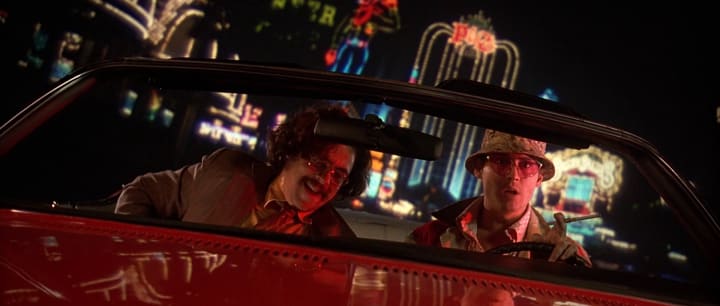
The Disillusionment with the American Dream:
One of the big themes of Fear and Loathing in Las Vegas is the disillusionment with the American Dream. Throughout the novel, Duke reflects on the collapse of the ideals that once shaped the American psyche. In the 1960s, the American Dream symbolised the pursuit of freedom, prosperity, and individualism. But by the early 1970s, this ideal had begun to rot, and what remained was a hollow version of consumerism and excess.
The very name “Las Vegas” evokes images of bright lights, neon signs, and the promise of a good time, but for Duke, it’s a symbol of the decay of the dream itself. In one key passage, Duke comments, “This is the weirdest country in the world, man. They sell you the American Dream...then you can’t get to it.”
As Duke and Gonzo spiral into their reckless behaviour, the book suggests that the countercultural movement, which had sought to reclaim the American Dream through ideals of freedom and individuality, has failed. This is only heightened by the final lines of the text.
Instead of providing a route to personal fulfillment, it led to a sense of aimlessness, shown by Duke’s inability to find purpose in his Las Vegas adventure. This sense of futility, where dreams collapse into nightmare, reflects the disillusionment that characterised the early 1970s in America.
“In a closed society where everybody's guilty, the only crime is getting caught. In a world of thieves, the only final sin is stupidity.”
- Fear and Loathing in Las Vegas by Hunter S. Thompson
Addiction:
Addiction is a key theme in the novel, not just as a physical dependency on drugs, but also as a psychological escape from reality. Duke and Gonzo use drugs as a way to disconnect from the world around them, entering a hallucinatory state where they believe they can avoid confronting the chaos of their pretty meaningless lives. But the novel also paints this picture that addiction is no game, it only leads to a deeper and deeper entrapment, spiralling into paranoia and impossible to leave.
For Duke, drugs are not just a form of recreation, but a means of survival. The intoxicating substances offer temporary relief from the alienation and disillusionment he feels with the world. It quickly becomes a cycle of dependency. The only realisation, if any, in the book is that escape is futile and that to mean something means to face up to your own realities. In a rare moment of clarity within the book, he notes, “We can't stop here...this is bat country,” showing the paranoia that fuels his actions and the complete breakdown of rational thought. This is something addiction often does. It clouds thought with paranoid nightmares.
Through this, Fear and Loathing in Las Vegas suggests that addiction, whether to drugs or escapism itself, is not a path to freedom. Rather, it’s a means of avoiding confronting reality, a journey that ultimately leads to destruction.
“We had two bags of grass, seventy-five pellets of mescaline, five sheets of high powered blotter acid, a salt shaker half full of cocaine, and a whole galaxy of multi-coloured uppers, downers, screamers, laughers... and also a quart of tequila, a quart of rum, a case of Budweiser, a pint of raw ether and two dozen amyls. Not that we needed all that for the trip, but once you get locked into a serious drug collection, the tendency is to push it as far as you can.”
- Fear and Loathing in Las Vegas by Hunter S. Thompson
Paranoia:
The author's depiction of paranoia is possibly one of the deepest themes in the whole book, reflecting the collapse of the countercultural American Dream - one that thrived on personal freedom. This is seen best through the reactions to various situations throughout the text. Everyone becomes a danger, even when they aren't. Conspiracies exist where there are none and at times, Duke's paranoia can appear funny to the reader, even though it is something very real to him. It is an extended metaphor for what would become of the American Dream to his generation - an existential crisis for something that should have existed but doesn't. It never did. In his pursuit for freedom he has lost his purpose. But from not having purpose for so long, he has become fearful of the very stability he was once against. It is a fractured back-and-forth which relies on irony in the person's own existence to survive.
The book's treatment of madness is closely linked to this idea. The want to achieve a greater sense of self and personal freedom ended up in emotional and mental dissaray, it ended up crash landing before it even started. The novel's entire style reflects this from the structure to the dialogue to even the illustrations that run many, however crude, in the book.
"So now, less than five years later, you can go up on a steep hill in Las Vegas and look West, and with the right kind of eyes you can almost see the high-water mark—that place where the wave finally broke and rolled back."
- Fear and Loathing in Las Vegas by Hunter S. Thompson
Why It's a Masterpiece

It critiques American society and its reliance on the consumption of drugs to escape, to produce and to free itself. But another thing it does is it shows us what we fear the most: the actual requirement for purpose and stability. We all want to be free, we all want our own liberation from the slings and arrows of life's milestones and requirements - but then what? Is this where we end up? It may have brought about Gonzo Journalism, but it also brought about some of the most existential questions you would even encounter in modern fiction. I have always believed that this book was not a road-trip text in which two male friends try to find themselves on an adventure that probably isn't the best idea. I have in fact, always believed that this book was a warning against the want for excess.
Conclusion

And so, the American Dream falls flat on its back once again. I personally love this book no matter how much I may trash talk it. It is one of those strange books that you acknowledge is awful but is also brilliant because of how horrifically original it is. We will never see anything like it again. I know we won't.
Next Week: The Maltese Falcon by Dashiell Hammett
About the Creator
Annie Kapur
I am:
🙋🏽♀️ Annie
📚 Avid Reader
📝 Reviewer and Commentator
🎓 Post-Grad Millennial (M.A)
***
I have:
📖 280K+ reads on Vocal
🫶🏼 Love for reading & research
🦋/X @AnnieWithBooks
***
🏡 UK
Keep reading
More stories from Annie Kapur and writers in Geeks and other communities.
Book Review: "Walkers" by Graham Masterton
You know how much of a fan of cheap books on my phone I am. Well, this is no exception. Graham Masterton is a really good author and honestly, though I've only read a couple of his books, there have often been some pretty interesting horror novels around the area. I'm quite surprised that more people haven't read this one considering it has such a great, classic kind of story. It feels like a cross between some sort of Stephen King novel and The Haunting of Hill House in a way. It feels very obsessive. I couldn't help myself. I told myself to go to bed at a reasonable hour, but this book definitely had other plans for me.
By Annie Kapur17 days ago in Geeks
The Rachels - 2025
Much to my surprise, I have kept a list of the films I‘ve seen this year. I daresay it isn’t complete. There will be films that snuck in on a late night in front of the TV that I would’ve forgotten to note. Or others, that I went to watch at the cinema, but then had a red wine and promptly forgotten about. But it’s not a bad approximation of the films I’ve seen this year. In total, there are 53 films listed, so an average of one a week and one for good luck.
By Rachel Robbins15 days ago in Geeks
Spring Fever: A Quiet, Intimate Portrait of Desire, Youth, and Emotional Recklessness
In a television landscape increasingly dominated by high-concept premises, explosive twists, and binge-friendly cliffhangers, Spring Fever stands out by doing something deceptively simple: it observes people. The show does not rush to explain itself or overwhelm viewers with plot mechanics. Instead, it unfolds slowly, allowing emotions to bloom, collide, and unravel in ways that feel uncomfortably real. Spring Fever is less about what happens and more about how it feels when longing, confusion, and self-discovery arrive all at once.
By David Cook3 days ago in Geeks
'20/20'
"Do It Again" the track that would ultimately open the Beach Boys final album on Capitol Records which was released on February 10th 1969 had originally been released as a single in August of 1968. The track was the first of many post-Pet Sounds era throwbacks to the early Beach Boys sound which would become continually more cliched and eventually lead the Beach Boys to the level of self-parody they would eventually succumb to in the 1980s while their closest contemporaries The Beatles nearing the end of their run in 1969 would go on to be viewed as the most influential band of all time. However, the song itself is not bad on its surface, and it opens with a futuristic sounding (for 1969) drumbeat captured by then-Beach Boys engineer Stephen Desper using tape delays on the drums performed by Dennis Wilson and John Guerin. The song has been re-recorded numerous times over the years on various Beach Boys-related projects most notably the 2011 re-recording at Capitol studios featuring the five surviving Beach Boys at the time backed instrumentally by various members of both the Brian Wilson Band and Mike Loves touring "Beach Boys" to promote the then upcoming Beach Boys 50th Anniversary reunion tour in 2012. The hammering and power drill sound at the end of the song was an excerpt from a track called "Workshop" that was to be a part of the uncompleted "SMiLE" album.
By Sean Callaghan6 days ago in Beat


Comments (2)
I think you've got it!
Love the book and the film and have both in my front room