
DOWN THE RABBIT HOLE AGAIN: DECONSTRUCTING TIM BURTON'S 'ALICE IN WONDERLAND
Lewis Carroll's "Alice's Adventures in Wonderland" has enchanted readers for generations, its whimsical prose and nonsensical scenarios providing fertile ground for endless reinterpretations. Among the most visually arresting is Tim Burton's 2010 adaptation, "Alice in Wonderland."


This reimagining, less a direct adaptation and more a sequel of sorts, plunges a now-teenage Alice back into the bizarre, vibrant world of Underland, a place she faintly remembers visiting as a child. Burton, known for his gothic sensibilities and penchant for the strange, brought his distinctive style to the beloved tale, crafting a film that sparked both fervent admiration and critical debate. This article delves into the depths of Burton's Underland, exploring its plot, cast, production, critical reception, and lasting impact on the legacy of Alice.
Plot:
The film opens with a 19-year-old Alice Kingsleigh (Mia Wasikowska) facing an unwanted marriage proposal from the pompous Hamish Ascot. Disoriented and unsure of her future, Alice flees, following a waistcoat-wearing White Rabbit down a rabbit hole. Emerging into Underland (misheard as "Wonderland" in her youth), Alice is greeted by a motley crew of creatures: the Dormouse, the March Hare, and the Mad Hatter. They believe she is the "real Alice," destined to slay the Jabberwocky and overthrow the tyrannical Red Queen, Iracebeth of Crims (Helena Bonham Carter).
Initially, Alice struggles to accept this prophesied destiny, plagued by doubts and fragmented memories of her previous visit. Guided by the cryptic Cheshire Cat (voiced by Stephen Fry), she embarks on a journey to discover her true purpose. Along the way, she encounters the caterpillar Absolem (voiced by Alan Rickman), who demands she define herself, and witnesses the Hatter's deep-seated pain under the Red Queen's reign.
The film builds to a crescendo as Alice, armed with the Vorpal Sword, confronts the Jabberwocky, a fearsome beast controlled by the Red Queen. In a spectacular battle, she slays the monster, fulfilling the prophecy and liberating Underland from Iracebeth's tyranny. The White Queen (Anne Hathaway) ascends to the throne, offering Alice a permanent place in Underland. However, Alice chooses to return to her own world, empowered and confident to forge her own path, rejecting Hamish's proposal and embracing a business venture that would have been unheard of for a woman of her time. The narrative, while rooted in Carroll's original work, takes significant liberties, transforming the episodic adventures into a more cohesive and action-oriented storyline, reflecting Burton's desire to create a coming-of-age story with a strong female protagonist.
Cast:

The cast of Alice in Wonderland is a blend of established stars and rising talent, each bringing their unique flair to the iconic characters. Mia Wasikowska, as Alice, delivers a nuanced performance, portraying a young woman grappling with societal expectations and discovering her inner strength. Johnny Depp, as the Mad Hatter, provides a predictably eccentric yet emotionally resonant portrayal. Depp's Hatter is a man fractured by the Red Queen's cruelty, his madness masking a profound sadness.
Helena Bonham Carter's Red Queen is a deliciously over-the-top villain, her tyrannical rule born from insecurity and a tragically large head. Anne Hathaway's White Queen, though seemingly benevolent, harbors a subtle darkness beneath her saccharine exterior. Alan Rickman's Absolem, in one of his final roles, lends a gravitas and wisdom to the enigmatic caterpillar. The supporting cast, including Stephen Fry as the Cheshire Cat, Michael Sheen as the White Rabbit, and Matt Lucas as Tweedledee and Tweedledum, all contribute memorable performances, adding to the film's overall sense of whimsy and wonder.
Reviews:
Alice in Wonderland polarized critics upon its release. While praised for its stunning visuals, imaginative set design, and strong performances, particularly by Bonham Carter and Depp, the film was criticized for its uneven pacing, weak screenplay, and a narrative that some felt strayed too far from the spirit of Carroll's original work. Some critics argued that the film's focus on action overshadowed the philosophical and nonsensical elements that made the original stories so beloved.

Audience reception was generally more positive, with many viewers captivated by Burton's visual spectacle and the film's entertaining storyline. The film's 3D presentation was a major draw, contributing to its massive box office success. However, even among audiences, some felt that the film lacked the depth and charm of the source material.
Production:
The production of "Alice in Wonderland" was a massive undertaking, combining live-action filming with extensive visual effects and CGI. Disney secured the rights to adapt the story, tapping Burton to direct based on his unique visual style and proven ability to create fantastical worlds. The film's budget soared to an estimated $200 million, reflecting the scale of the production and the reliance on cutting-edge technology.
Writing and Casting:
Linda Woolverton, known for her work on animated Disney films such as "Beauty and the Beast" and "The Lion King," penned the screenplay. She opted for a sequel-like approach, allowing Alice to revisit Underland as a young woman facing new challenges. The casting process was meticulous, with Burton seeking actors who could embody the unique personalities of the characters while also bringing their own interpretations to the roles. Depp's involvement as the Mad Hatter was highly anticipated, given his long-standing collaboration with Burton.
Principal Photography:
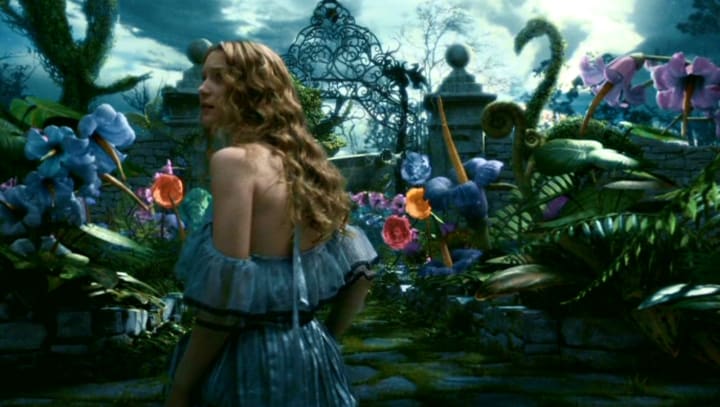
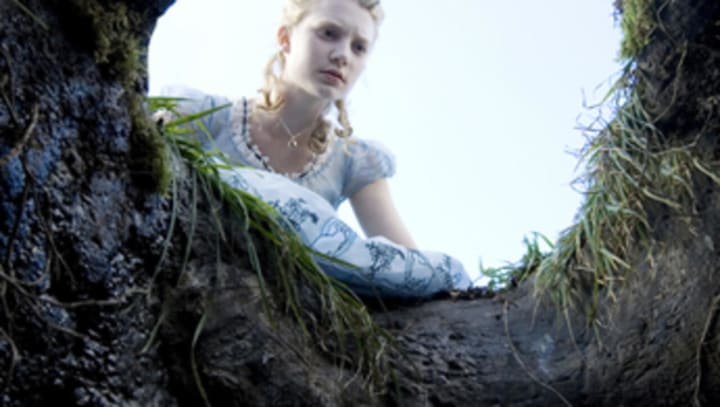
Principal photography began in Shepperton Studios in Surrey, England, in May 2008. The filming process was a mix of practical sets and green screen work, with actors often performing against blank backgrounds that would later be filled with elaborate CGI environments. This presented challenges for the actors, who had to rely on their imagination to interact with creatures and landscapes that didn't exist in the physical world.
Anecdotally, the set was often filled with laughter, particularly during scenes involving Depp's unpredictable improvisations as the Mad Hatter. Helena Bonham Carter, wearing a prosthetic head to accentuate the Red Queen's features, reportedly found it difficult to navigate doorways and often bumped into things, much to the amusement of the crew.
Production Design:
The production design of "Alice in Wonderland" is a visual feast, reflecting Burton's signature style. The sets are whimsical and surreal, blending gothic elements with vibrant colors and fantastical details. The costumes, designed by Colleen Atwood, are equally striking, capturing the essence of each character while adding a unique Burtonesque touch.
The Red Queen's elaborate gowns and towering heart-shaped collar perfectly convey her tyrannical personality, while the Mad Hatter's mismatched attire and vibrant makeup reflect his fractured mind. Alice's costumes evolve throughout the film, mirroring her journey of self-discovery, culminating in a battle-ready outfit that signifies her newfound strength and determination.
Sound Design & Music:
The sound design of "Alice in Wonderland" is immersive and dynamic, creating a rich and engaging auditory experience. The film's soundtrack, composed by Danny Elfman, perfectly complements Burton's visuals, blending whimsical melodies with darker, more ominous tones. Elfman's score captures the sense of wonder and danger that permeates Underland, enhancing the film's emotional impact. The use of iconic sounds, such as the Hatter’s constant giggling or the Red Queen’s infamous shout, “Off with their heads!”, adds to the fantastical atmosphere.
Visual Effects:

The visual effects in "Alice in Wonderland" are groundbreaking, pushing the boundaries of what was possible at the time. The CGI creatures, such as the Cheshire Cat and the Jabberwocky, are seamlessly integrated into the live-action footage, creating a believable and immersive world. The film's use of 3D technology was also innovative, adding depth and dimension to the already visually stunning landscapes. However, some critics argued that the over-reliance on CGI detracted from the film's charm, making it feel overly polished and artificial.
Influences:
"Alice in Wonderland" draws inspiration from a variety of sources, including Lewis Carroll's original books, classic Disney animation, and Burton's own previous works. The film's gothic aesthetic and quirky characters are reminiscent of Burton's earlier films, such as "Beetlejuice" and "Edward Scissorhands." The film also borrows elements from other fantasy films, such as "The Lord of the Rings" and "Harry Potter," creating a familiar yet unique cinematic experience.

Scientific Knowledge :
While "Alice in Wonderland" is primarily a work of fantasy, it does incorporate some elements of scientific plausibility. The film's use of forced perspective and CGI manipulation is grounded in real-world principles of visual perception. Alice's shrinking and growing, while fantastical, can be seen as a metaphorical representation of the challenges and uncertainties of adolescence.
Marketing, Release & Box Office:
Disney launched a massive marketing campaign for "Alice in Wonderland," targeting a wide range of audiences. The film's trailers and promotional materials emphasized its visual spectacle and star-studded cast. The 3D presentation was heavily promoted, creating a sense of must-see event. The film was released in theaters on March 5, 2010, and quickly became a box office phenomenon, grossing over $1 billion worldwide.
The release strategy was meticulous, saturating theaters worldwide and capitalizing on the 3D craze. Merchandise, ranging from clothing to toys, flooded the market, further cementing the film's cultural impact.
Critical Responses:

Ultimately, "Alice in Wonderland" remains a divisive film. While praised for its visual splendor and strong performances, it was criticized for its weak screenplay and deviation from the source material. However, its box office success speaks to its enduring appeal, demonstrating the power of Burton's vision and the timelessness of Carroll's story. The film solidified Burton's status as a master of visual storytelling and introduced a new generation to the whimsical world of Underland, albeit a darker, more action-oriented version than previous iterations. Despite the mixed critical reception, "Alice in Wonderland" continues to be watched, debated, and celebrated for its unique blend of fantasy, spectacle, and Burtonesque flair.
About the Creator
Xavier
Global news reporter covering science, tech, environment, Entertainment & sports. Delivering balanced insights to inform and inspire readers worldwide. Sometimes a poet.
The Politics of Playing Dress-Up
Well, to start off I'd like to say a happy world book day to all who celebrate. I know I haven't really posted anything on my socials about it but I'm not a jubilant kind of person. I lay low most of the time. Let's start off with a popular anecdote from the vaults...
By Annie Kapur4 days ago in Geeks
FOX Marvel Power Rankings
The world of the X-Men isn’t built on clean heroism — it’s shaped by evolution, prejudice, and power spiraling out of control. Mutants aren’t just gifted; many are walking weapons capable of leveling cities, bending reality, or wiping out entire armies. Some dominate through raw destructive force, others through psychic mastery, regeneration, or calculated manipulation — but only a select few rise to the top of the mutant hierarchy.
By Top Ranked6 days ago in Geeks



Comments
There are no comments for this story
Be the first to respond and start the conversation.