
Distant Memories: A Poignant Exploration of Alzheimer's
This short film is a powerful representation of memory and human connection.

It feels like I am mourning someone who is still alive.
Distant Memories is a short film directed by Chris Esper. The film centers on Anna, a woman with Alzheimer’s Disease who struggles to make sense of her deteriorating world. Snippets of old memories play in her fading mind as she fights to recollect her life.
A wave of emotions swept through the audience at Regent Theatre’s Summerdance Film Festival. I was close to tears myself. Distant Memories portrays Alzheimer’s disease in a distinct format and powerfully pays respect to anyone fighting the horrible illness.
Sissy O’Hara does an astounding job as Anna. This challenging role strongly required her to act through her countenance. O’Hara did as much research on Alzheimer’s to make a respectful portrayal and also worked closely with Esper and the rest of the crew to develop the character.
Anna’s daughter, Noelle (Christie Devine) remains patient with her mother, trying to call her back to reality. Noelle remains brave through this difficult time, but the disease has put a great deal of stress on her and their loving relationship. The scene at the end, followed by Noelle’s tearful reaction is heartbreaking.
Although casting was tricky, Distant Memories involved actors with whom Chris Esper has worked in the past or has close connections. Alyson Muzila, Gabriella Spinny, and Chelsea Hueter play Anna as a child or an adult to signify different moments in her life - now fading. More credits include Tim Connelly, Grace Babikien, Nick Wakely, and Lily Ewald.
Esper allowed his actors to improv when shooting the home movie scenes. I like how he worked closely with his actors to distinguish their backstories before filming began. He hoped to make it feel like a real home movie to present memories as a record of existence.
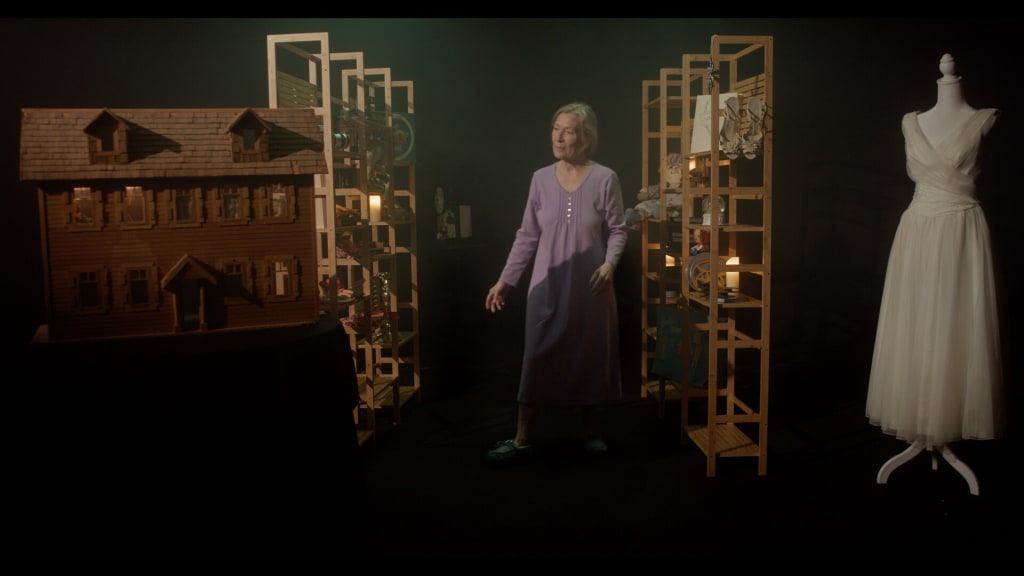
Set up in the dark chamber of a woman’s deteriorating mind, shelves of once familiar objects, like a doll and an old TV, are now unrecognizable. There’s also an hourglass - but no sand pours out. For this setting, filmmakers used a room in the Cultural Center of Fall River to represent Anna’s deteriorating mind.
Anna inspects the familiar objects and observes slides showing fading memories. At one moment, a phone rings with familiar voices on the other end, but Anna can’t quite make out. It distinguishes the people speaking to her, but the words no longer make sense.
The technical aspect of Distant Memories was more important than ever, particularly the visuals and sound. In a rare choice, the film features no music, relying solely on sound to emphasize the situation.
Esper wanted to present the disease with visuals and no dialogue, commenting that music may have ruined the experience. Minimal dialogue is another tactic filmmakers need to implement. Actions speak louder than words.
Chris Esper described this film as pieces of someone’s heart. Telling this story was important to him as he had two grandparents with Alzheimer’s. For research, Esper watched a few films on Alzheimer’s, like Still Alice and Barney’s Version. The films were heartwrenching, but they all showed the perspective from the outside world.
Anxious to examine this story differently, Esper explored Distant Memories through the perspective of an Alzheimer’s patient. It allowed him to venture into a new creative territory and hopefully bring light to the situation. He also played around with editing to set up the audience.
Well done to everyone involved for making a powerful short film. The film is lovingly dedicated to anyone battling Alzheimer’s. Chris Esper’s Distant Memories is more than a film about Alzheimer’s but is a powerful representation of memory and human connection.
About the Creator
Marielle Sabbag
Writing has been my passion since I was 11 years old. I love creating stories from fiction, poetry, fanfiction. I enjoy writing movie reviews. I would love to become a creative writing teacher and leave the world inspiring minds.
Keep reading
More stories from Marielle Sabbag and writers in Geeks and other communities.
Buckle Your Seat Belts! Acting Out's 'It's Only a Play' is Comical Genius
Everybody’s a critic. It’s up to you how you want to keep your sanity. Acting Out Theater Company invites audiences to a whirlwind of laughter with its production of Terrance McNally’s It’s Only a Play. In one chaotic night, a group of actors, producers, and playwrights feverishly await reviews, only for their clashing egos to spiral into comical mayhem.
By Marielle Sabbagabout a year ago in Geeks
The Rachels - 2025
Much to my surprise, I have kept a list of the films I‘ve seen this year. I daresay it isn’t complete. There will be films that snuck in on a late night in front of the TV that I would’ve forgotten to note. Or others, that I went to watch at the cinema, but then had a red wine and promptly forgotten about. But it’s not a bad approximation of the films I’ve seen this year. In total, there are 53 films listed, so an average of one a week and one for good luck.
By Rachel Robbins26 days ago in Geeks
Grant Gustin's Chances Of Returning As The DC Universe's Flash Have Just Increased After New Update
The Flash has yet to be cast for the new DC Universe, and after a new update, the rumors of Grant Gustin's return as Barry Allen in the new franchise have gained strength once again. Gustin made history by playing Barry for The Flash's nine seasons. The actor also starred in multiple Arrowverse crossovers, becoming one of the franchise's fan-favorites.
By Dena Falken Esq7 days ago in Geeks


Comments
There are no comments for this story
Be the first to respond and start the conversation.