

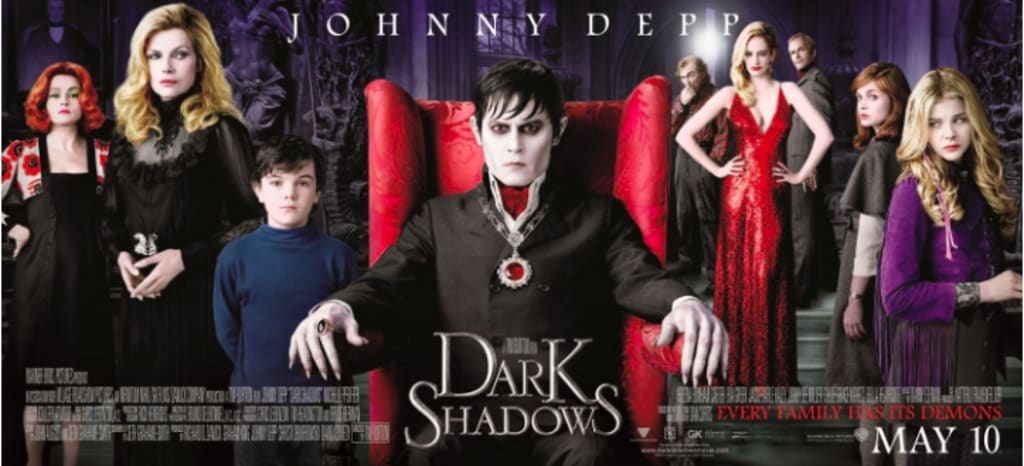
Since we've already delved into the outskirts of cinema with Kung Fu Hustle, why not talk about vampire movies as well? It's a significant segment with dedicated, faithful, and steady audiences (unlike myself, who feels no affinity toward it).
Unlike its counterparts in the periphery of the film set, the theme is much more generous and has been turned on all sides. We've already seen hero vampires, persecuted vampires and victims, social minority vampires, vampires of different orientations and in ethnic conflicts, racial segregations, and even a psychological approach with pretensions (but mediocre): Only Lovers Left Alive - Jim Jarmusch (2013). And for today, out of the entire pile, I have chosen a monograph. A chronicle in time of a family with a tradition in which vampirism becomes a tool of a malevolent plan hatched and triggered by unrequited love.
The Tim Burton/Johnny Depp duo (in their eighth collaboration) contributed decisively to the choice, and the original thesis of interpreting the phenomenon from a pathological perspective, with obvious compassion and in soap opera style, decided: we are talking about Dark Shadows.
The year is 1776. Barnabas (Johnny Depp), the son of the Collins family of industrialists (freshly emigrated from Liverpool), has an affair with Angelique Bouchard, a young neighbor with whom he had grown up and who is a trained witch. Barnabas goes on and marries Josette du Pres (Bella Heathcote... jee... I love this girl), which triggers a hysterical reaction from Angelique... but also immediate retaliation. Through her occult powers, Barnabas' parents are killed, Josette is pushed to jump off a cliff to prevent him from committing suicide, and Barnabas is transformed into an immortal vampire. The succession of events does not change anything, so in continuation of her pursuit, Miss Bouchard captures Barnabas (now a newly turned vampire) and securely chains him in a wooden coffin, which she then buries (for an indeterminate period) in the depths of the forest, giving him time to reconsider.
Exactly 196 years later, the action is resumed from roughly the same point, through the accidental exhumation of the coffin (by some workers), this time with the participation of the current descendants of the Collins family (more or less alive)... and in opposition to the eternal Angelique Bouchard.
The adaptation of one accustomed to the retro atmosphere of the 18th century to the pop culture of the 70s creates many moments of amusement, exploited subtly or directly by the story.
Dark Shadows was accused of having a narrative inconsistency and a certain lack of coherence. The movie was received with a lot of reservation by critics, and without adequate support, it failed to impress the audience, ultimately meaning a poor business venture for investors.
Personally, I was disappointed with Depp's performance, whose facial expressions burdened by inappropriate makeup are lost (as pale-faced as anyone who has been buried for two centuries), and the overuse of special effects (especially their lack of originality was annoying).
Despite my dissatisfaction and that of others, Dark Shadows will always be a charming fairy tale, if only for its polychromatic, comic, and spectacular plot, and its strange happy ending. However, its exceptional nature lies in the success of several metaphors placed "in cascade" in successive frames full of symbols and meaning.
I hesitated a lot about which one to talk about. Tim Burton is such a refined and complex poet that I'm not even sure I understood them all, most of them needing additional research.
There is the confrontation scene where Angelique Bouchard is unleashed in violence. Hard blows are exchanged, and a lot of energy, magic, invocations, incantations, and curses are consumed. A blow to the head suggests by its characteristics that Angelique has the fragility of an eggshell. In the following frame where she descends into the chandelier net where she was projected, she resembles a doll operated by strings, and the immediate images following where she breaks her chest to take out the beautiful, functional pink heart to offer it to Barnabas again, and the way she crumbles and disintegrates when rejected, turn the film around. She is an infamous character, responsible for all the evil in the script, and culpable for the entire plot. But... here is: she is a lonely soul with an impressive motivation. She did everything she did out of love. By the new light incriminated in the end, it is not the witch Angelique Bouchard, but the whole set of hostile conditions that prevent her fulfillment. The twistedness of a world that does not work better on other levels (supernatural, miraculous, fantastic), and for which fairness is just as abstract.
Dark Shadows is not an incursion into the world populated by characters who ensure their immortality at the expense of absorbed victims, but only a careful observation of one with more possibilities, in which vampirism is just one of the options.
About the Creator
Andreea Sorm
Revolutionary spirit. AI contributor. Badass Engineer. Struggling millennial. Post-modern feminist.
YouTube - Chiarra AI
Keep reading
More stories from Andreea Sorm and writers in Geeks and other communities.
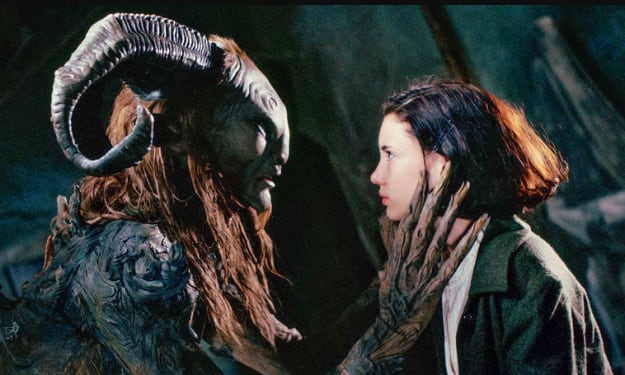
Pan's Labyrinth - Guillermo del Toro (2006)
It's about obsessions, the balance between good and evil, the huge dimension of any story, reality, and imagination, about their relationships and hierarchy. It's a fairy tale with fairies and monsters built from dreams and daydreams, opposed to extreme but concrete events, in an ambiguous escapist commitment. Visceral, terrifying frames, the indispensable blue-green/amber (Torro brand) alternations, grandeur, surrealism, historical allegory, mythical and religious level, horrors of war; compose an extensive metaphor in which nothing is more present than the expressive.
By Andreea Sorm3 years ago in Geeks
The Island of Dr Moreau by HG Wells
Background and Context: You guys probably already know that 'The Island of Dr Moreau' is my favourite HG Wells novel and it has one of the most twisted storylines in Victorian Fiction. It takes the 'mad scientist' trope and turns it into something that blends it with a classic villain from the movies with a cult leader, drunk off his own sense of power. It's a really short book and really easy to read so please, if you haven't read it yet I would recommend getting stuck into it when you have some time. You definitely will not regret it. I've written multiple things about this book in my previous articles, praising it for its incredible themes and its fantastic blend of Sci-Fi and horror. Something that really characterises the era it was written in.
By Annie Kapurabout 17 hours ago in Geeks
TUS NUA - ch 53
TUS NUA – ch 53 New Beginnings – Mia and Midnight (*)(*)(*) Finola knew Ali’s brother-in-law needed to put his mind at rest. She fed her arm through his and led him outside. “We’ll sit here. If you like, I can put a block around us so our conversation will be private.”
By Margaret Brennan6 days ago in Fiction


Comments
There are no comments for this story
Be the first to respond and start the conversation.