
Creed
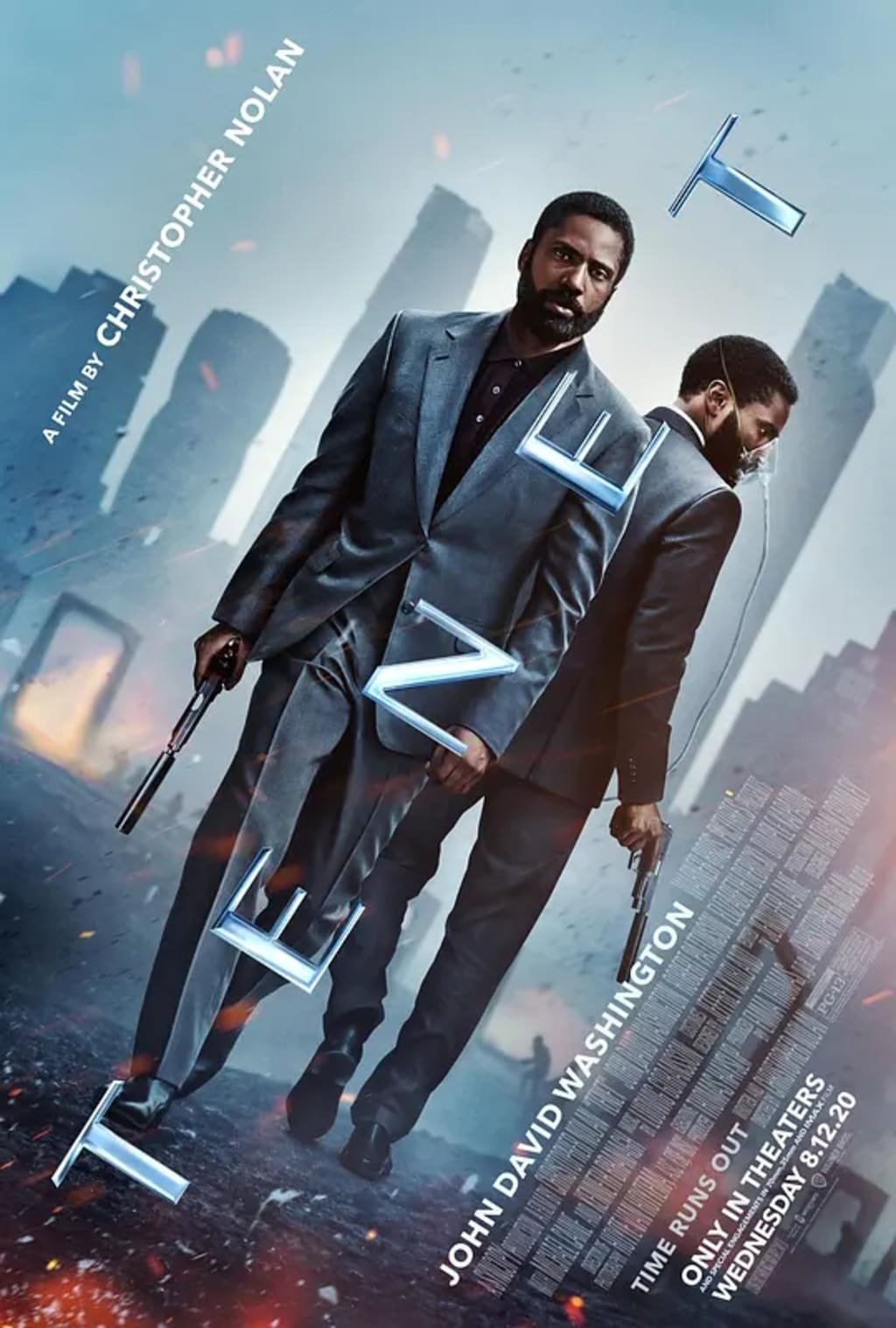
Ten years ago, Nolan succeeded in burning his brain out of the circle with the help of "Will the gyro fall?". Because of Memento, fans labeled Nolan as brain-burning, and because of Inception, Volkswagen labeled Nolan as brain-burning. When Tenet was promoted as Nolan's brain-burning work, the audience's expectation was raised invisibly, and the higher the expectation, the greater the disappointment. Many excellent UPs have done a lot of video parsing, so I won't say much.
In fact, I have always been not very cold about the word "brain burning". Every time I see a movie review labeled as brain burning, it is like watching a super brain. Besides, I don't think there is any similarity between Tenet and Memento or Inception. Although Nolan has always been happy to "play with" time, every time it is a brand-new technique and concept, which is very commendable. What made me look stupid for the first time was not the plot, but the concretization of reversing time. It was difficult to accept the visual impact that someone dragged the progress bar back on the big screen and forced the picture back.
I agree that Tenet is more like a time magic. When you go back and forth to examine and question it again and again, you have already missed its most wonderful appearance. Anyone who has played magic knows that performing is not the hardest part of magic, but creating a new magic is the hardest and most imaginative thing. Nolan, as the screenwriter of this film, convinced the audience trying to find bugs with strict logic and details, without revealing any flaws.
People who don't like magic usually give the reason that "magic is all false". Similarly, people who don't like Tenet will say that Nolan is making a fool of himself. Similarly, Memento Inception can give the audience enough buffer time to understand the story, while Tenet is not so friendly to the audience. If the former is a large-scale magic show, it presents stage wonders, while the latter is close-range magic, creating miraculous moments in an instant.
The usual theme of time passing through, no matter when it passes through, still flows in forward time, which is easy to understand. However, Nolan suddenly put forward a concept of reverse flow of time in Tenet. When this concept is not popular with the public, the film does not give too much explanation, and even confuses the audience with complicated action scenes and electronic music that blows ears. As an excellent master of time magic, Nolan is undoubtedly successful.
A simple linear narrative style can't satisfy Nolan's expression desire. You have to start looking at the world in a new way. Before the final battle in Tenet, the captain said to the hero, "If you still think in a straight line, you should not board the plane" (I forgot what I said specifically, which probably means anyway), as if Nolan was blacking himself out.
Memento cut the time bar and spliced it again. Inception used multiple dreams to realize multi-line parallel narration. Even Dunkirk, a war film based on historical facts, should be set to three narrative lines: sea, land and air, which shows how keen Nolan is on nonlinear narration. Tenet's main story uses a straight line narrative that Nolan can hardly use, but he skillfully breaks the straight line into a U-shape. If the opera house is not replaced with a base, the end-to-end closure will become the same as Interstellar's theory.
Nolan is good at challenging the time dimension and breaking away from the real space, but the protagonist of his works always has to return to reality. Inception brought the audience back to reality with a gyro that distinguishes reality from dreams, and Interstellar brought the protagonist back to reality with five-dimensional space. Neil, played by Robert Pattinson in Tenet, gave his last farewell answer of "reality".
Nolan doesn't like overhead sci-fi imagination, and insists on real-life shooting, even when shooting sci-fi films. There is no green screen in the whole film, only 280 special effects shots, which is the least used in Nolan's works with special effects shots, and it is also Nolan's fifth film made with IMAX machine with 70mm film.
I think this is the last sense of reality that he tried to keep for the film, and it is also his support for returning to the cinema by himself. Tenet shows us a different Nolan, whether it is a soundtrack or an actor, which is in line with my new expectation for Nolan every time. Hans Zimmer, an old partner, turned down Tenet for denis villeneuve's Dunes, but recommended his friend Ludwig Goransson (on behalf of Black Panther's Venom) to Nolan. In the Tenet, we can't hear the magnificent classical music that is common in Nolan's works, but it is replaced by electronic music with pioneering experiment. If this is not the case, it is hard for me to imagine how Hans Zimmer will deal with the reverse of the score when reversing the time. Let's just say they've helped each other.
My daughter-in-law said that Gao Mei (Elizabeth Debicki) played very well, and the fear of being trapped by wild animals was very real. I like John David Washington's inexplicable temperament, unlike his father, Denzel Hayes Washington Jr.'s tough guy, but with the same firm eyes and a little soft and warm trust, which is very suitable for this nameless character and conforms to the setting of anti-hero. Robert Pattinson's acting skills have been outstanding after training. It is precisely because of his wonderful performances in Good Times and Lost Z City that Nolan pays attention.
Finally, I suggest going to the cinema for a second brush if I have the chance. Before the second brush, I can help you understand with bilibili's analytic video. Believe me, the second look is equally exciting. Don't indulge in detailed analysis. "Understanding" is not the meaning of Tenet, nor is it the ultimate meaning of watching movies.
Don't try to understand it. Feel it.
About the Creator
Not Just For Clean Up: A History Of The MCU's Department of Damage Control
Initially an organisation that seemed to exist to help the heroes of the Marvel Cinematic Universe, from Phase Four onwards, the Department of Damage Control has shifted into a more antagonistic role. Most recently seen in the Wonder Man series, the current incarnation of Damage Control seems to target superpowered individuals, regardless of whether that person poses an active or intentional threat.
By Kristy Anderson7 days ago in Geeks



Comments
There are no comments for this story
Be the first to respond and start the conversation.