

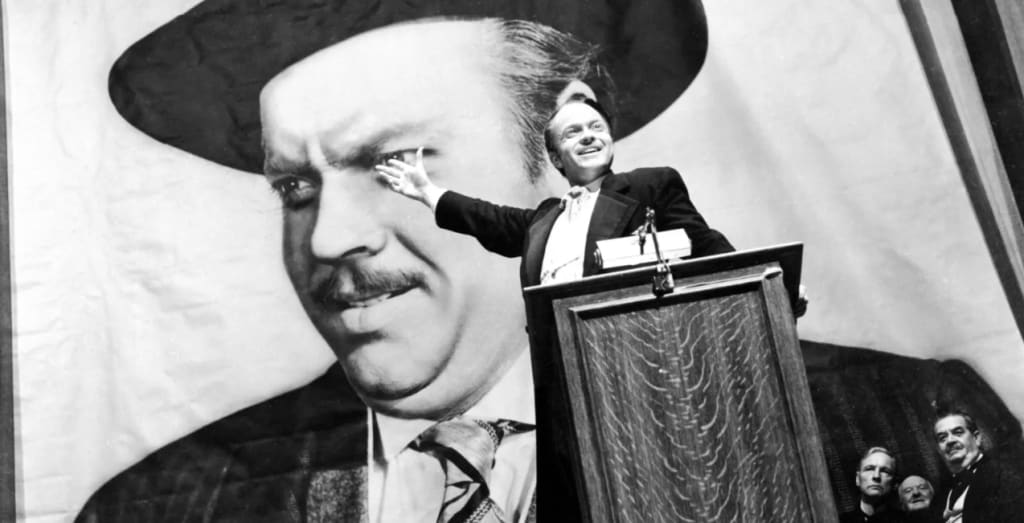
Who is Orson Welles?
A gifted enfant terrible with genius, talent, imagination, boldness, and consistency. He was an actor, director, writer, and producer, the founder of the Mercury Theatre repertory company, which, under his guidance, managed to secure a radio broadcast slot (Columbia Broadcasting System - CBS radio network) at an average listening hour, creating the conditions for what would become "The War of the Worlds" and the most significant event ever broadcast.
What is "Citizen Kane"?
According to the American Film Institute, it is the best production of all time, and for a long time, it held the number one position in the combined rankings for cinematography, storytelling, soundtrack, and inventiveness. The rest of the world's critics also oscillate among superlatives, but the feature film is usually ranked among the top 20.
For the rest of us, "Citizen Kane" is a perfect masterpiece, and the undisputed truth is that we have here an important milestone; a redirection evolution, with the demolition of walls, standards, and templates; and their replacement with new, bold, powerful, and impressive techniques. About this intriguing film, tons of literature has been written, and rivers of ink have flowed, would be nothing, but it is mandatory to know that everything happened under a severe embargo.
Recognizing himself as the main character, William Hearst boycotted both the film's promotion through the press and its screening in theaters; he bought the votes of the film academy and launched a ruthless war against Welles, with results that diverted him from a path that promised glory. Thus, one of the most remarkable successes of the seventh art did not even manage to cover its investment budget, and it remained almost only in the attention of critics. A criticism that kept him in his rightful place (fighting admirably from underground); a criticism that stoically confronted the interests and conspiracies hatched, through solidarity, again, unique and unprecedented. Even more dramatic, the entire persecution was unfounded, as Orson Welles did not directly target Hearst, but only the archetype of the magnate at the top of the pyramid, a typology that the director researched by studying a large number of individuals (although many of the scenes do not accidentally resemble the important journalist).
Why "Citizen Kane"?
It's a long list. At the top, I would place impeccable cinematography, largely due to the prolific imagination and agility that launched a truly new way of making films. Orson Welles proceeded pragmatically, taking the innovative techniques of the moment and finding the most suitable place for them in his work, assimilating them in a personalized way. The transitions of images, sounds, and dialogues from one scene to another through overlapping had been invented by Howard Hawks in His Girl Friday (1940), the deep-focus technique by William Wyler in Dead End (1937), the use of a low-angle shot to show the ceiling as a background by John Ford in Stagecoach (1939), the non-linear mix of flashbacks/flashforwards by Garson Kanin in A Man to Remember (1938), and the successive axial traveling shots with a fixed point of reference by Alfred Hitchcock in Rebecca (1940).
The second priority is related to being unconventional and experimental. There is hardly a frame in "Citizen Kane" that does not contain at least the intention to try something new, from strategies to equipment, techniques to acting, and from symbol to metaphor.
In this production, Welles imposed the use of coated lenses (just appearing), and quite controversial at that time (lacking in color). The defect did not exist in black and white, only the advantages. So... To bring Dorothy Comingore into her character's skin, she is deliberately harassed and humiliated on the set... and the result?... as expected.
Orson himself undergoes a total transposition, suffering serious injuries to his hands (in the scene where he destroys Susan's room) and fracturing his ankle when he runs up the stairs after Getty. The lighting conditions are extravagant and beyond any classic scheme; they force the film crew to push the limits, who already face the special challenges of ensuring deep depth of field (DOF).
I will not speak about the structured narrative in multiple dimensions. Its fluidity is legendary and miraculous, and the boundary between the means that contribute to its achievement is so finely drawn that even the most astute eye can easily miss it. However, I cannot conclude these brief considerations without drawing attention to the supernatural, insinuating, hypnotic, and equally haunting opening sequences.
It is a complex process that brings together the perfect collaboration (in synchrony to be envied) of successive recordings that reproduce the camera's foray from a sinister landscape to the interior of a habitat whose illuminated window is not missed in any position, even if the angles are changed countless times. The end of the traveling, which is nothing but a disguised prologue, takes place similarly, with the camera withdrawing from inside the enclosure of a glass globe, in which snowflakes cover a little house, symbolizing the psychoanalytic period of intrauterine calm. The hand that drops the globe, the shattering of it, and the utterance of the keyword "Illusion" create a mysterious and tense atmosphere that captures you instantly.
No one is left in the room, so how the last word of the lonely billionaire becomes public should be a mystery... but it's not...Go see Citizen Kane, a film/masterpiece directed by Orson Welles!!
About the Creator
Andreea Sorm
Revolutionary spirit. AI contributor. Badass Engineer. Struggling millennial. Post-modern feminist.
YouTube - Chiarra AI
Keep reading
More stories from Andreea Sorm and writers in Geeks and other communities.
Point Break - Kathryn Bigelow (1991)
From a chemical point of view, it is a product designed to almost instantly trigger the chain of reactions that prepare the body for extreme conditions. The starting point lies in the synthesis of the amino acids tyrosine or phenylalanine, which through stereoselective L-DOPA hydrolysis (and a decarboxylation process) becomes an active dopamine. Manufactured and circulated by the medulla oblongata gland, its effects are immediate and lead to accelerated heart rate, conjugated with vasodilation and bronchial volume increase, all in order to favor lipolysis (glucose production).
By Andreea Sorm3 years ago in Geeks
A Knight of the Seven Kingdoms Series Review (Season 1)
As one of the biggest properties in fantasy, A Song of Ice and Fire remains immensely popular with audiences. After reaching far into the past with House of the Dragon, a second spin-off was on the cards. A Knight of the Seven Kingdoms serves up a bite-sized slice of action and drama, but it still claims a spot among the best small-screen titles.
By Robert Cain16 days ago in Geeks
If Netanyahu Is Alive, Why Isn’t He Appearing Publicly?
In the digital age, rumors can spread across the world within minutes. Recently, many people on social media have been asking an unusual question: if Israeli Prime Minister Benjamin Netanyahu is alive, why isn’t he appearing publicly as often as before? The question has fueled speculation, conspiracy theories, and debates across different online platforms.
By shaoor afridiabout an hour ago in Geeks
Why Didn't Anyone Tell Us
Men, move along. This is not for you. This is for the women. I was forty-five when I began menopause. It is pretty young for that to be going on in a woman’s life, but I had undiagnosed PCOS, my entire life. Thank you to all the gynecologists I had seen my entire life. That in itself should encourage women to keep seeking second opinions, especially when you are not getting correct answers or any at all.
By Alexandra Grant5 days ago in Humans


Comments
There are no comments for this story
Be the first to respond and start the conversation.