
Circus Roncalli In Germany Uses Holograms Instead Of Live Animals
The show started using holographic projections in 2018 to help fight claims of animal cruelty

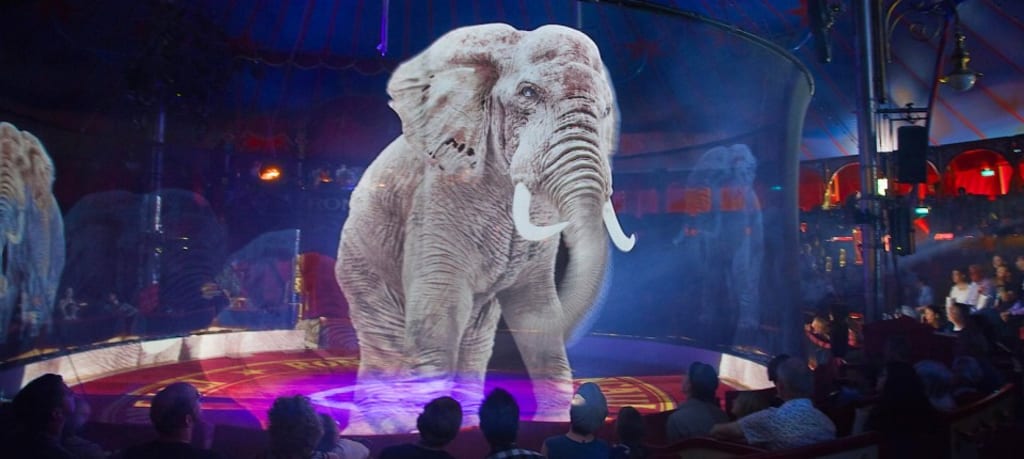
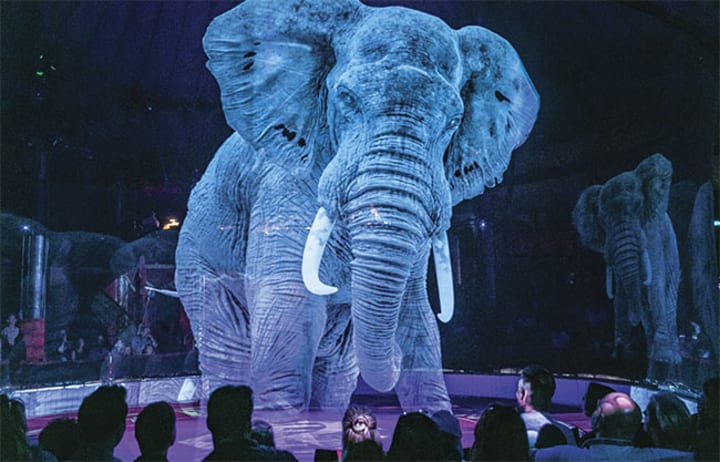
At the Circus Roncalli performance in Germany, an elephant emerges before the audience, its ears flapping and trunk wagging. It stands up its hind legs as the crowd cheers and claps, then... it disappears.
Like the other animals presented at Circus Roncalli, this elephant is a 3D hologram, a tech-savvy attempt to preserve the flavor of historic circuses while easing concerns about animal cruelty.
Circus Roncalli was founded in 1976 and started gradually phasing out animal shows in the 1990s. According to Bernhard Paul, the name was inspired by a film script of his fellow Austrian friend Peter Hajek. The first performance of the circus took place on May 18, 1976 at the Hofgartenwiese in Bonn, and the tour ended on August 16, 1976 in Munich. After the first season Paul and Heller were at odds over the concept and rights, so that Bernhard Paul conducted the circus alone at a later performance on June 4 1980 in Cologne. (In September 1976, there were already performances without Heller in Vienna, but the show was discontinued after a short time due to dwindling audience.) Since then, the circus has toured Germany and abroad, including the first appearance of a West German circus in the Soviet Union. Model photographer Ellen von Unwerth worked as an assistant at Circus Roncalli in Munich for about a month when she was 18 years old.
Since 1984, the winter quarters of the circus have been located at Neurather Weg 7 in Mülheim. The building, which used to belong to Circus Williams, was converted for the Circus Roncalli and officially opened on April 27, 1986.
Since 2018, the show has not featured live animals, but holographic projections with 360-degree views for onlookers around the ring. Eleven projectors are needed to accomplish this, according to the BBC.
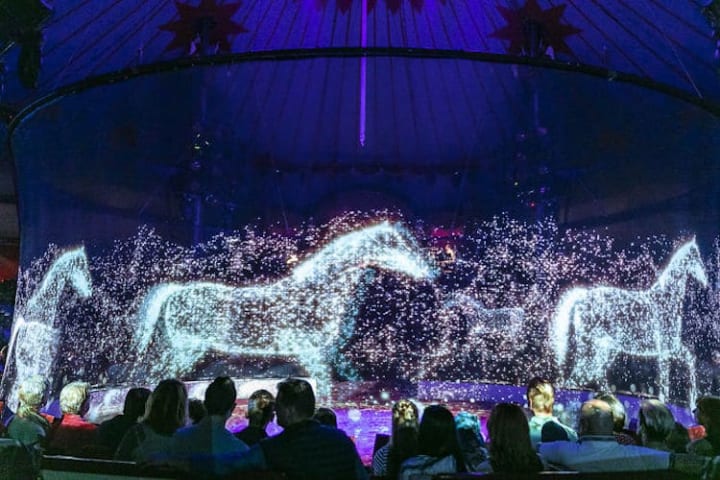
Some of the holographic performances depict traditional circus fare, such as the elephant and an ethereal ring of horses galloping around the big top. Other acts are more fantastic; past circus-goers, for example, would not have seen the sight of a giant goldfish in the middle of the ring.
Once a popular source of entertainment, circuses have struggled with the current times. A number of factors have driven this decline, including the emergence of other media such as movies and video games that compete for a younger audiences attention, and the increased cost of transporting performers and animals by train. (In 2016, when Circus Roncalli still used some animals, a single ride could cost them nearly $90,000, according to Handelsblatt.)
But reports of appalling animal cruelty played a role in tarnishing the circus's reputation. In the United States, activist groups like People for the Ethical Treatment of Animals (PETA) spent years targeting the Ringling Bros. and Barnum & Bailey circus with campaigns and lawsuits. In 2015, Ringling decided to phase out its elephants, citing a “mood shift” among consumers, but this only led to a further decline in ticket sales. While many were disappointed to see the elephants leave, others continued to protest against the circus's use of other animals like lions, tigers, horses, kangaroos and other animals. In 2017, Ringling Bros. and Barnum & Bailey shut down after a long 146-year run.
Today, seven American states and 149 cities, towns and counties have imposed restrictions on using wild animals in circuses, according to the animal rights organization Four Paws. In the last year, New Jersey and Hawaii issued statewide bans on animal circuses, and more than 40 countries around the world have imposed restrictions or bans on animal performances.
As Circus Roncalli has shown, this concern over the treatment of animals doesn’t mean they have to be completely gone in performances. With help from advanced technology, the show can go on!
About the Creator
Buzzword
BuzzWord features, news, reviews and top ten lists.
A Knight of the Seven Kingdoms Series Review (Season 1)
As one of the biggest properties in fantasy, A Song of Ice and Fire remains immensely popular with audiences. After reaching far into the past with House of the Dragon, a second spin-off was on the cards. A Knight of the Seven Kingdoms serves up a bite-sized slice of action and drama, but it still claims a spot among the best small-screen titles.
By Robert Cain15 days ago in Geeks
Naruto Power Rankings
Few anime series feature a cast as massive and as powerful as Naruto and its sequel Naruto: Shippuden. Across hundreds of episodes, the series introduces dozens of shinobi with wildly different fighting styles, abilities, and levels of power. From tactical geniuses and elite jonin to god-like beings capable of altering entire dimensions, the Naruto universe constantly escalates the scale of its battles.
By Top Ranked5 days ago in Geeks
Why Didn't Anyone Tell Us
Men, move along. This is not for you. This is for the women. I was forty-five when I began menopause. It is pretty young for that to be going on in a woman’s life, but I had undiagnosed PCOS, my entire life. Thank you to all the gynecologists I had seen my entire life. That in itself should encourage women to keep seeking second opinions, especially when you are not getting correct answers or any at all.
By Alexandra Grant4 days ago in Humans


Comments
There are no comments for this story
Be the first to respond and start the conversation.