
Chess the Musical Back on Broadway!
There are spoilers. There are opinions. You are warned...

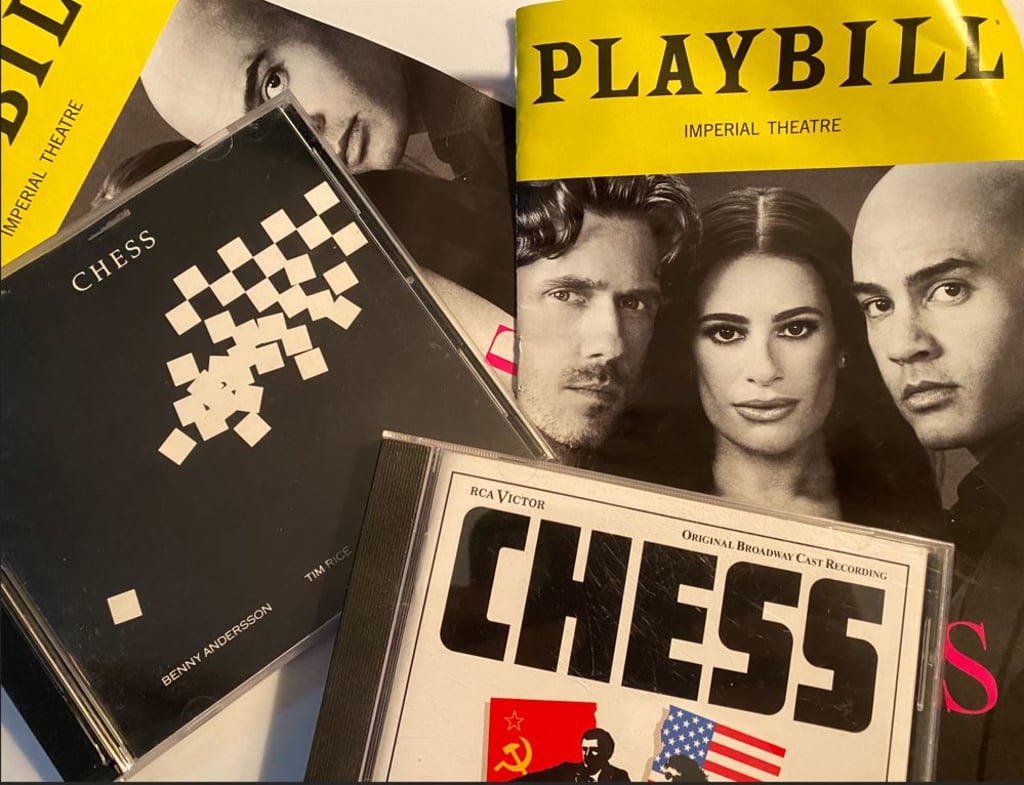
Have I ever mentioned how much of a fan of the musical Chess I am?
I know the answer is “No,” because if it were “Yes,” this one-off story of my day, taking a nibble out of the Big Apple, would become Chapter 327 of my new novel Bishop’s Gamble: The Chess Variations of the ABBA Musical.
Seriously, I’m obsessed.
The various incarnations of Chess are well-known: the London Variation, which, while not the original-original, is close enough that we’ll ignore the actual original. The American Variation: the ending of the musical in Europe, caught between the two Cold War superpowers, would never stand while being performed in one of those poles of power, so things where changed and rearranged. And still the American public was not ready for a real-time cutting analysis, therefore some of those sharp edges were softened. The American got a name. The Russian and Florence’s relationship cracked a bit earlier, and the break was more bitter. Florence got screwed much harder. New songs were added, others cut.
And the show went dark fast. I was supposed to go the week after it shut. My bestie saw it, and downloaded as much as she could to me. We obsessively played the London Variation vinyl record, squinting over the lyrics, memorizing them. Then the American Variation vinyl. We’d pick apart which details we liked in which. Made mix tapes blending the best of both. How precocious – and prescient – we were.
I was singing along to One Night in Bangkok as it made its “debut” on American radio. My classmates hated me. How could I know something cool, long before they could declare it cool?
I got to introduce Chess the musical to my hubster (then boyfriend). He was as enthralled as I was – honestly, the fact that our first real date was taking him to see the touring production of Les Mis in Philly should have been a clue. We did get to see a semi-pro production of Chess (American Variation) years later, which, while good, was not nearly Broadway-level. And the two leads loathed each other, their twin egos dancing around each other, not on the board. Kinda funny in retrospect, but irritating at the time. I go to a musical to see the musical, not brand name performers. Check your egos at the door, people, it’s all about the show – unless the director encourages it, but that’s a whole new series of problematic complications that any good play or musical really doesn’t need. Can you tell I’ve been in quite a few productions over the years myself, and even directed once?
Can you tell I have the London and Broadway CDs within reach, the Global Variant DVD one shelf over, and will play Nobody’s Side when I’ve reached my limit of acceptable societal behavior?
Can you tell I sniffed a bit at Mamma Mia? Sure, it’s a nice fluff musical, retro ABBA songs and all, but the ABBA boys wrote Chess, and that is their magnum opus. Hands down.
Luckily, I’m not the only one who thinks so, but it’s hard to find us in a crowd. It’s not like we wear little chessmen pins or something, and burst into chanting renditions of A Model of Decorum and Tranquility on command (more than once….)
Being about the Cold War antics, the musical has aged oddly. This one doesn’t bring up warm fuzzy nostalgia, like Oklahoma, or stark but distant history, like The Civil War. Chess is played on every level, from the board itself to the personal lives of the people playing it, to the politics behind the game history, to the international politics of possible nuclear war.
Chess the musical is dated. There are flaws in each variation. There are very few happy endings in the game of chess, and sometimes the best you can do is some sort of draw.
But in all the variations, the implication is clear, on all levels: Do Not Throw Away Your Queen.
For that alone, I absolutely LOVE LOVE LOVE this new variation. What shall we call it, Broadway? Revival? Florence’s Grandfather-Turned-Father’s Triumphant Return?
With this new variation, three new songs, a scrambling of some of the songs from both the London and American variant (which was a bit discordant to an aficionado’s heart), made for a bit of cognitive dissonance. Heaven Help My Heart sung about Anatoly?? (Florence originally sings it about Freddy / The American.) Freddy singing Pity the Child un-ironically, and the song broken up throughout the show? (In the American version, he’s giving an interview that’s meant to be “heartfelt” to soften the European view of Americans, and botches it so badly that we’re certain he made the story up on the spot.)
Dear sweet Lord above, how has forty years gone by so fast? This was my childhood on stage, my formative years, songs that have permeated my life and the life I’ve chosen to live with my hubby, and this retrospective version comes and rearranges my life like a freaking stage-owning kaleidoscope.
Firstly, The Shift: forty years. The number of rank and file people who understand chess (both the rules and the complications of play) have plummeted. The first two variations of the musical had real games played over real boards, and the metaphor was expanded by having much of the dialogue played on a pattern of black-and-white light squares projected onto the stage. Characters were dressed in black or white, and switched colors as their characters shifted. The whole show was a chess game that you could play on a real board at home – if you knew who the players represented. No chess boards this time, the game itself has become background, and the political climate takes center stage, with all the interpersonal dynamics observed by, and commentated upon, by the Narrator / Arbiter. Government machines see the people as pawns in their own game, and eliminate all that cross that line. When the players take agency, they’re removed. When they take over and play their own game, the governments scramble to recover. The end game is amazing. For once, the dick Walter (they call him that!) is the one who doesn’t throw away Florence as queen, and gives her a future that isn’t ashes.
On expanding the role of The Arbiter: this was AWESOME. Freaking AWESOME. He breaks the fourth wall, he throws in some deep-freeze biting commentary on today’s politics for free (I spontaneously clapped on the one, it was sooo cold), he brought in the “we didn’t know at the time but had our suspicions that there was more going on than we knew” political angles. It ties the musical together, and it beings balance back to a game that, at the time, living through it, we all thought we’d be swept off the board. Forty years brings a sense of perspective we didn’t have at the time, and rather justifies some of the character’s behaviors. I loved the swipe at Putin (did you catch it?), and I especially loved him calling out the chess gambits being played out by the characters as the pressure to cave ramps up.
Freddy: we all know that this role is based on Bobby Fischer. Bobby knew it, and sued when the musical was released. I always felt bad for the real person behind the character – paranoid, delusional, broken, mocked, cracked under the immense pressure put on his to win, keep winning, don’t let the bad guys win. Also an ass, which we knew. Acknowledging Freddy’s bipolar right up front, and how his being on or off the meds affects his game, is a game-changer. He also admits he’s an asshole even while on the meds. Giving him the most deranged lines, which all turn out to be so true they hurt, is his redemption arc. He loses Florence, but in the American variant, he refuses to take responsibility for his own actions that led to it. This variation, a refinement of the London Variation, gives Freddy the pity he deserves, tempered with a huge dollop of “you brought this on yourself, buddy.”
Florence: damn this character’s been put through the wringer. Like the other characters, she’s obsessed with chess, but cracks differently than the boys, so it’s easy to dismiss and minimize - and miss entirely. This time, she’s powerful, like the chess queen has always been. She doesn’t fall for the governmental schemes, but gets caught in them anyway, because governments have power. She ends up walking away with as much of a win as she can, and gets her father (not grandfather) back. Not a spy dressed up as her grandfather that she must pretend is her grandfather (American variant), or a fictitious grandfather that may or may not be alive that we promise Scout’s honor we’ll start looking for tomorrow (London Variation). By switching from grandfather to father, and increasing her age to ten so she remembers what her father looks like, it resolves the ambiguity that permeates the earlier variations. This time, the love is solid, but Florence’s and Anatoly’s own self-realizations doom the relationship. This time, she and Anatoly lose each other, but on their own terms. Florence is given a future that’s not the crumbled detritus of a disaster.
Svetlana: Anatoly’s discarded wife, left in Russia to raise their kids while he’s off gallivanting being Russia’s rock star, has been fleshed out and made a real person. Originally just a pawn that was dressed as a queen and sent off on a suicide mission, she’s given legitimate, real concerns. She’s now a full-fledged queen, meeting Florence on her own terms, though pushed into the role. Dropping the KGB-influenced plan, and telling the honest truth, gets her what she wants. Sort of. At least she and her children are not dead, which is the alternative. Both queens count that as a win, but recognize they both lost. Neither gets Anatoly, and they know it – one only gets his body, one only gets his spirit. I Know Him So Well, which should have been a duet sung to each other from the very beginning (and I will die on this hill), is FINALLY sung to each other. AO3, please re-write your Florence-Svetlana shipping stories accordingly.
Anatoly: I do not like that he’s much more of an automaton that before. One of the main points of the original variation was that we (“the West”) viewed Russia and all its denizens as The Enemy, and this was one made real and worthy of pity. We were asked to show some sympathy for his plight, while recognizing his privileged status within Russia itself. Forty years of thawing relations, the focus is now on The Evil Government(s), and what kind of abuses each government slops onto their people in the name of Peace and Safety. Anthem is still there, but Where I Want to Be is broken up and doled out in pieces. I’d rather see his character done with less mystery, and more fleshing out. I can see why we pulled away from overselling his humanity, but to my eye, it’s made him even more of a cookie cutter Russian robot shoved into a chess-playing role, like all the others. I want to see it come back towards the middle. Yes, I know, the musical already runs two hours forty minutes, what’s a little more added back???
The Chorus: okay, enough already. It was overdone in Hamilton. The writhing, wriggling, Does Not Work Here. We do not need Fosse-esque Interpretive Dance any more than the London (or was it the American?) Variant (um, insert citation here? I didn’t see it, but overheard part of a conversation by an usher to someone else in my row) needed ballet scenes on a chessboard. Stripping and becoming the People of Questionable Virtue in One Night in Bangkok was brilliant. Being an almost ever-present audience (like Hamilton) is good, while still leaving for the intimate scenes. This is blended with the Arbiter’s now expanded role as The Narrator to a decent effect. The is Chess the Musical, people, not the Hamilton Variation.
Now, for a few quibbles…
Lea Michele as Florence: She’s got the pipes for it. She’s got the acting skills for it. No mistake, Florence is one of the toughest roles on Broadway. But the hands-like-claws motif was very distracting. And turning her back to the audience. These things should have been ironed out before opening curtain.
Freddy: aw, come on, you take away his best line?? Really??? “It’s in the YOGURT!”?? Okay, I get it, I get it. The brilliance of this re-defined character is recognizing the disease that makes him brilliant up front, plus making the meds and taking of said, part of the manipulation. All the tricks alluded to in previous variations had been brushed away by other characters as part of his psychosis, and in this variation, he’s been right all along despite being ignored. He now says the most truthful lines in the whole musical…. when he’s not being triggered by targeted prompts designed to shatter his fragile psyche. He still loses it all, but gains back the game. So, maybe Freddy pulls a draw this time. I still miss the American Variation, where Anatoly throws the match, but only Florence knows and realizes what he’s doing, and after the crowds leave Freddy alone, he realizes it too. That loss is one I treasure for the asshole that’s Freddy.
I very much miss the song The History of Chess. We still hear it, in fragments. It was front and center as the Prologue in the American Variant, and I loved it. It sets up Florence’s long-time craving for the game. Add even a few more minutes back into the show for it, willya? It’s not like I have a bus to catch...
Nicholas Christopher as Anatoly: you can soften the character a bit. Make it more obvious that there are now cracks in the armor. Maybe I was too far away to see, but a smile here or there when a character’s back is turned would have been good. Loosening up your position. Snapping back to rigid posture when on public display.
The color coding: now, instead of just black and white, it’s more red / white / blue versus red / gold. The black and white was there because chess colors, and the switching of colors was meant to signal changing alliances / sides. With eliminating the chess boards, the symbolism is lost, so back to country flag colors. Oh, come on, I recognize that chess as a game isn’t as well known anymore, but The Queen’s Gambit has brought it back into focus. Having the chorus in neutral grays was good. Having them strip to colorful skivvies for One Night in Bangkok was quite effective, but I think they should have been bold jewel tones to reflect Bangkok’s colorful night life. Having Freddy in white skivvies for the same song number was brilliant, and getting half-dressed for the TV broadcast update was phenomenal.
Adding in the levels of government that are now unclassified: freaking brilliant. I lived through it, forty years ago. I understood the implications and hinted-at back room politics. New generations do not. Explanation is needed. A shift of chess game venue was needed. Less emphasis on the game itself (I get it), the reflection on the lighting, setting and clothing (boo), the removal of game elements except as plays called into two mics (meh) which are only used as furtherance of plot (very much boo), making the in-game angst bleed into and out of the game with visual board-ers (freaking brilliant, use it more often throughout the musical!), the final cry of freedom bleeding into reality (freaking amazing, poignantly brilliant). Walter, the CIA agent described multiple times as “kind of a dick,” and hates / doesn’t understand chess, ends up giving the coup-de-grace that gives Florence the win. Still a dick, but now not so thoroughly odious.
In the end, it’s chess in life, chess on the board, chess in governments. Chess IS life. As the song says, “Each game of chess / means there’s one less / variation left to be played. Each day you’re through / means one or two / less mistakes remain to be made.”
The game as metaphor. Life as metaphor for the board game, interpreted through those ABBA guys. Honed and refined, forty years down the road from that first move onto a London stage.
If you can, go see it. If you’re Chess (the musical) obsessed, or “just” chess (the game) obsessed, go see it. I’ll be writing up my travels to and from NYC after I post this, so you can get an idea for one way to see it without driving all the way in.
And remember, the most important rule of chess, and Chess: Never, and I mean NEVER, throw away your queen.
About the Creator
Meredith Harmon
Mix equal parts anthropologist, biologist, geologist, and artisan, stir and heat in the heart of Pennsylvania Dutch country, sprinkle with a heaping pile of odd life experiences. Half-baked.
Keep reading
More stories from Meredith Harmon and writers in Geeks and other communities.
Menthe
Did I deserve it? The punishment? Perhaps. But the reputation? Absolutely not. It’s too neat, too pat. Show me a storyteller who glides easily over an important part of the story, and I’ll show you a person who didn’t bother to investigate any further than their tiny mind can fathom.
By Meredith Harmon3 days ago in Fiction
A Knight of the Seven Kingdoms Series Review (Season 1)
As one of the biggest properties in fantasy, A Song of Ice and Fire remains immensely popular with audiences. After reaching far into the past with House of the Dragon, a second spin-off was on the cards. A Knight of the Seven Kingdoms serves up a bite-sized slice of action and drama, but it still claims a spot among the best small-screen titles.
By Robert Cain6 days ago in Geeks
Smiling Friends's Final Season: Why Adult Swim's Best-Selling Series Has Come to an End
Fans of the quirky Adult Swim animated comedy Smiling Friends were stunned this week when creators Zach Hadel and Michael Cusack announced that the series will conclude with its third season, effectively cancelling further seasons despite prior renewal plans. One of the decade's most talked-about adult animated films abruptly comes to an abrupt end with the surprise announcement made by the showrunners themselves.
By Raviha Imran7 days ago in Geeks
Flower Bloom 369
FLOWER Bloom 2/25/26 Wednesday By Mariann Carroll Karen had been with Tony for 7 years. Tony started acting strangely after her surgery. He would mow the lawn in the rain and be on his cellphone. He started pushing Karen away. Tony came clean about seeing someone. Karen moved out two months later. Karen moved in with a friend. She felt betrayed.
By Mariann Carroll7 days ago in Fiction



Comments
There are no comments for this story
Be the first to respond and start the conversation.