
Brock Lesnar's Controversial Return
The Beast has never been more polarizing

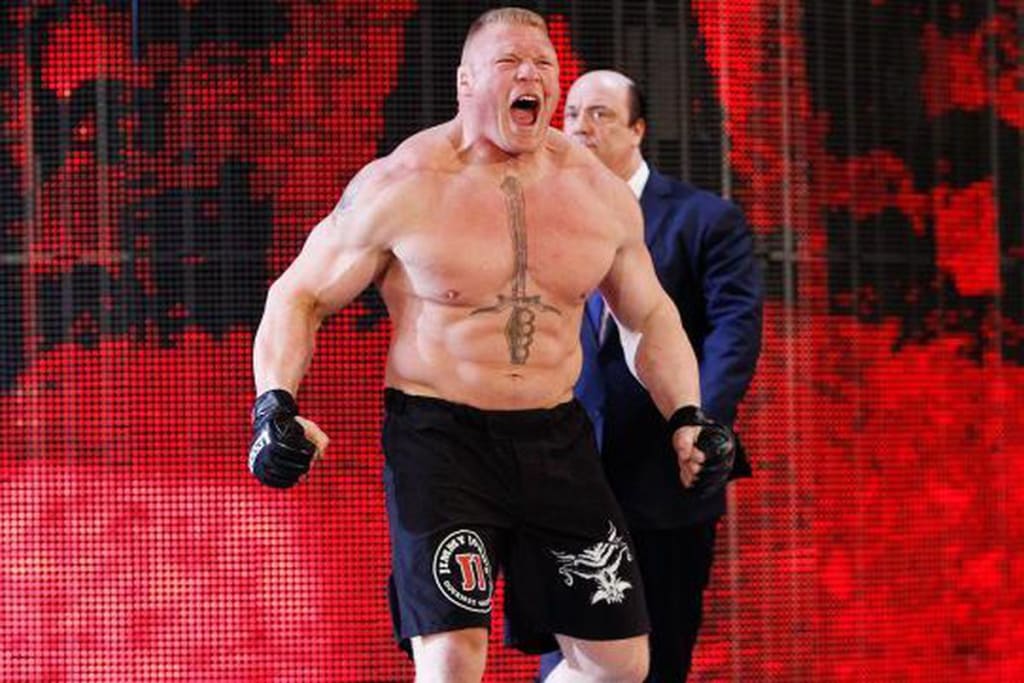
Brock Lesnar’s return at SummerSlam 2025 is one of the most shocking and controversial moments WWE has delivered in years—not just because of his surprise appearance, but because of everything surrounding his name since the Vince McMahon scandal broke wide open in early 2024. Once seen as WWE’s most dangerous attraction, Lesnar is now a lightning rod for criticism, not only for what he represents in terms of WWE's creative philosophy but also because of his alleged association with one of the darkest chapters in the company's modern history. His reemergence at SummerSlam wasn’t just a wrestling angle—it was a cultural flashpoint.
Let’s get the obvious out of the way first: Brock Lesnar is, undeniably, a megastar. He’s a once-in-a-generation athlete who commands attention the moment his music hits. Whether you love his smash-mouth style or find his sporadic appearances frustrating, there’s no denying his influence. His return during the main event of SummerSlam 2025, where Cody Rhodes and Gunther were tearing the house down, was meant to create a “moment.” And it did. But the reaction was far from universally positive. Sure, some fans popped. But the wave of boos and confused silence spoke volumes, too. This wasn’t the same as previous Lesnar returns. The landscape has changed—and Lesnar’s legacy is no longer as clean as it once was.
Much of that shift stems from Lesnar’s name being brought up in connection with the Vince McMahon scandal that rocked WWE’s foundations. As reported in multiple outlets during 2024, Lesnar was allegedly involved—at least peripherally—in the culture of silence and complicity that allowed McMahon’s misconduct to continue unchecked for decades. While he was never formally accused of wrongdoing himself, the public reports indicated that Lesnar was named in at least one instance as someone McMahon allegedly used to “enforce” certain backstage power dynamics. That alone cast a shadow over Lesnar’s reputation.
Following the revelations, Lesnar quietly disappeared from WWE programming. Internally, it was rumored that his planned WrestleMania 40 match had been scrapped due to the growing controversy and pressure from both fans and corporate partners. The company, trying to distance itself from the scandal, reportedly made the decision to put Lesnar on the shelf until the storm had passed. But has it really passed?
Bringing Lesnar back now, with the McMahon situation still fresh in the minds of many fans, raises troubling questions about WWE's willingness to truly move on from its past. For all the positive steps taken under the new regime—Triple H’s improved booking, a stronger focus on long-term storytelling, and a renewed emphasis on in-ring talent—the return of Brock Lesnar, of all people, feels like a regression. It sends a message, intentional or not, that some stars are simply too big to face consequences, even tangential ones.
That’s not to say Lesnar is guilty by association, but WWE knows how sensitive this subject is. They know fans haven’t forgotten. So when Lesnar walks into SummerSlam and derails a main event built on the backs of full-time workhorses like Cody and Gunther, it doesn’t just feel like a typical surprise return—it feels tone-deaf. It feels like a company unable, or unwilling, to let go of its problematic past.
From a purely wrestling perspective, the arguments about Lesnar’s impact remain the same. He’s a spectacle. He brings legitimacy. His fights feel real. There is no denying that. His match quality, when motivated, is often incredible. But this is 2025, not 2015. WWE no longer needs to rely on him the way it once did. They have stars now—Cody, Gunther, LA Knight, Bron Breakker, Carmelo Hayes, and others—who can headline without Brock’s shadow looming over them. So the creative justification for his return is already on shaky ground. Add the McMahon cloud hanging over him, and it feels downright misguided.
That said, there is a path forward—if WWE has the courage to take it. Lesnar’s return can still be valuable, but it must be handled with awareness and narrative purpose. Use the controversy. Acknowledge the reality. If Lesnar is back, then don’t pretend the last 18 months didn’t happen. Don’t pretend like the audience has forgotten what his name has been attached to. WWE could choose to lean in, make it part of the story, and give Lesnar an arc that reflects real-world consequences—a redemption story, or even a reckoning. There’s drama there. There’s substance. But pretending it never happened? That’s where WWE risks insulting its audience.
And maybe this return isn’t about legacy or storytelling at all. Maybe it’s about business. With ongoing global expansion, new TV deals, and rumored talks of licensing Brock to projects outside WWE, the timing may have been strategic. Lesnar is still a name that draws clicks, headlines, and attention beyond the ring. But wrestling fans, particularly the ones who’ve stuck with WWE through its turbulent years, deserve more than a cynical ratings boost.
SummerSlam 2025 could’ve been a showcase of the company’s new direction—young stars, compelling stories, clean progression. And for most of the night, it was. But when Lesnar’s music hit, it became something else: a reminder that, no matter how much WWE claims to have changed, the past still lingers, and sometimes, it returns wearing MMA gloves and a grim smile.
Brock Lesnar will always be a key figure in WWE history. His accolades, his aura, and his influence are all cemented. But history is not static—it evolves, and so do public perceptions. His connection to the McMahon fallout, however tangential, has reshaped how many fans see him. WWE now faces a choice: use his return as a meaningful part of a broader narrative, or treat it as business as usual and hope the fans forget. The latter path may bring short-term gain, but the former could bring lasting change.
In the end, Lesnar’s SummerSlam comeback wasn’t just a return—it was a test. A test of WWE’s self-awareness. A test of how serious the company is about accountability. And perhaps most importantly, a test of whether professional wrestling can truly evolve beyond the shadows of its past, or whether it’s doomed to keep repeating it.
About the Creator
Jake Mitchell
Follow Jake on Twitter: @TheJakeMitchell
Keep reading
More stories from Jake Mitchell and writers in Geeks and other communities.
The Politics of Playing Dress-Up
Well, to start off I'd like to say a happy world book day to all who celebrate. I know I haven't really posted anything on my socials about it but I'm not a jubilant kind of person. I lay low most of the time. Let's start off with a popular anecdote from the vaults...
By Annie Kapur4 days ago in Geeks


Comments
There are no comments for this story
Be the first to respond and start the conversation.