
"Brideshead Revisited" by Evelyn Waugh
A Reading Experience (Pt.3)

“Brideshead Revisited” by Evelyn Waugh is one of those books you read and you just don’t forget. You don’t just put it away after one read, you don’t just leave it out of your life. After you’ve read it, like a spell it will keep pulling you back into its charm. I read it for the first time when I was fifteen. I remember it very well because it just so happens I wrote that day down in my diary. Apparently, I was in a moving car and it was the bleak midwinter. My mother was driving and kept telling me to put the book down because apparently it would give me a headache (which to this day I do not understand, I have never had a headache from reading in a moving car, train, bus etc.).
I discovered the book after reading an article written by another author on how “Brideshead Revisited” was one of the most important books of the 20th Century. All I was thinking back then was ‘how could I miss out on something so important?’ And then I pursued it in a book store, finding it and reading it in the space of a few hours in a car. When I got home, I didn’t get dressed straight away because I was too busy reading the final volume of the book. After I finished it, I was greeted by my mother screaming me down the stairs and shouting at me because I wasn’t in my pyjamas. It was unlikely that I was thinking about anything else except for that amazing book at that particular time when she was shouting at me, but “Brideshead Revisited” had managed to teach me that families weren’t supposed to be perfect. If they seemed perfect on the outside, I guess that was all that mattered. Just don’t let anyone get too close, or they may slip and fall into it all, just like Charles Ryder did.
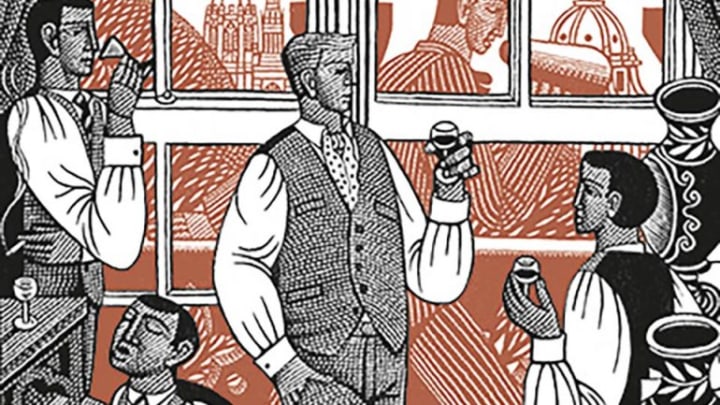
My favourite character in “Brideshead Revisited” was Lord Sebastian Flyte. Sebastian is a curious and flamboyant character with a strange disposition for carrying around a teddy bear named Aloysius. It really doesn’t matter that he’s about twenty years’ old apparently to anyone except Charles Ryder, who thinks it is completely strange. Not only that but, Charles Ryder is initially warned against making friends with the charming Dorian Gray-esque Sebastian. But he does so anyway, coming under his charm and finding it hard to resist his urges for adventure. As he gets more and more involved with Sebastian and the Marchmain family, he begins to realise that it isn’t all that it seems to be and there are some deep familial problems that are cracking at the edges he is desperately trying to brush paint over. Sebastian has a crippling drinking problem, Julia is an existential romantic mess, the mother is neurotic and the father is - gone. The father has disappeared and didn’t return. Sebastian’s lack of a male figure in his life has led him to go astray with wild behaviour and a sheer lack of self-assurance or confidence. Most of his character is a facade and I think that is the best thing about him and also his greatest fault. Sebastian represents the dying aristocracy of the 1930s before the second war and during the depression. Sebastian doesn’t feel the depression since he is rich, but he definitely feels the effects of his way of life slowly dying under the hands of socialism. Sebastian knows his way of life is coming to an end and so he tries to retain his childhood in which he was assured nothing bad would ever happen to him. Hence why he carries around Aloysius. You could say that Aloysius is the resistance against socialism for Sebastian. It is his greatest fear.
A big theme I noticed in the book was art. Obviously because Charles Ryder is set to paint Marchmain house, we have the theme of art already established when we hit the second volume. But what about the first? The first volume is called “Et in Arcadia Ego” - it is the name of a mysterious painting in which some figures are looking on at what seems to be some sort of tomb. I have several theories about why the volume is named this way. The first reason I can give you is because these figures in the painting represent the general public and the tomb represents the aristocratic Sebastian which not only has people constantly looking at him, but is also well aware his way of life is coming to a brutal end. Hence why we have the tomb instead of another human being. Another way we could look at it is that the surrounding figures are the general public and the tomb is Sebastian Flyte at the end of the novel. This, in itself, would be a foreshadowing of what happens to him. He lets his drinking get the better of him and his way of life really does come to an end with the outbreak of the next war. But one thing I am sure about is that the tomb in the painting has definitely got something to do with Sebastian Flyte in the book. Why? Well because the volume is named that way and most of the volume is about how Charles Ryder and others observe and comment on the extravagant and self-destructive behaviours of Lord Sebastian Flyte.
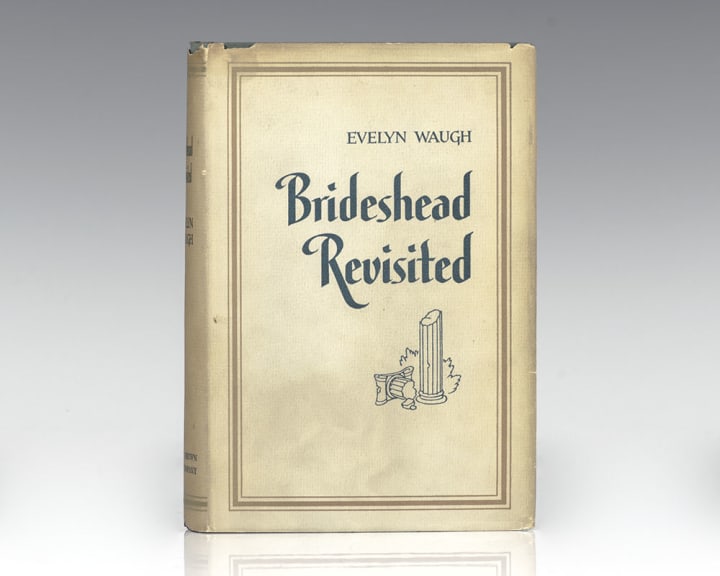
This book means so much to me because ever since I first read it, I have been in love with it. I have read it over and over again over the years and, as it is fairly short, I have managed to keep it within my schedule. It is a brilliant book about the dying facade of the aristocracy and the harsh realities that they faced with a constantly changing England. It is quite possibly one of the greatest books to ever be written in English. It impacted my latter reading experiences because after this, I wanted to read everything ever written by Evelyn Waugh. That I did until I was eighteen. Only recently had I found I had missed one out. This year I read a book called “Helena” by Evelyn Waugh, the final one on my list and the one that six years’ ago, I never got around to reading. It was a beautiful experience. Through my re-readings of “Brideshead Revisited” as well, I have also been able to appreciate more of the beauty of it because of the fact I have read more Waugh. When you start to compare the language of “Brideshead Revisited” with “Vile Bodies” then you’re definitely a Waugh fan. The best thing about “Brideshead Revisited” is actually just that fact. No matter how many times you read it, there is always something else to discover.
I think more people should read this book because it is one of the greatest experience of shattered dreams and humanity you will ever have. It’s a dark family saga of people stuck in an age where their kind is dying out. They are endangered and scared of extinction and so they constantly throw themselves back into their past - which is an even darker and scarier place than this. People actually do read this book widely as well. I have recommended it to many people who have said that they enjoyed it. The reason that people still love this book is because it is about that cusp that people don’t normally talk about unless they’re talking about something like the murder of the Romanov family - the death of the richer classes. People are interested to see how these people died out and left for the shadows because the vast majority of the planet are not the richer class of people. We are interested in those who are different from us. In my next re-read, I would like to concentrate more on the character of the father, Lord Marchmain, and how he and Sebastian Flyte have both similarities and differences. If you compare Julia with her mother, I think you’ll be pleasantly surprised to learn a few things yourself.
“He wasn't a complete human being at all. He was a tiny bit of one, unnaturally developed; something in a bottle, an organ kept alive in a laboratory. I thought he was a sort of primitive savage, but he was something absolutely modern and up-to-date that only this ghastly age could produce. A tiny bit of a man pretending he was the whole.”
"Brideshead Revisited" by Evelyn Waugh
About the Creator
Annie Kapur
I am:
🙋🏽♀️ Annie
📚 Avid Reader
📝 Reviewer and Commentator
🎓 Post-Grad Millennial (M.A)
***
I have:
📖 280K+ reads on Vocal
🫶🏼 Love for reading & research
🦋/X @AnnieWithBooks
***
🏡 UK
Keep reading
More stories from Annie Kapur and writers in Geeks and other communities.
A Filmmaker's Review: "The Devil Next Door" (2019, Netflix)
There were some aspects of this documentary that were better done than others. First and foremost we have the portrayal of information. Let us first go through what that information is. The information is simply this: a man who is now living in America after coming from Europe years before was once the ‘Ivan the Terrible’ at the Soribor Death Camp in Poland during the Second World War. This man ‘Ivan the Terrible’ was the one who took the most joy in sending the Jews to their deaths and was considered one of the scariest and harshest guards on site at the time. The suspect is taken to Jerusalem to face trial and is initially sentenced to death by hanging. But, when other pieces of information emerge, he is claimed to be not guilty and sent back to the USA. It is after a further point that he is considered to be a guard at the Treblinka Death Camp but not the ‘Ivan the Terrible’ they are looking for and he is arrested in America and put in prison with due course. During this time, he fakes disability and being too sick to face trial, a farce used by the Nazis during the Nuremberg trials in the 40s. However, he is still sentenced and we are left to make up our own minds about who he is after being given every piece of information about his past, his present and finally - his end.
By Annie Kapur6 years ago in Geeks
The Rachels - 2025
Much to my surprise, I have kept a list of the films I‘ve seen this year. I daresay it isn’t complete. There will be films that snuck in on a late night in front of the TV that I would’ve forgotten to note. Or others, that I went to watch at the cinema, but then had a red wine and promptly forgotten about. But it’s not a bad approximation of the films I’ve seen this year. In total, there are 53 films listed, so an average of one a week and one for good luck.
By Rachel Robbins25 days ago in Geeks
Grant Gustin's Chances Of Returning As The DC Universe's Flash Have Just Increased After New Update
The Flash has yet to be cast for the new DC Universe, and after a new update, the rumors of Grant Gustin's return as Barry Allen in the new franchise have gained strength once again. Gustin made history by playing Barry for The Flash's nine seasons. The actor also starred in multiple Arrowverse crossovers, becoming one of the franchise's fan-favorites.
By Dena Falken Esq6 days ago in Geeks


Comments
There are no comments for this story
Be the first to respond and start the conversation.