
Book Review: "The Marshmallow Test" by Walter Mischel
3/5 - the more you read it, the more you can poke hole in it...


In the introduction, it is clear that Mischel took his experiment very seriously. The entirety of the experiment boils down to one thing: delayed gratification. But is delayed gratification really an indicator of IQ, or status, class or whether someone will suffer certain health problems later in their life? Initially I thought the answer was no. I believed that there was correlation but no causation and yet, after reading this book my mind has been slightly changed. The Marshmallow Test is one of the most widely recognised psychological tests in the western world, but what is it and why is it so culturally important? Let's take a look...
During the first part of the book, the author gives us the overview of what is being tested for in the Marshmallow Test. We get mentions of people like Descartes in order to show that this isn't just in the realm of psychology, but seems to be an underpinning of human nature understood from long ago: what can be achieved through delayed gratification? From SAT scores in the years after the test through to midlife brain scans, we see exactly how the children who delayed their treat did in comparison to those who did not. The author writes this quite clearly, almost mechanically so and thus, we definitely feel like we aren't being lied to or manipulated through research.
He then goes through some ideas to do with Freud, especially those concerning how the psychoanalyst believed that small children had low impulse control. We are also introduced to an idea from the introduction - hot versus cool focus, which is basically like thinking fast and slow it is where we have a difference between hot thinking (impulsive) and cool thinking (longer, more reasoned focus). This definitely reminded me of ideas explored in the book Thinking, Fast and Slow but I think the latter perhaps went into more depth and there were few, if any, examples of circular logic.
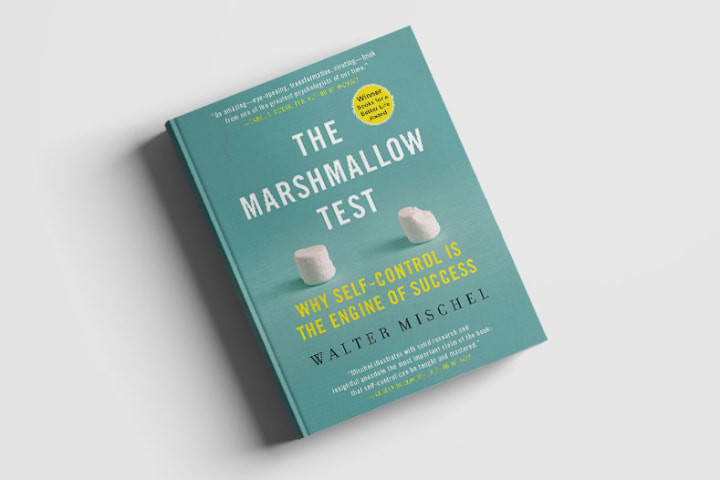
One thing I have constantly found a bit wonky about the Marshmallow Test is that it doesn't take context into account. We have a split between children who 'delay gratification' and those who do not. But do we actually have a split between those who listen to adults more often and those who do not? What are the socio-cultural factors involved here? Are the children who took the marshmallow before the 15 minutes were up have less access to their parents on a daily basis, or perhaps their parents have not raised them to respect and listen to all adults. Are the children who can wait the entire 15 minutes better off in any way? Are there cultural factors which mean they have more than the other children and therefore, don't particularly require a marshmallow? Or even two? This is not really visited in much depth.
Anyways, the author emphasises that self control and delayed gratification are skills and not traits. Through some careful (and often shoddy, in my opinion) analysis, he walks us through how self control can actually be taught and tries to save his experiment by stating that it was really about how children dealt with temptation. Though it is very clear that many did not deal with it at all. Follow-up studies showed correlations between early delay of gratification and later outcomes such as academic achievement, health, and social functioning. Yes, the author states that they are probabilistic and not deterministic but I'm sorry - it sounds rather far fetched in of itself. Waiting longer as a child does not guarantee success, nor does eating the marshmallow doom anyone to failure. The best the test can do is perhaps enlighten us on the way children from differing backgrounds deal with temptation - not, as the author says, observe how delayed gratification skills in youth can shape expectations and experiences later on in life.
The author also states that delay of gratification depends heavily on trust. If a child doubts that the promised second marshmallow will actually appear, waiting becomes irrational. Later research confirmed that children’s willingness to delay is strongly influenced by whether adults have previously kept their promises. This I can agree with, and this would also determine the level of respect they hold for the adult in the room and thus, they will eat the marshmallow. But this has nothing to do with patience and delayed gratification. But again, the author knows that - he just chooses to only mention it in passing.
As you can see, the further into the argument I get, the more I start to pick it apart. I'm sorry, it just seems more and more far-fetched to me the more he tries to hypothesise about what his test may be able to predict. The Marshmallow Test is more of a pop-culture experiment and though it is an interesting one, I doubt it tells us anything realistic about the way in which delayed gratification can significantly impact someone's quality of life. It can, it's just that this test doesn't quite show us that. There are too many holes in it.
About the Creator
Annie Kapur
I am:
🙋🏽♀️ Annie
📚 Avid Reader
📝 Reviewer and Commentator
🎓 Post-Grad Millennial (M.A)
***
I have:
📖 280K+ reads on Vocal
🫶🏼 Love for reading & research
🦋/X @AnnieWithBooks
***
🏡 UK
Keep reading
More stories from Annie Kapur and writers in Geeks and other communities.
Book Review: "Itch!" by Gemma Amor
Cheap horror novels are definitely my thing and I've been off the scene for about a month or so, and so as you can imagine - lots of it has been released without my knowledge. I'm often glad for Kindle Unlimited because there are so many great horror novels to discover that I end up borrowing maybe ten to fifteen at any one time and just devouring them. This was definitely the case here. Itch! is a book about our protagonist Josie who, when she is young, has only memories of her dead mother, is seen as an inconvenience to her father and, can constantly feel the itch and pull of ants. She can see them, almost always. When Josie discovers a dead body in the Forest of Dean, things begin to shift and change.
By Annie Kapur3 days ago in Geeks
Theatre at the Bell Howls "Lila the Werewolf" Onto the Stage
I don’t know how to say this - she’s a werewolf, and I’m a human. Theatre at the Bell is bringing “Lila the Werewolf,” a short story written by Peter S. Beagle, to the stage this February. Farrell is about to break up with his girlfriend, Lila, only to discover that she is a werewolf. He has to decide whether to leave her or continue a relationship that has lost its moon.
By Marielle Sabbag2 days ago in Geeks




Comments (1)
Thanks for this, another for my ever-growing list