
Book Review: "Sleep" by Nick Littlehales
2.5/5 - halfway there, but not quite...

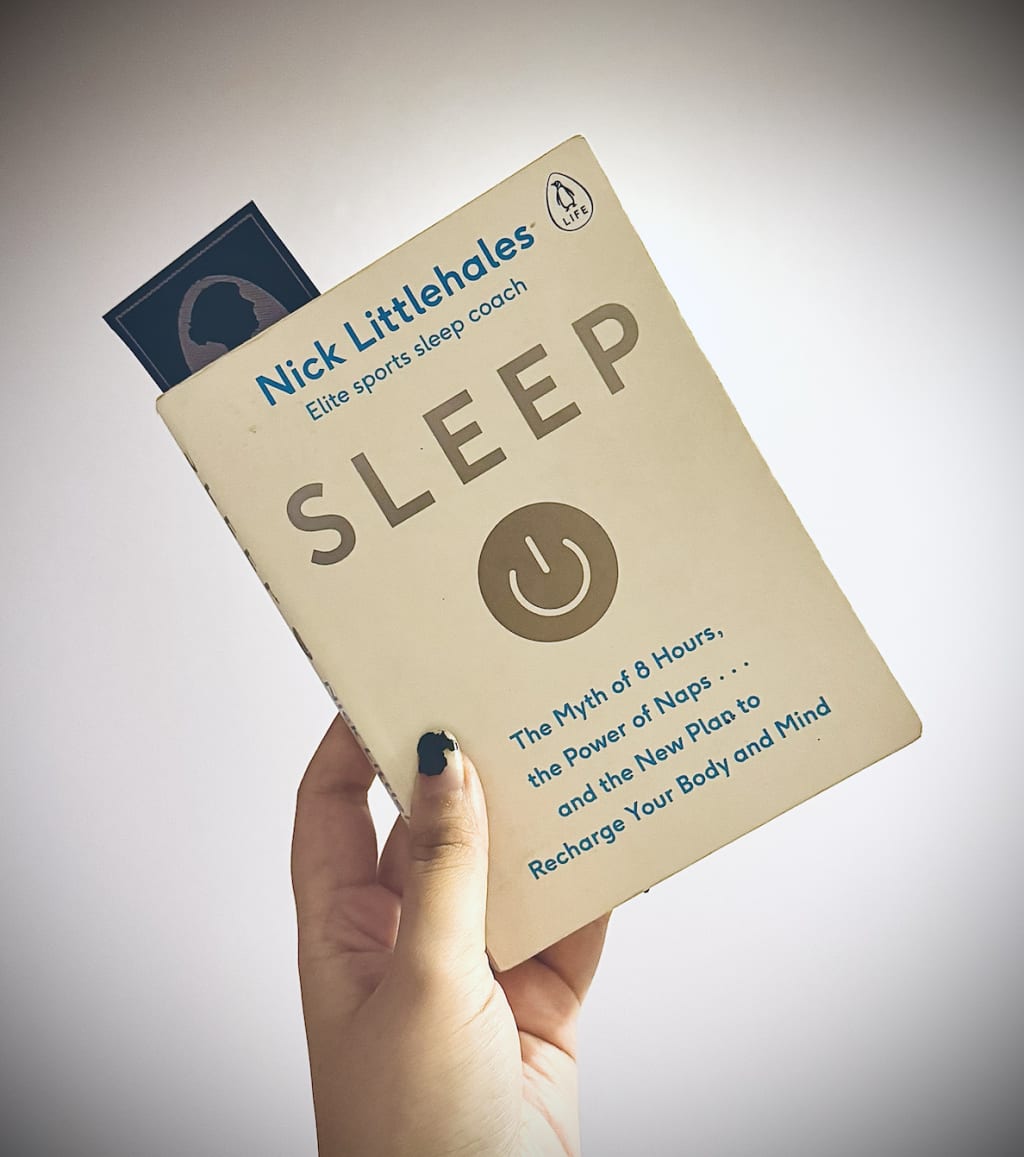
Okay, so I might have already read a great book about sleep entitled Why We Sleep by Matthew Walker, which tends to be the go-to for many people. I've also read Alex Edmans May Contain Lies which dismantles some strange statistics in the Walker book. But I think that Nick Littlehales may take the cake for the most comprehensive book about sleep I have seen in a while. A tiny book with very little scientific research compared to the Walker book means that we are meant to rely on the fact that this man is a sleep coach in order to receive the 'message'. That message: there are many myths about sleep - some aren't all that helpful.
It really is quality over quantity, but Littlehales makes the argument that sleep cycles are of a certain length and people should work backwards from their waking time to calculate how they are fitting their sleep cycles in. This basically means that the eight hours of sleep theory is most likely false according to the book as some people may feel better and more optimal after six hours of sleep. Now, from all I have read about sleep quality and quantity, it is definitely the case that quality is more important. However, I definitely think that the eight-hour thing is important or why would every sleep expert and doctor ever be pushing us towards it? I don't know, I just don't feel like being a contrarian here helps anyone. Be that as it may, I do like the way he emphasises the fact that we must rest naturally rather than simply trying to force it.
We all understand by now that sleep is a recovery process for the body from going through the day. Littlehales argues it is not a passivity but rather a conscious action we must do in order to stay well. Captain Obvious may be striking here, but at least it moves us through the point logically. He is basically making the argument that waking up is natural and that people who wake up during the night should not simply assume something is wrong. I don't know about this because there are so many health conditions that start out with someone waking up in the middle of the night or waking up several times during the night. This really isn't helpful advice though I can understand where he's coming from. I would still advise someone to seek physical and mental health help if they find that they wake up more than once during the night.
The author also argues that fighting against your biological preferences leads to chronic exhaustion and frustration. Again, good in theory but not workable in real life. In real life, we all have to fight against our biological preferences in some way. This is a point that is made in Why We Sleep as well - that some people are naturally early birds and others, night owls. Unfortunately, we don't live in a society where folks actually care about the workers of a company and so, 9am to 5pm is typical (though many, many people work far, far more hours). This means both the early birds and the night owls end up never actually optimising their behaviours and nobody gets anywhere. Everyone is exhausted, always. Those who have the wealth get to (not) work when they feel like it - the rest of us are left to the dogs.
Of course, we get the argument about having naps, again something that simply is not possible in the working person's day. Imagine asking your boss if you can have a nap, whilst at work, on paid time - yeah, don't do that. I understand that it helps compensate sleep debt and improves certain aspects of performance, but it is not a viable and workable model for the average person's life and thus, it continues to be a non-point. Then there's the argument about the sleep rituals and I can admit, these have some scientific backing behind them to actually improve sleep. I mean, it's probably not a good idea to sit there on your laptop or iPhone doomscrolling at night time. We are all aware of that, the question is: why do some people know this and yet find it so difficult to stop doing it? I feel I will never know the answer.
Sleep is one of those books which has a similar problem to other books about sleeping. It is riddled with things that aren't actually workable, it feels like it's making points that thousands of people already know and, atop of this, it doesn't take the average person's lifestyle into account. However, it also makes good on its promise to deliver a small book on little ways to improve your sleep - so at least that's something.
About the Creator
Annie Kapur
I am:
🙋🏽♀️ Annie
📚 Avid Reader
📝 Reviewer and Commentator
🎓 Post-Grad Millennial (M.A)
***
I have:
📖 280K+ reads on Vocal
🫶🏼 Love for reading & research
🦋/X @AnnieWithBooks
***
🏡 UK
Keep reading
More stories from Annie Kapur and writers in Geeks and other communities.
Why It's a Masterpiece at 100 Weeks
I personally can't believe we've been doing 'Why It's a Masterpiece' for almost two years now. At 100 weeks, I have decided to expand and rework 'Why It's a Masterpiece' to include some more pieces of literature and other parts that I think could be quite interesting. This also means that this series of articles is about to get a bit longer than usual.
By Annie Kapurabout 21 hours ago in Geeks
The Rachels - 2025
Much to my surprise, I have kept a list of the films I‘ve seen this year. I daresay it isn’t complete. There will be films that snuck in on a late night in front of the TV that I would’ve forgotten to note. Or others, that I went to watch at the cinema, but then had a red wine and promptly forgotten about. But it’s not a bad approximation of the films I’ve seen this year. In total, there are 53 films listed, so an average of one a week and one for good luck.
By Rachel Robbins29 days ago in Geeks
Game of Thrones: Knight of the Seven Kingdoms Review Episode 1 (The Hedge Knight)
Westeros is officially back in tournament mode. Episode 1 of A Knight of the Seven Kingdoms finally dropped, and yes, it’s absolutely packed with Easter eggs tying back to both the original Game of Thrones series and House of the Dragon. Because this story is wedged right between the major Targaryen eras, everything connects in some really clever ways, and we’re breaking all of it down step by step.
By Bella Anderson5 days ago in Geeks
📢 Raise Your Voice Thread: 01/22/2026
Our “Raise Your Voice Threads” are hosted most alternating Thursdays at 12PM ET to offer creators more avenues to uncover exceptional stories on Vocal. As we are continuously searching for fresh creators and inspiring stories, this thread provides an opportunity to exchange and discuss the stories that have moved and motivated us on Vocal.
By Raise Your Voice by Vocal3 days ago in Resources




Comments
There are no comments for this story
Be the first to respond and start the conversation.