
Book Review: "Memoirs" by Lorenzo Da Ponte
4/5 - a memoir representing an age of history...

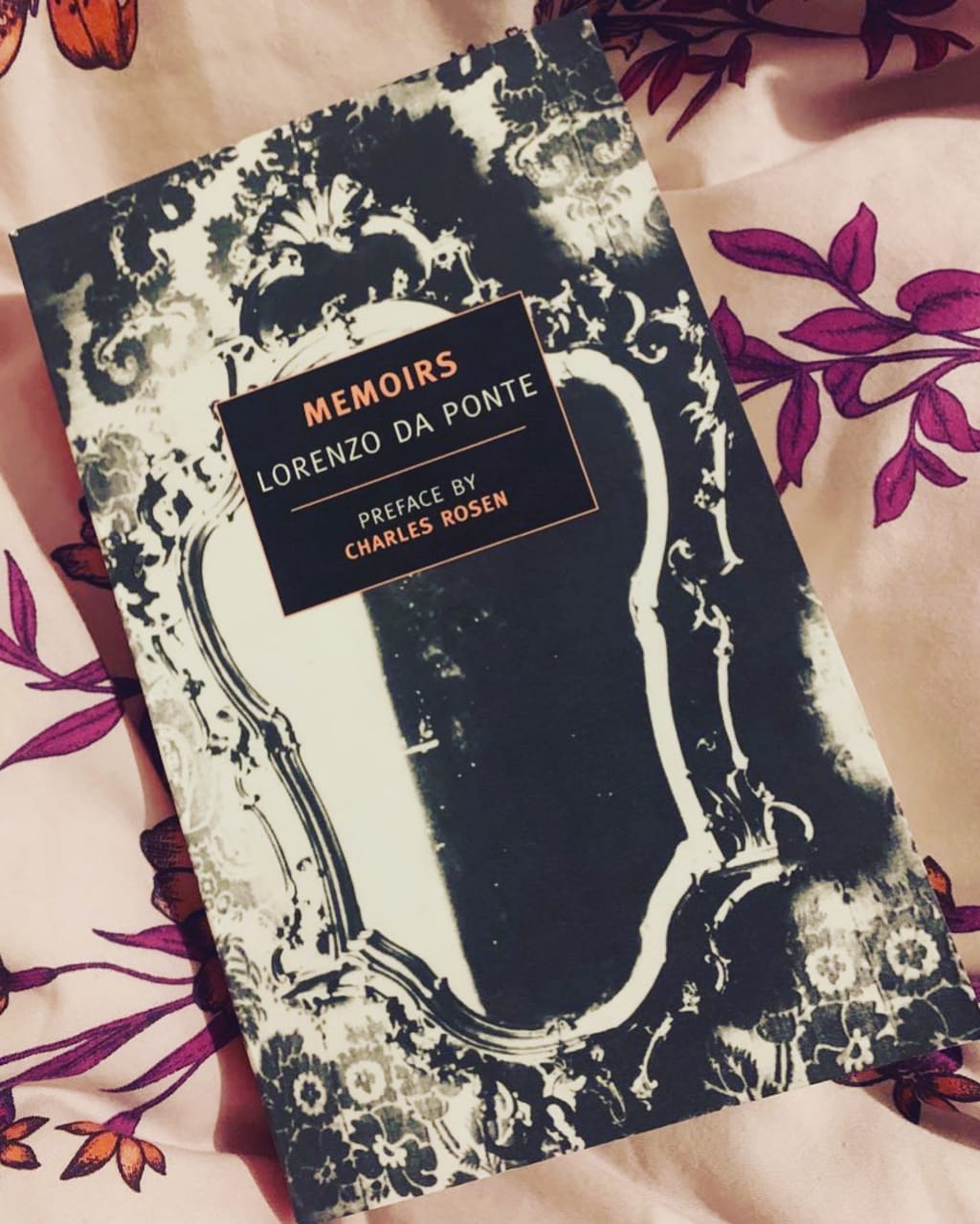
Memoirs are an interesting thing. Autobiographies of certain great events in a person's life can really give you an insight into where and how certain ideas developed and, if written well, they can also provide a great story to read for entertainment. In my life I have come across memoirs both great and terrible. I have come across some that I cannot quite put a review on and so, I stayed on the fence and I have come across some that I thought were less a memoir for a person, more an advert of their life to massage their own ego.
Possibly the best autobiography/memoir I have ever read in my life is My Autobiography by Charlie Chaplin. An incredible insight into the world of the entertainer and his humble beginnings. The way he speaks about his mother and his upbringing, the man seriously had a way with words for all the silent he was. Nothing really has ever topped the experience of that autobiography and though Memoirs by Lorenzo Da Ponte is probably in my top twenty, it still doesn't come close to the autobiography of Charlie Chaplin.
If you were like me and grew up meticulously studying the piano, you would know who Lorenzo Da Ponte was. Lorenzo Da Ponte was an opera librettist and in his time, he worked with a great number of human beings including the famed Mozart. He translated Beaumarchais and prepared the work The Marriage of Figaro for Mozart to create an opera from for the stage. His memoirs were very telling of his networking with other people, but most importantly they were also a journey of identity and culture in a time where music, art and love were exploding into life and existence.
One thing I liked about Lorenzo Da Ponte's memoirs is that it doesn't just concentrate on him in the opera. It isn't an advert for himself instead, it takes the reader on a journey of him being a few different people. From being a priest to involved with Giacomo Casanova, he was a gambler and a poet. He had strong political ties, noting that he could not stay in a certain city because of its politics, its philosophies and its strains. When he went travelling it was always as a different person. Above all this though, he was avidly popular amongst people, especially women. When he is coming to the end of his time in one city, he states this:
The effect of this blow on my enemies need not be described. I lingered three weeks in that city. More than a hundred Italians came to visit me, but I received few of them. On the faces of these I could clearly see consternation, envy, displeasure, and, above all, a devouring curiosity to know just how such a metamorphosis had occurred. I amused myself hugely at their expense, telling one thing to one, and another to another, and to no one the truth.
He later leaves for Paris and notices the change in political and philosophical atmosphere, the change of the mannerisms and the culture and yet, his base remains the same - to connect, to influence and to create.
In conclusion, Lorenzo Da Ponte is a man who is constantly recreating himself in society in order to not find his place, but for the place to find him. He wants to stand out and yet, he also wants to be a working part of something bigger than himself (such as Mozart's three operas). He wants a large social circle, but he also appreciates this vast amount of alone time he takes out to write these memoirs. He is a complex human being to say the least.
About the Creator
Annie Kapur
I am:
🙋🏽♀️ Annie
📚 Avid Reader
📝 Reviewer and Commentator
🎓 Post-Grad Millennial (M.A)
***
I have:
📖 280K+ reads on Vocal
🫶🏼 Love for reading & research
🦋/X @AnnieWithBooks
***
🏡 UK
Keep reading
More stories from Annie Kapur and writers in Geeks and other communities.
Book Review: "Hitch-22: A Memoir" by Christopher Hitchens
When I read a memoir, there are certain things I am looking for in order to not only be entertained, but to gain more insight into the person's life than I had before. I am really looking for someone to tell me a good story about how they came to be the way they were. Books such as Just Kids by Patti Smith, Mommie Dearest by Christina Crawford, and even the farce that was Greenlights by Matthew McConaughey allow the reader to become immersed in the life of the person they are reading about and gain this feeling of really getting to know the person that wrote said memoir. Then problems arise when they are written badly, when they are written badly the first problem is normally that the reader gets angry with the author and this disallows the reader to become more immersed in the life of the figure writing.
By Annie Kapur4 years ago in Geeks
The Rachels - 2025
Much to my surprise, I have kept a list of the films I‘ve seen this year. I daresay it isn’t complete. There will be films that snuck in on a late night in front of the TV that I would’ve forgotten to note. Or others, that I went to watch at the cinema, but then had a red wine and promptly forgotten about. But it’s not a bad approximation of the films I’ve seen this year. In total, there are 53 films listed, so an average of one a week and one for good luck.
By Rachel Robbins25 days ago in Geeks
Can you watch Super Bowl in Australia?
Super Bowl, one of the most exciting sporting nights of the year, is now less than a month away and the excitement is already palpable. Scheduled on February 8, 2026 at Levi’s Stadium in Santa Clara, California, this will be the third Super Bowl held in the San Francisco Bay Area.
By David Cookabout 20 hours ago in Geeks



Comments
There are no comments for this story
Be the first to respond and start the conversation.