
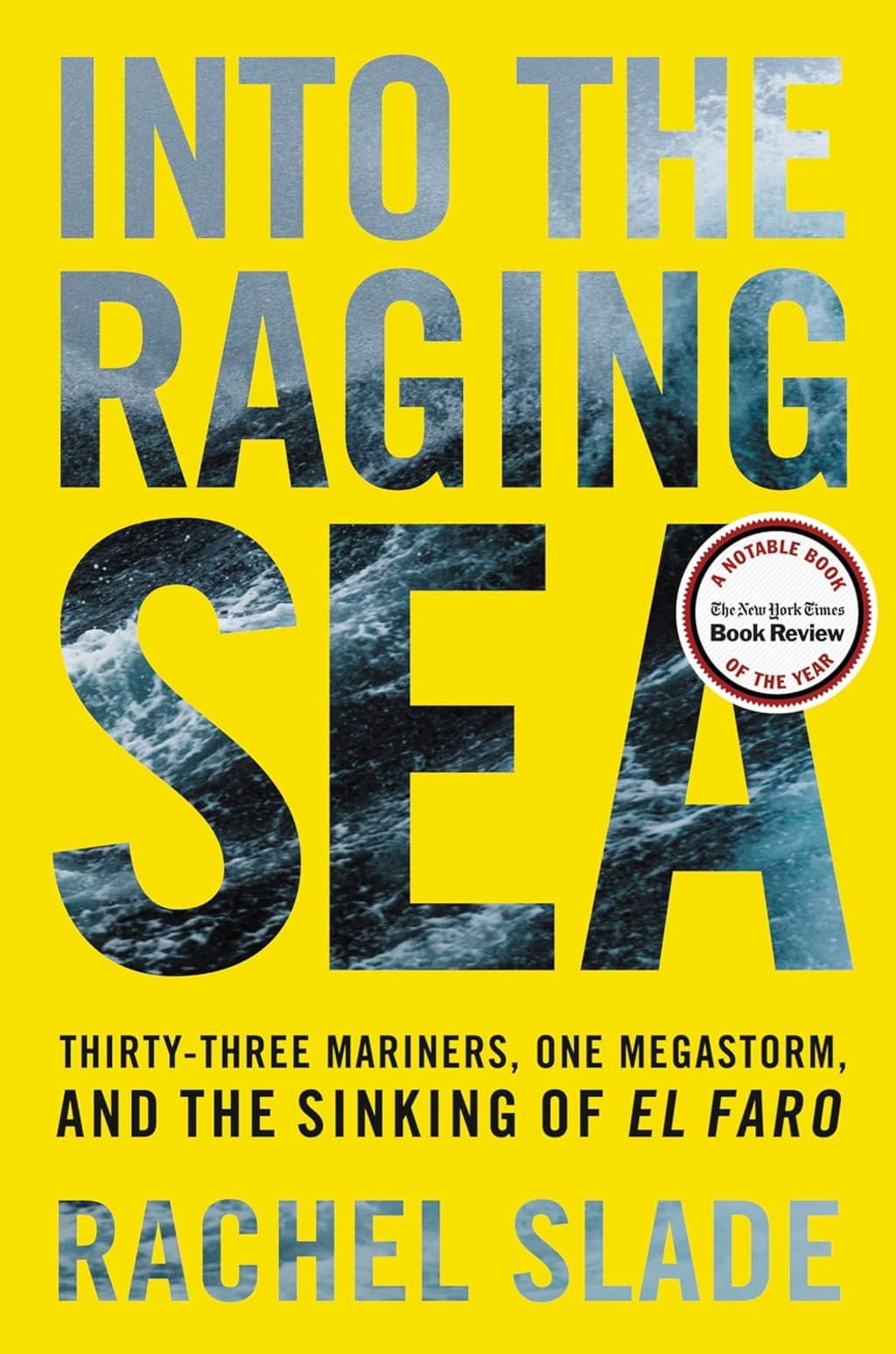
Book Review: "Into the Raging Sea" by Rachel Slade
5/5 - terrifying and disastrous, this book humanises the catastrophe of the El Faro...

*This review was written on the 18th December, 2024
As you can tell, I am having a little break from work and my focus is to get back to some of the things I enjoy doing that may not just be reading (though I have definitely been doing more of that as well). I've been watching movies (as you can tell from the 'movie reviews' that are coming out on my page lately), going out for food, buying some new stuff for my apartment and obviously, drinking coffee with mint chocolate in it (it's my winter treat that I usually buy around Christmas). This book entitled Into the Raging Sea has been on my TBR for a while so, I thought: why not give it a go now?
Slade opens with the catastrophic loss of the El Faro, a massive American cargo ship that sank on 1 October 2015 in the Atlantic during Hurricane Joaquin, claiming all 33 crew members’ lives. The narrative begins with the ship’s departure from Jacksonville, Florida, on 29 September 2015, carrying cargo bound for Puerto Rico. Slade introduces the ship itself, describing its ageing structure and the vital but vulnerable trade route it navigated through the hurricane-prone Caribbean. It is presented to the reader as an avoidable disaster each step of the way, but if you an unfortunate enough to remember it happening - this ability to be avoided did not take away from the horrifying disaster that it was.
The El Faro was built in 1975 and designed for a 30-year lifespan, but corporate cost-cutting kept it operational well past its prime. Slade paints a stark picture of the maritime industry, marked by deregulation, reduced oversight, and the prioritisation of profit over safety. Tote Maritime, the ship’s owner, had chosen to delay costly repairs and upgrades, relying on outdated technology and flawed systems. The El Faro’s decrepit condition included a history of engine failures and a lack of modern weather-routing software, leaving it ill-prepared to face a major storm. Though we already know what's going to happen, there is still a certain amount of tension that is being built throughout the text.

Captain Michael Davidson, a seasoned mariner with decades of experience, takes centre stage as a complex figure. Slade portrays him as confident yet rigid, with a commanding presence that demanded respect but occasionally alienated his crew. His decision to maintain the ship’s scheduled route, even as Hurricane Joaquin intensified, becomes a pivotal focus of the book. Davidson underestimated the storm’s unpredictability and overestimated the El Faro’s ability to weather harsh conditions, leading to a series of decisions that placed the ship directly in harm’s way. I honestly believe this man simply made a horrid blunder and most of the disaster had more to do with the nature of the ship itself. I don't believe that a Captain would have an ego big enough to sail an old and broken ship on purpose through a storm. Davidson probably under-estimated both the storm and how old and broken the ship actually was before it hit the storm.
The book gives voice to the El Faro’s diverse crew, humanising the tragedy by sharing their backgrounds, motivations, and relationships. Among them were young sailors eager to establish careers, seasoned mariners supporting families, and individuals struggling with the physical and emotional toll of life at sea. Slade captures the friendships and underlying tensions on board, as well as the growing unease as the storm approached. The crew’s individual fears and collective efforts to confront the crisis emerge as an important element of the narrative. I loved this part of the book. I always love learning about the people who would perish in this disaster because it turns this into a reality for everyone. Everyone knows someone or other people like these and it makes us stop and think about it.

Through the description of the storm, the aftermath and everything in between, the author gives us a graphic physical description of the intensity felt on every level of the disaster. The massive changes in maritime travel that followed is something that makes us glad, but also upset that it costed the lives of thirty-three people to do so. All in all, this book is a fantastic, horrifying and important novel about how we need to stop putting profits above people's lives.
About the Creator
Annie Kapur
I am:
🙋🏽♀️ Annie
📚 Avid Reader
📝 Reviewer and Commentator
🎓 Post-Grad Millennial (M.A)
***
I have:
📖 280K+ reads on Vocal
🫶🏼 Love for reading & research
🦋/X @AnnieWithBooks
***
🏡 UK
Keep reading
More stories from Annie Kapur and writers in Geeks and other communities.
Book Review: "Dead Wake" by Erik Larson
Now, I've read quite a bit by Erik Larson including his books The Devil in the White City and In the Garden of the Beasts and I can tell you that though me and him have had our differences, his writing is a bit more interesting than that of David Grann who takes a similar, if not more droning approach. Dead Wake investigates the final crossing and eventual sinking of the Lusitania ship on the 7th May 1915. To be honest, I wasn't expecting so much from this book as it is one of the author's lesser known works and yet, it was so completely immersive. If you loved books like The Terror by Dan Simmons and The Night Ship by Jess Kidd, then you will love Dead Wake by Erik Larson.
By Annie Kapurabout a year ago in Geeks
The Rachels - 2025
Much to my surprise, I have kept a list of the films I‘ve seen this year. I daresay it isn’t complete. There will be films that snuck in on a late night in front of the TV that I would’ve forgotten to note. Or others, that I went to watch at the cinema, but then had a red wine and promptly forgotten about. But it’s not a bad approximation of the films I’ve seen this year. In total, there are 53 films listed, so an average of one a week and one for good luck.
By Rachel Robbins27 days ago in Geeks
Tamer Hassan
Tamer Hassan is a name that carries weight in British film, television, and even popular culture beyond the screen. Known for his tough-guy roles and unmistakable presence, Hassan has built a career that reflects resilience, reinvention, and a deep connection to family. In recent years, public curiosity around him has also grown because of his daughter, Belle Hassan, who rose to fame on Love Island. This combination of cinematic grit and reality TV visibility has introduced Tamer Hassan to a whole new generation of audiences. Early Life and Path to Acting Before becoming a familiar face in crime dramas and action films, Tamer Hassan lived a life far removed from movie sets. Born in London, he grew up in a working-class environment where discipline and survival were everyday lessons. In his early adulthood, Hassan was involved in professional boxing and worked as a bouncer, experiences that later influenced the authenticity he brought to his on-screen roles. Unlike many actors who follow a traditional drama school route, Hassan’s entry into acting was unconventional. His natural intensity, real-life toughness, and commanding voice caught the attention of casting directors looking for realism rather than polish. This background helped him stand out in an industry often saturated with similar profiles. Career Highlights and Acting Style Tamer Hassan is best known for portraying hardened characters—gangsters, enforcers, and morally complex figures who live on the edge. Films such as Layer Cake, The Business, Kick-Ass, and Batman Begins allowed him to showcase his ability to bring depth to characters that could otherwise feel one-dimensional. His performances often balance menace with vulnerability, making his roles memorable even when screen time is limited. On television, Hassan has appeared in popular British series including EastEnders, Silent Witness, and Game of Thrones. These roles further cemented his reputation as a reliable character actor who elevates every project he joins. Rather than chasing leading-man status, Hassan has built a steady career by embracing roles that feel authentic to his life experience. Life Beyond the Camera While his on-screen persona is often intimidating, those close to him describe a different side of Tamer Hassan. Family plays a central role in his life, and this became especially visible when his daughter entered the public eye. Many viewers who searched online for “belle hassan dad” or “who is belle’s dad Love Island” were surprised to discover the connection between the reality TV contestant and the seasoned actor. This curiosity wasn’t just gossip-driven. It reflected genuine interest in how two people from the same family could navigate fame in such different ways—one through gritty cinema and the other through modern reality television. Belle Hassan and Public Curiosity Belle Hassan appeared on Love Island in 2019 and quickly became known for her strong personality and emotional honesty. As her popularity grew, so did questions like “who is Belle from Love Island’s dad” and “who is Belle Hassan dad”. The answer consistently led back to Tamer Hassan. Unlike some celebrity parents who actively leverage their status, Hassan remained largely in the background during Belle’s time on the show. This approach earned respect from fans who appreciated that Belle’s journey felt independent rather than manufactured. Searches such as “Love Island Belle dad” or “belles dad Love Island” often revealed interviews where Hassan expressed pride in his daughter while emphasizing that her success was her own. A Father-Daughter Dynamic in the Public Eye The relationship between Tamer Hassan and his daughter added an interesting layer to public discussions. People asking “who is Belle’s dad from Love Island” often expected a flashy celebrity figure, but instead found a grounded actor who values privacy and hard work. Hassan has spoken openly about wanting to protect his children from the harsher sides of fame while still supporting their ambitions. This balance resonated with many parents watching from the sidelines, especially those navigating social media-driven celebrity culture. In that sense, Hassan’s role as a father became just as compelling as his roles on screen. Legacy and Cultural Impact Tamer Hassan’s career is a reminder that success in entertainment doesn’t follow a single path. His journey from boxing gyms and nightclubs to major film sets reflects determination and adaptability. At the same time, his association with Love Island through Belle Hassan has expanded his relevance beyond traditional film audiences. For some, he is the actor known for intense performances; for others, he is simply the answer to “who is Belle from Love Island dad.” Both identities coexist, and together they paint a fuller picture of a man who has lived multiple lives within one. Final Thoughts Tamer Hassan stands as a unique figure in British popular culture. His work ethic, authenticity, and commitment to family have shaped a career that continues to evolve. Whether recognized for his film roles or through questions about who is Belle Hassan dad, Hassan remains a compelling example of how personal history and professional life can intersect without losing integrity.
By Saboor Brohi 6 days ago in Geeks


Comments
There are no comments for this story
Be the first to respond and start the conversation.