
Book Review: "Calling Bullshit" by Carl T. Bergstrom and Jevin D. West
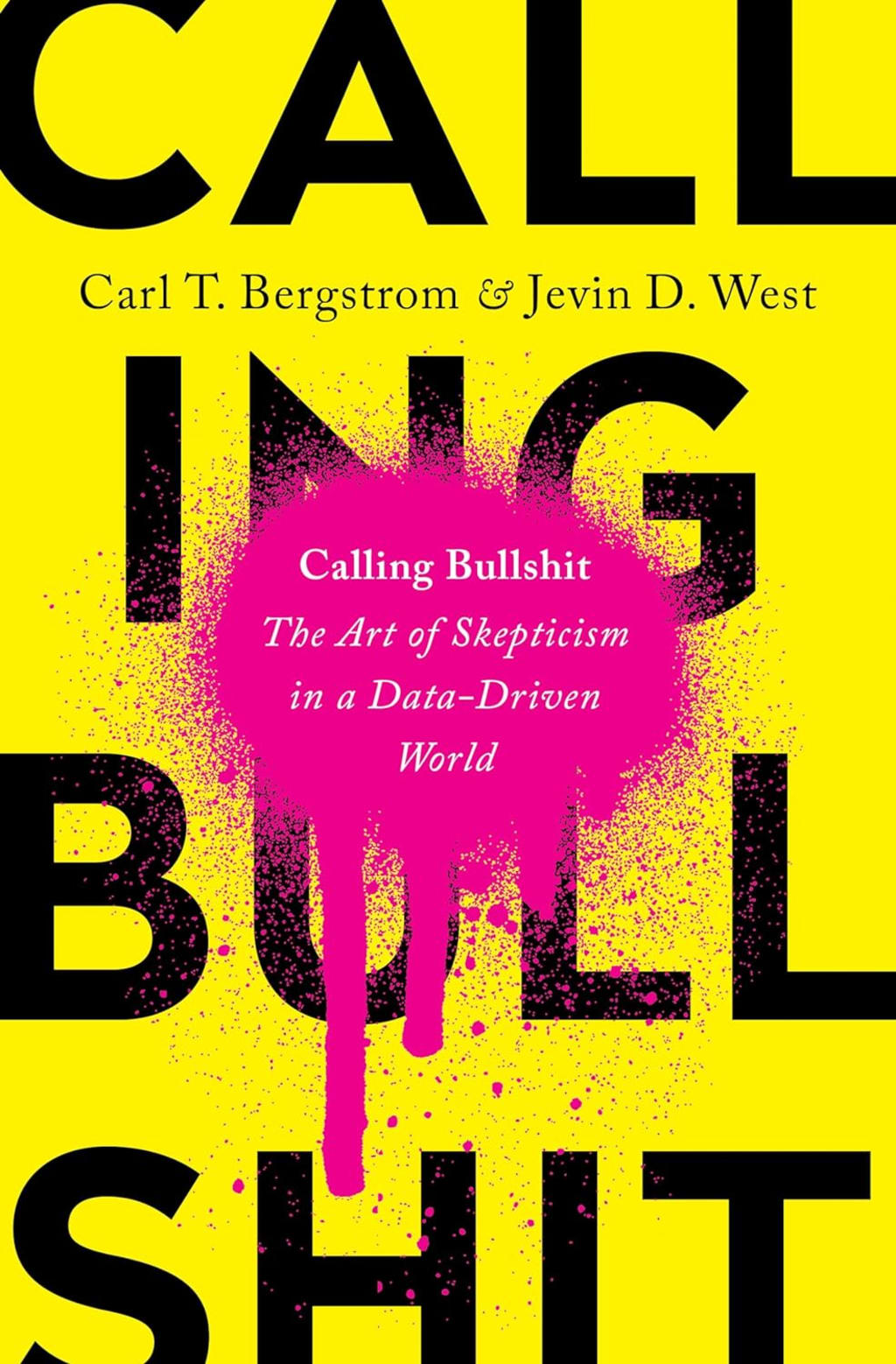
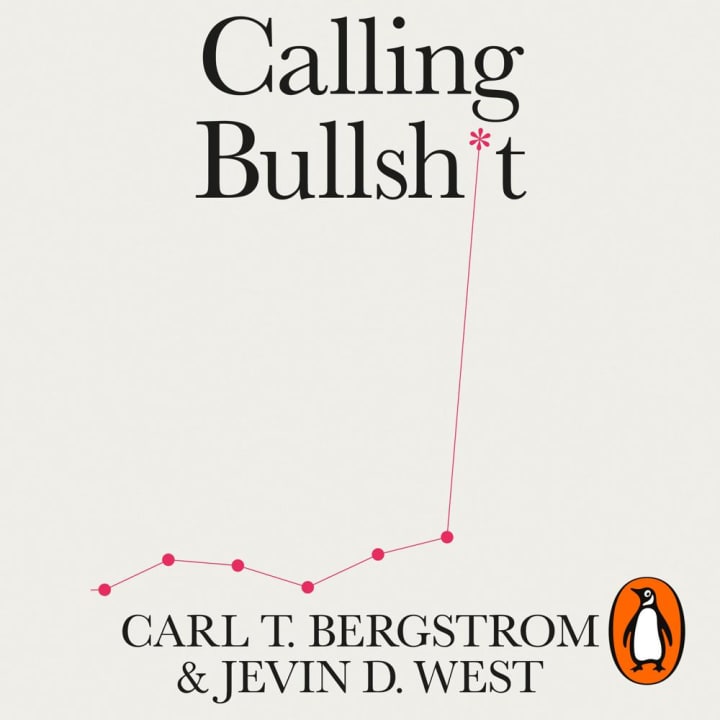
5/5 - a fantastic book about what bullshit is and how not to get bullshitted...

“Nothing that you will learn in the course of your studies will be of the slightest possible use to you, save only this, that if you work hard and intelligently you should be able to detect when a man is talking rot, and that, in my view, is the main, if not the sole, purpose of education.”
- "Calling Bullshit" by Carl T. Bergstrom and Jevin D. West
I originally found this book through my Amazon Recommendations in the shape of 'because you read Alex Edmans' May Contain Lies...' and obviously my main question was 'how does this have anything to do with that?'
Calling Bullshit is a book about misinformation and whether it is done out of malice or out of animal nature. It is about how clicks are better than reads in the online media world and how this same online media is no longer written by writing professionals like those of the New York Times, but instead by basically anyone who wants to 'go viral' in some way. How headlines are made to be inflammatory and some funny stuff regarding them as well such as: experiments on the social network and divisiveness becoming an increasing topic that both sides don't talk to each other about but both acknowledge.
If you are one of these social media addicts that gets riled up from reading the name 'Donald Trump' on anything or if you are one of those right-wing conspiracy theorists who supports the coup-d'etat of January 6th, then prepare to be insulted into oblivion. This book is not just informative, it is also absolutely hilarious to those of us who do not use social media in this way. I found it quite striking to say the least.
Bullshit is more than often known to distract. That is one of the things this book wants us to understand so well, that we won't need to be reminded as we go along. Even certain birds will pretend to bury food when they are aware they're being watched by others birds. In fact, the food is still in their mouths and hasn't been deposited at all. The hungry birds looking on are none-the-wiser and are ultimately disappointed when the subject bird flies away having 'bullshitted' the other birds. This leads us into the argument about how people bullshit other people, whether it is always malicious or manipulative and how sometimes, it can be useful to our own senses of selves. But before all that, we need to delve into that dreaded hole: the media and the online world.
One of the first major points we are introduced to is that bullshit is much easier to produce than it is to clean up. This is written is as a scathing rebuke of the anti-vax movement and all the lies it is based on. Whilst contributing to a British Paper, one of the writers claimed to have performed some sort of experiment in which he linked vaccines to autism. Many people began to believe this and yet, over the years, more and more holes started to appear in the research. First of all, there was the falsification of the hospital documents of the 12 children involved in the experiment (yes, only 12). After that, the motives of the researcher came under scrutiny which ended with the research being arrested and formally charged.
However, there is a growing movement of people who apparently believe in the anti-vaccination rhetoric. This is because bullshit is much harder to clean up than it is to produce. According to the book, it still takes multiple researchers to run a whole lot of experiments basically disproving the anti-vax idea that vaccines cause autism and even though they have done this over and over again on a scale of thousands of children over twenty or so years, there are still people who believe in the old and false rhetoric. In that respect, the book is correct: it is far harder to clean up than it is to produce.
Another point this book makes is that the rise of the internet and social media has allowed people who do not have the intelligence and the intergrity to commit to writing an honest news source are now allowed to spread whichever misinformation suits them. An example of this is these influencers who pedal the ideas and news that suits their own products and endorsements and either do not bother with anything else or deliberately misrepresent the facts of a case to suit themselves and their audience.
But the book gives an even more prominent example of where this happens. Headlines, according to the book, can be more malicious on social media because though newspapers seek a subscription for their news, social media only seeks you to click on it and that is how they make money. Language such as 'clickbait' comes to mind in the fact that there are thousands of articles out there that people don't even bother to read before they comment on them, often passionately for or against.

This was also displayed in the book in which an experiment was done in order to prove this. The article was titled something along the lines of a certain percentage of people not reading articles before they comment on them and presumably the article would go on to talk about how ignorant they were. You can imagine what happened. Many people started commenting on how silly these people sounded and yet, when you opened the article you would be met with the 'Lorem Ipsum' for a page or so - meaning that even the people commenting on that article had not actually bothered to read it.
The irony about that absolutely kills me every time.
The book talks about what life was like in this realm before the internet. Familiar voices and faces would tell us the news with some sort of integrity even if it was biased. The only thing this book missed out was the fact that these news channels and papers, even thought hey did have professional integrity, were more biased than not and essentially, were feeding slower but the same sorts of stories which social media has sped up to its own viewers. I will overlook this for now and state that the slow feeding process and the ability to turn the TV off and walk away seems to have been the height of this jab. Nowadays, it is not so much that we cannot turn away, it is more so that we require our smartphones for everything and when everything is on there then we have to remember tha so is everything else. Not all of it is very good. We become more susceptible to believing things we read on our own social media because we are trained (and are training the algorithm) to enjoy it.
One other point I enjoyed was divisiveness. The authors suggest that divisiveness is bad not just because it divides people but it also stops them from conversing with each other about it, even though both sides are perfectly aware that it is happening. So no matter whether you are a fan of Donald Trump or a Bernie Sanders supporter, you are going to get fed what you want and thus, it will move you further away from the opposite side eventually, making a conversation that is healthy and constructive pretty much impossible.
Another big idea in this book is constantly repeated and reflected on as the idea of something being too good to be true, possibly is too good to be true gets investigated. The writers clearly enjoy showing us the reality of things and so, are adamant that there is no truth in something that appears overly good or overly aspirational on social media in any respect.
Brandolini is the one who stated, according to the book, that there was a lot of work to do when cleaning up bullshit but next to nothing when it is produced for mass consumption. This is another thing that gets repeated over and over again in the text with the hopes of teaching the reader that they should not take anything for face value if it is written as a fact on social media. Why? the clicks are more worth than the integrity. Not only is this repeated over and over again but there is a kind of snarky tone when the author writes it that makes it so easy to understand that you wonder why you yourself has never thought about this before.
I am sure that anyone in this room, including myself has taken something at face value before without reading into it. Especially something on social media. It is either something we want to be true or something we are passionately against. It doesn't matter as long as it is written in a clickbait headline. We will read the headline, comment and move on. Cleaning up the bullshit is not done as frequently and so, misinformation spreads ten fold.
One thing that really made sense to me is how the media online seems to attract people over and over again to the same content - they cannot be doing this by producing the same content every single time. Instead what is actually happening is that little by little they are producing more and more extreme content in order to lead these people down some sort of rabbit hole. I recently watched something on Netflix called The Anti-Social Network in which this kind of plays out ont he screen starting with the hacktavist group called Anonymous and moving on to the coup of January 6th. It covers a lot of ground but has the same talking points about how things became more and more extreme over time. This means that the more extreme they become, the more the people already invited down the rabbit hole will become invested in them. It is, as I believe, some sort of bullshit chain reaction.
Deepfaking is another point this book talks about in which it discusses the malicious ideas behind manipulation and causing more, as it puts, bullshit. Are deepfakes nefarious with their intentions to make people believe things are not real? Yes they are. It pulls me back to that Tom Cruise deepfake that I saw on the internet. Now, me having watched it a few times realised that there was something wrong with the video but I thought it was up against a green screen or something. It felt very much like one of the nodes in the uncanny valley - but to me this simply means the background is probably not real. However, it was proven that the video was a complete fake and that was not even Tom Cruise. This was not malicious and porbably just a bit of fun, but if you can find out why we need to keep deepfaking away from social media - it is basically every other reason apart from fun.
There are thousands of great points that this book makes against accepting everything at face value from social media to scientific research. It also goes through why we might do so not just to confirm our own biases, but to have them as talking points, proving that we are impressive as human beings. We often bullshit about ourselves in order to make conversation to other people we have never met before and yet, we are very rarely found out upon that and in the end, nobody really cares about it. Everyone takes part and everyone is susceptible no matter how intelligent you think you are. And yet, this book teaches you how to see through the bullshit, at least the stuff that is especially nefarious or manipulative. It is books like these that make nonfiction worth reading.
About the Creator
Annie Kapur
I am:
🙋🏽♀️ Annie
📚 Avid Reader
📝 Reviewer and Commentator
🎓 Post-Grad Millennial (M.A)
***
I have:
📖 280K+ reads on Vocal
🫶🏼 Love for reading & research
🦋/X @AnnieWithBooks
***
🏡 UK
Keep reading
More stories from Annie Kapur and writers in Geeks and other communities.
Book Review: "James" by Percival Everett
“With my pencil I wrote myself into being. I wrote myself to here.” - James by Percival Everett I have been waiting for this book for a long time. When it came out, I initially decided not to get it because it was fairly expensive. Having read some of the other books of the same author, I actually could not wait for James to be released. I was absolutely itching even though it was out of my price range. However, I ended up buying it when it came down in price slightly from a bookshop and ultimately, got to reading it when I arrived back home. From reading one of the best novels of the last 10 years, The Trees, and other great books like Damned if I do, Percival Everett is proving to be a really exciting voice in the world of literary fiction. In James, he takes one of my favourite novels: The Adventures of Huckleberry Finn and writes the first person narrative of one of the most intense and carefully crafted characters in American Literature: Jim.
By Annie Kapur2 years ago in Geeks
The Rachels - 2025
Much to my surprise, I have kept a list of the films I‘ve seen this year. I daresay it isn’t complete. There will be films that snuck in on a late night in front of the TV that I would’ve forgotten to note. Or others, that I went to watch at the cinema, but then had a red wine and promptly forgotten about. But it’s not a bad approximation of the films I’ve seen this year. In total, there are 53 films listed, so an average of one a week and one for good luck.
By Rachel Robbins26 days ago in Geeks
WWE: Unreal Season 2 Is the Most “Wait, Should I Be Watching This?” Wrestling Show Ever
When Netflix dropped WWE: Unreal, it didn’t just give wrestling fans extra content — it basically handed us the keys to the writer’s room and said, “Go ahead. Look around.” Season 2 (released Jan. 20, 2026) leans even harder into that vibe: fascinating, addictive… and occasionally weirdly intimate in a way wrestling hasn’t really done before.
By Lawrence Lease28 minutes ago in Geeks




Comments (1)
Truly interesting. Thank you for sharing.