
Book Review: "A Posthumous Confession" by Marcellus Emants
5/5 - A character-driven tale of madness

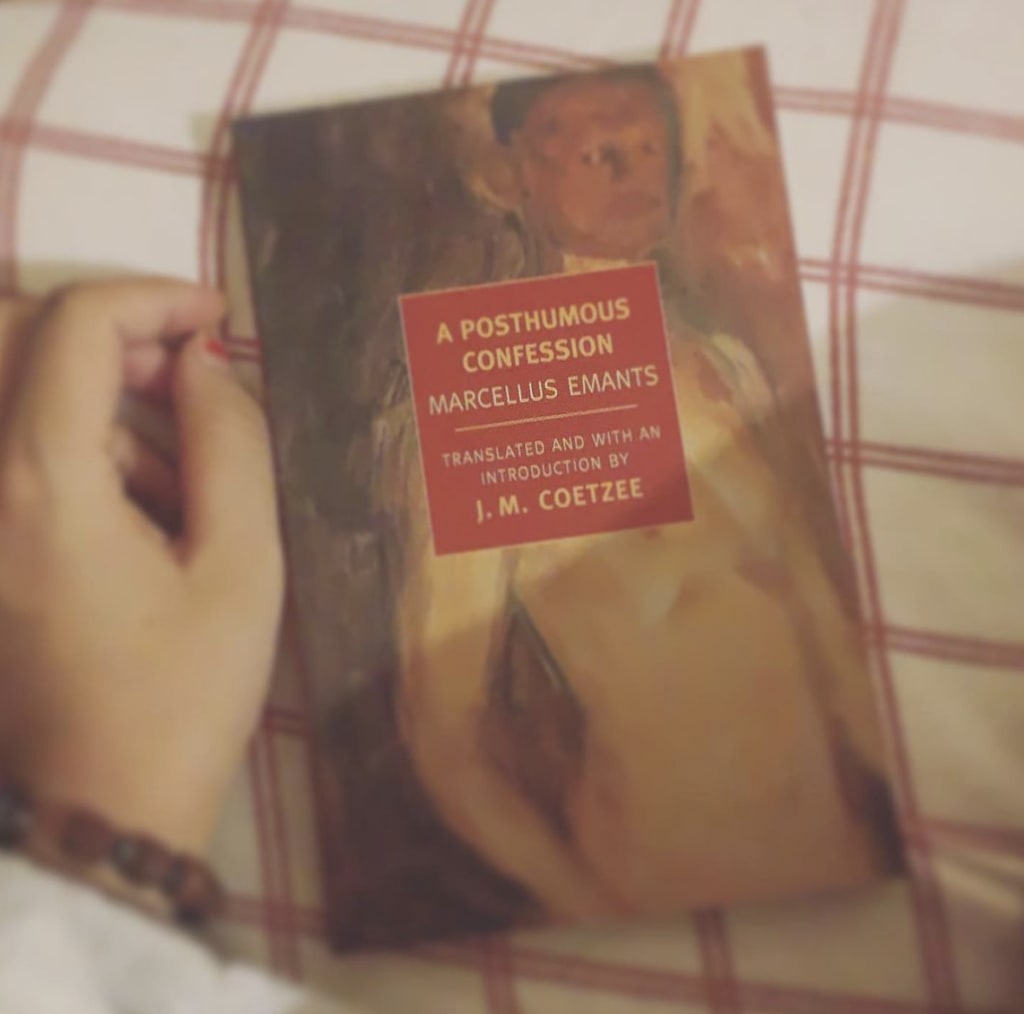
This book is most definitely one of the best I have read of 2021 so far and that being said, the character has also brought me much to think about. When first going through the book, I noticed that the character, at the beginning is someone we should feel sorry for in terms of his forced solitude and emotional isolation but as the book continues, he becomes less and less likeable and ultimately you simply cannot pity him at all.
When we first meet the character he is within the school ages and has very few friends yet, seems to move away from anyone who invites him to social events etc. He has interests of a regular school boy and yet, he chooses to lead a more solitary life, describing that he is not as normal as the other boys. Yet, we do not know what he means by this until later. When we do learn why he is not normal it is because he prefers darker interests rather than just the simple things that life has to offer him. His father's rages, his mother's death and other traumatic incidents may be part of the cause but we could never really know why this is. We are therefore made to believe that the regular habits and interests are there simply to mask the ones that are darker and less socially acceptable.
As the book continues, we realise why this mask is placed over his face and as he confesses more and more to his weird and disgusting crimes, we can see that he imitates his father in the acts of random rage against his wife and child. Yet, throughout his life - he has always had the reason and the means to do it differently. Making no choice towards good means that it is impossible to like him, even at the very end of the text.
Let's take a look at a quotation from the text that needs no introduction but makes us realise what kind of a character we are dealing with:
"My wife is dead and buried. I am alone at home, along with the two maids. So I am free again. Yet what good is it to me, this freedom? I am within reach of what I have wanted for the last twenty years (I am thirty-five) but I have not the courage to grasp it, and would anyhow no longer enjoy it very much. I am too frightened of anything that excites me, too frightened of a glass of wine, too frightened of music, too frightened of women; for only in my matter-of-fact morning mood am I in control of myself, sure that I will keep silent about my deed. Yet it is precisely thie morning mood that is intolerable. To feel no interest - no interest in any person, any work, even any book - to roam without aim or will through an empty house in which only the indifferent guarded whispering of two maids drifts about like the far-off talk of warders around the cell of a sequestered madman, to be able to think, with the last snatch of desire, in an extinct nervous life about only one thing, and to tremble before that one thing like a squirrel in a hypnotic gaze of a snake - how can I persevere to the end day in day out in such an abomnible existence?"
To conclude, this book is possibly one of the best examples of a conflated existence since people like Rousseau and Shelley contemplated the difference between being and doing in their own respectable works. There is something about this book though that makes it uncontrollably modern - with its writing style not over-the-top, flamboyant or even colourful, the depressing tone runs deep into the wounds of each page and comes out the other side to be a contemplation of life and death.
About the Creator
Annie Kapur
I am:
🙋🏽♀️ Annie
📚 Avid Reader
📝 Reviewer and Commentator
🎓 Post-Grad Millennial (M.A)
***
I have:
📖 300K+ reads on Vocal
🫶🏼 Love for reading & research
🦋/X @AnnieWithBooks
***
🏡 UK
Keep reading
More stories from Annie Kapur and writers in Geeks and other communities.
A Filmmaker's Review: "Circus of Horrors" (1960)
One of the great horror films of the British Horror Revival makes an appearance on my screen somewhat bi-regularly as a comfort film of mine. For the life of me, I cannot remember where I first saw it or when, but I have watched it multiple times by now and it is nothing new for me to bestow so many praises on this film, apart from some parts of its script which seem a little forced. The sheer violence of this film is absolutely brilliant in contrast to the storyline because it all happens so smoothly. None of it seems out of place and even though we are expecting it, it is still able to provide the shock value that the British Horror Films of the 1960s were so keen to show upon the screen.
By Annie Kapur5 years ago in Geeks
A Knight of the Seven Kingdoms Series Review (Season 1)
As one of the biggest properties in fantasy, A Song of Ice and Fire remains immensely popular with audiences. After reaching far into the past with House of the Dragon, a second spin-off was on the cards. A Knight of the Seven Kingdoms serves up a bite-sized slice of action and drama, but it still claims a spot among the best small-screen titles.
By Robert Cain10 days ago in Geeks
Spider-Man Rogues Gallery Power Rankings
Spider-Man’s world isn’t just defined by great power — it’s shaped by the enemies determined to break him. The rogues gallery of Spider-Man is one of the most iconic in comic history, filled with brilliant scientists, monstrous experiments, criminal masterminds, and deeply tragic figures. Some rely on raw strength, others on genius-level intellect, advanced technology, or psychological warfare — but all of them have pushed Peter Parker to his absolute limits.
By Top Ranked7 days ago in Geeks


Comments
There are no comments for this story
Be the first to respond and start the conversation.