
Best Picture Winner Reviews: Wings (1927)
The 1st Academy Award Winning Film

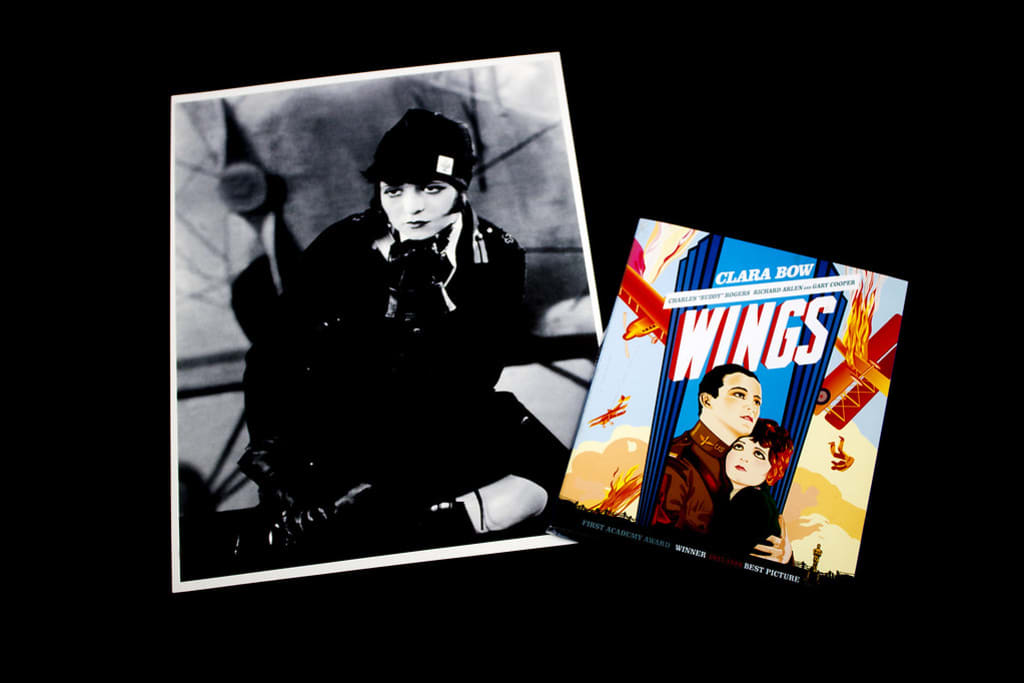
Title: Wings (1927)
Film Rating: PG-13
Best Picture Award Year: 1929
Genre: Action, Drama, Propaganda, Romance, Silent film
Top Billed Cast: Clara Bow, Charles “Buddy” Rogers, Richard Arlen
Tagline: “An epic of the air”
BEFORE WE BEGIN
Finished and released to the public for viewing pleasure in 1927, Wings was made in Hollywood during “the roaring ‘20s.” After major victories during World War I, the U.S. had finally become a superpower, and once it attained that status, it lit up like the Fourth of July! The U.S. was booming! People had more disposable income than ever before, the west was expanding, Hollywood produced millionaires, giving rise to “American royalty,” and thanks to women’s suffrage, women in America were getting a taste of freedom, many falling in line with the idolized “flapper girl” image. (Our leading lady, Clara Bow, had a lot to do with the popularity of that look!)
However, contrary to the effects of a new wave of liberal popular culture at the time, American society was still extremely conservative and films, especially war epics like this one, were riddled with classic devices such as, epic title cards, biblical quotes, and ancient Greek references which, on the surface, have nothing to do with the immediate plot or scene. While this may seem strange by today’s standards, filmmakers of the time wouldn't dream of leaving those elements out of a war drama!
But wait—the film takes place in 1917 during World War I, so why so much talk about the 1920s? At this point in time, recorded sound wasn’t applicable to film just yet, so naturally this is a silent film. Filmmakers and actors had to rely entirely on visuals with minimal dialogue which occurred in the form of visual title cards. This meant that every scene had to be as attention-grabbing as possible and historical accuracy didn’t always meet that need.
Most of the clothes and props portrayed in the film coincide with fashion and technologies of the 1920s, regardless of the fact that the film takes place from 1917-18. The most obvious wardrobe inaccuracy is Clara Bow’s flapper girl outfit, which had yet to be invented and popularized until years after World War I. I believe the reason they chose to include such an obvious inaccuracy was due to Bow’s popularity at the time. As what many considered to be the original flapper girl, it appears Bow’s iconic image was kept intact in order to draw the masses—specifically men—who couldn’t wait to see more of America’s first “it girl.”
Finally, although this was released as a silent film, which would have required a live orchestra and/or sound effects team in every theatre location to provide the full experience for filmgoers—fear not! Available versions of the film have been restored and have added both sound effects and a heroic score. Far more watchable for us these days!
Without further ado, let’s dive in!
PLOT
For a film with a runtime just short of two and a half hours, the plot is painfully simple. Jack and David, two best friends pining after a beautiful city girl named Sylvia, join the service as fighter pilots to protect and honor their country. Meanwhile, Jack’s childhood friend Mary, who is madly in love with him, becomes a driver in the Army in order to stay as close to him as possible.
To be blunt—plot was certainly not the most important aspect of this film to its makers. Blatant foreshadowing is used throughout the film, almost spoon-feeding the upcoming events for the audience. That being said, I suppose I can’t be too critical of the said spoon-feeding, given that viewers were expected to make important connections without one of two crucial aspects of film—sound. Wings makes its purpose indisputably clear: to pay homage to the brave “knights and ladies” of war and show some mind-blowing special effects in the process. The film portrays religious rites, ceremonies, and ancient chivalry in battle that resound honor, patriotism, and self-sacrifice. We get all the classic elements of a war epic jam-packed into one hard-hitting rendition.
Overall, the plot aims to showcase chivalrous values and valiant deeds, rather than to take its viewers on a dramatic plot-driven journey. In fact, we’re left with quite a few loose ends in the conclusion, but in an epic war film like this one, filmgoers were more than willing to overlook the shaky plot for the inventive and realistic special effects. I was extremely impressed with the visuals and found myself puzzling over how engineers managed to achieve them in their time.
CHARACTERS
- Jack (Charles “Buddy” Rogers):
Although Buddy Rogers’s performance was widely praised upon the release of the film, I have a few bones to pick. Jack’s character is childlike, distracted, energetic, playful, and naive. Rogers and the directors took this a little too literally from time to time, making quite a few of Jack’s scenes hard to watch, especially considering Jack is intended to be at least 18 years old at the time.
In an attempt to portray Jack’s innocence, the film opens with him laying in a field as he rocks on his back with his legs in the air like an infant child. All of Jack’s mannerisms and communications are childlike, even after he has seen the terrors of war.
In a bar scene in Paris, France, an extremely drunk Jack is far more interested in champagne bubbles than in the ladies fawning over him on either side. He maintains this childishness for the entirety of the film, even during his battle scenes where his enthusiasm often seems inappropriate in correspondence to the circumstances. While it was common for films to exaggerate their characters’ personality traits in this way, running over to an enemy to finish him off with a youthful, ear-to-ear smile on one’s face is a bit much.
Of course, the events that transpire with David do seem to change Jack somewhat in the end. His disposition isn’t as exuberant as it once was, but this change takes place within the last 10-15 minutes of the film. (There’s a pretty obvious pacing issue in the film as a whole, which we’ll talk about more later on.)
To be fair to Rogers as a performer, Jack was a hard character to play. Although he is the primary and undisputed hero in the story, his character lacks depth and aside from the excessive childishness, portrays dislikable qualities such as arrogance and narcissism up until the final scenes.
- David (Richard Arlen):
Oh, David. Handsome, rich, and stoic, he’s captivating then and now. To my complete surprise, I came to find out that upon the film’s release, Arlen’s performance and acting abilities were criticized. This just goes to show that the standards for acting and performing were completely different from those we expect from our audio/visual films today.
Without sound, silent film actors were expected to give over-the-top performances with exaggerated expressions, movements, and choreography. Comparing Arlen’s performance to those of his co-stars, he is the least animated and hyperbolic. However, much of his performance is pretty realistic and falls in line with standards we have for our actors today. In fact, the rest of his film career was extremely successful while many silent film actors struggled to adapt to sound films. (Unfortunately, Clara Bow was one of many actors whose career plummeted after sound films made their debut.)
Of all the characters, including favored Jack, David is the most changed and completed character from beginning to end. Starting out as a somewhat spoiled mama’s boy in the beginning—which makes his passionate, mouth-to-mouth goodbye kiss with her that much weirder—David toughens up and learns to hold his own against the rougher and tougher middle and lower class men he’s in bootcamp with, including Jack. His childhood teddy bear is a recurring image in the film and is one of the subplots that doesn’t fall off in the film’s conclusion.
Ultimately, David comes to value compassion and brotherhood, both of which he lacked early on, and the consistent symbolism associated with details of his character’s journey remain consistent throughout.
- Mary (Clara Bow):
Here’s where the characters begin to taper off in terms of depth, plot, and overall importance to the film. Remember this film is over 93 years old, so it does portray misogynistic depictions of women.
Although Mary is the leading lady in the film, sadly her primary function in the story is to wrap up Jack’s romantic dilemma: Sylvia never loved him and David isn’t in the picture anymore. Falling in line with conservative and sexist views of women during the time, Mary is a lovesick woman on a mission to get her man—nothing more. Nevermind that she’s a fellow military service member who operates motor vehicles! Even in uniform, she’s harassed by just about every man she comes in contact with. She always laughs it off, even after being fooled by a fellow service member who gets her to grovel over him after he pretends to be hit by the vehicle she was driving. (Of course, she doesn’t attempt to call for help, just holds him to her chest and coddles him, whatever that may have done for the man had he needed medical attention.)
The worst mistreatment of her character takes place during Jack’s drunk scene in Paris when she attempts to get him onto his feet after his leave is cut short and he’s expected to report to duty immediately. It’s important to note that Mary is in full flapper glamour during this scene via the help of a random, matronly woman in the follies’ dressing room who told Mary that she’d never get her man in a uniform.
Between the champagne in his system and Mary’s sudden glow-up, Jack doesn’t recognize her. She manages to get him to his room to lie down where he passes out after what I can only describe as a psychotic episode about bubbles. Once Jack is asleep, Mary conceals herself from his side of the room behind a dressing screen and begins to change out of her flapper dress and into her uniform.
The moment Mary’s top is off, two fellow soldiers enter the room and inappropriately ogle at her while one of the soldiers reprimands her scandalous behavior. The same man, still staring a hole through her and continuously raising his eyebrows in arousal, tells her that women can’t conduct themselves in that manner, to pack up her things, and head home. That’s right—she gets dishonorably discharged, and Jack is completely free of any reprimand whatsoever for being black out drunk and unable to report to duty. Worst of all, Mary, a spritely, independent, confident, and dedicated service member, simply nods in agreement with the harassers and packs her bags.
My first thoughts on this scene were: Okay, maybe we’ll circle back around to that later on. Maybe Jack remembers what happened when he wakes and speaks up for her. Maybe Mary has a trick up her sleeve? It’s 1917, but that scene has to be a joke between the obvious sexual harassment, humiliation, and punishment from two of her fellow soldiers. Where’s the honor in that?
Nope! We don’t see or hear from Mary again until Jack returns home with a newfound love for her. She eagerly accepts him into her arms, and she doesn't disclose to Jack that she was the woman in the room with him in Paris although he mentions a fuzzy memory of it to her. I can only assume that this plot point was meant to act as a sort of “get out of jail free card” for Mary when the viewers are able to determine that Jack doesn’t remember her supposedly scandalous behavior. Very demeaning, but alas, 1917.
At one point, Jack does defend Mary’s honor to another service member who suggests she’s a promiscuous woman; however, nothing further is mentioned on the subject, and her character remains completely unchanged from beginning to end other than the fact that she was discharged from the military but finally gets her man.
- Sylvia (Jobyna Ralston):
A young, beautiful “city girl” and Jack and David’s shared love interest. She’s immediately portrayed as a medieval lady or goddess character, dressed in a billowy white gown and playing what appears to be a lute. Unlike the other characters, her costume isn’t necessarily indicative of either the 1910s or 1920s and falls more in line with classical visual depictions of female innocence, beauty, and courtship. Although her character is mentioned consistently throughout the film, we see very little of her, and her plotline completely drops off after David’s finale, which was one of the most bothersome flaws of the film.
- Other Mentionable Characters:
David’s Mother (Julia Swayne Gordon) and David’s Father (Henry B. Walhall) make a couple appearances in the film, and seem to act as the primary portrayal of parental challenges of war, loss, and the unnatural order of things that go along with them.
Cadet White (Gary Cooper), only makes a swift appearance in the film. His character acts as a plot device to portray the imminent dangers that Jack and David will inevitably face and potentially succumb to. But let’s not forget who played him—the late and great Gary Cooper.
Count von Kellerman is an integral and compelling character although the actor who plays him went uncredited. As the leader of a Germain air fleet who goes plane-to-plane with Jack and David multiple times in the film, he surprisingly isn’t portrayed as a villain. In fact, he upholds strict chivalrous law in battle, even sparing one of the boys when their machine gun jams and are unable to fight back. We’ll have to remember that the time in which the film takes place and the time in which the film was made had yet to know Hitler and the Nazis as a part of history. It wouldn’t be for another decade or so until World War II that they would come into the spotlight, completely changing the views of chivalrous ideals in war forever.
Herman Schwimpf (El Brendel) provides some comic relief in the film. As a first generation American with a (perhaps) German-sounding last name, he is harassed multiple times by other men who argue that he isn’t a true American. Schwimpf becomes angry and defensive (as he should!), but rolls up his sleeve to reveal a tattoo on the inside of his arm of an American flag.
But here’s the thing—this isn’t a Popeye moment. No, Schwimpf doesn’t flex his muscles to make his tattooed flag dance. He simply raises his arm, jiggles it like jello, and lets the flag wave! This show of patriotism works like a charm and the haters make an instant 360° every time.
STRUCTURE
The structure of this film was one of the strangest I’ve seen to date. I theorize this is primarily due to the infancy of visual story-telling and/or the director’s vision for an action-heavy war epic composed mainly of battle scenes. The pace is inconsistent, sometimes providing absolutely no transition between locations and times, making it periodically difficult to follow. For example: Cadet White, a seasoned fighter pilot. All within a minute or two of Cadet White’s introduction, Jack and David meet him, bond with him, and mourn his death.
The call-to-action scenes begin suddenly and all-at-once, often misleading the viewer into misinterpreting the air battles as taking place over their U.S. airbase when subsequent shots suggest that not only are the men not fighting over their airbase, they seem to be in a different country altogether.
I found the film’s exposition to be successful as the characters and character relationships were clearly defined. The competitive relationship between Jack and David add excellent tension, especially considering they’ve both been writing to the same girl back home. It isn’t until Jack and David kick the sh*t out of each other in bootcamp that they’re able to overcome their differences. Although Sylvia truly loves David, she only writes to Jack out of pity, and had even let him take a locket with her photo inside—and a love note to David written secretly on the back—after Jack mistakes it as a parting gift from her to him. After bonding with Jack, David continues to conceal Sylvia’s true intentions from him in order to avoid breaking his heart. This motive comes back to haunt the two later on in the film, making for excellent drama.
SPOILER ALERT!
Tragically, Jack accidentally kills David after mistaking him for a German pilot while David was flying in a hijacked German plane. This leads us to arguably the most dramatic scene in the film as David slowly passes away. Upon realizing what he has done, Jack scoops David into his arms and we’re cast into an emotional, almost romantic, scene between the two in which they hug and kiss goodbye.
Upon further research, I have found that in recent years, many viewers have interpreted homosexual or bisexual tones, some even suggesting the true reason David never spoke to Jack about Sylvia was because David wasn’t concerned with Sylvia at all; it was Jack he truly wanted. However you’d like to interpret it, it’s a powerful scene that wraps up a beautiful and intriguing friendship.
As for the ending, it’s about as forced as forced can be. We don’t hear anymore about Sylvia nor do we find out how she takes the news of her love’s untimely death. Although Jack has shown next to zero interest in Mary as anything other than a friend, he changes his mind in the blink of an eye, and realizes he’s in love with her. The two kiss under a shooting star and in “the shooting star,”Jack’s Ford Model A hotrod which he named with Mary before initially leaving for war. It’s a feel-good ending, one I don’t feel the need to complain about, but one I certainly won’t praise either. I just can’t help but feel like Mary was Jack’s third choice for love after David and Sylvia fell through.
SCENES
Let’s get the least successful scenes out of the way, and let’s start with the big one: David’s uncomfortable goodbye kiss with his mother. Yes, we’ve talked about the exaggerated actions and movements of silent film actors, but this scene blurs the line between drama and Freudian theory.
Collectively, the least successful scenes seem to include Mary and Sylvia while the most successful scenes revolve around Jack and David. It’s obvious why present day viewers would have newfound interests in the film through an LGBQ lens. Aside from the incredible special effects, the relationship between Jack and David is the most successful element to the film. Although I was surprised to see a mouth-to-mouth kiss between the two men in a 1920s feature film, it came naturally to the scene and frankly, was the most authentic form of love portrayed within it.
As previously mentioned, this film is carried on the wings of it’s battle scenes (pun intended), and it does not disappoint in that category. Real stock footage from WWI was used in some scenes, while the rest were filmed with real planes, tanks, weapons, and ammunition. Although it appears the actors filmed most of their aerial battle scenes in a grounded plane, many shots were filmed in the air with stuntmen who performed extremely dangerous stunts.
The film’s tagline, “An epic of the air,” proves itself in the exciting climax, sending both Jack and David into whirlwind battles and inevitable circumstances. Let me tell you—I was hooked! The impressive and realistic aerial battle scenes are still successful in their attempt to amaze its viewers. (In fact, my husband popped into the living room during the climax of the film and after silently watching for a minute or so he said, “Wow, this looks really real, actually.” I have to agree!)
FINAL THOUGHTS
Wings isn't without its flaws (some pretty significant ones at that), but the inspiring visual effects and Jack and David’s compelling relationship pick up the slack. It also wouldn’t be right not to grant honorable mentions to the costumes, makeup, and talented actors that brought their characters to life on the silent silver screen.
Personally, the film captivated me! Flaws aside, I was thoroughly entertained for the entirety of the film, and the special effects hold up surprisingly well for the—comparatively speaking—limited SFX resources available at the time of its making. I also found myself almost craving more silent film entertainment. If you’re new to the world of silent film, this would be an excellent option to start for its masterful engineering and theatrics which make for a nice segway between the past and present of feature film.
And now for my rating! (As a reminder, this is my personal rating for the film and not that of existing reviews on other sources.) Full transparency—this was a hard one to rate as I want to pay due respect to the film’s accomplishments and time era while maintaining the 5 elements of excellent film as the basis for my rating.
CONCLUSION
MY RATING: 3 ½ stars
PROS: Exciting, Eye-catching, Interesting concept, Excellent special effects and costumes, Symbolism, Good drama
CONS: Lacking character arcs, Inconsistent pacing, Outdated concepts
BE AWARE: Classism, Discrimination, Mysoginy, War, Violence
NEXT UP: Best Picture Winner for the 2nd Academy Awards ceremony, The Boradway Melody (1929)
About the Creator
Kylie Pulford
Kylie Rochelle is a creative writer and artist from Orlando Florida.
Keep reading
More stories from Kylie Pulford and writers in Geeks and other communities.
Not Just For Clean Up: A History Of The MCU's Department of Damage Control
Initially an organisation that seemed to exist to help the heroes of the Marvel Cinematic Universe, from Phase Four onwards, the Department of Damage Control has shifted into a more antagonistic role. Most recently seen in the Wonder Man series, the current incarnation of Damage Control seems to target superpowered individuals, regardless of whether that person poses an active or intentional threat.
By Kristy Anderson7 days ago in Geeks


Comments
There are no comments for this story
Be the first to respond and start the conversation.