
'Avatar: The Last Airbender': How A Heartbreaking Piece Of The Series' Lore Could Be Used To Explain Aang's Aging In Season 2
The downside of the Avatar State.

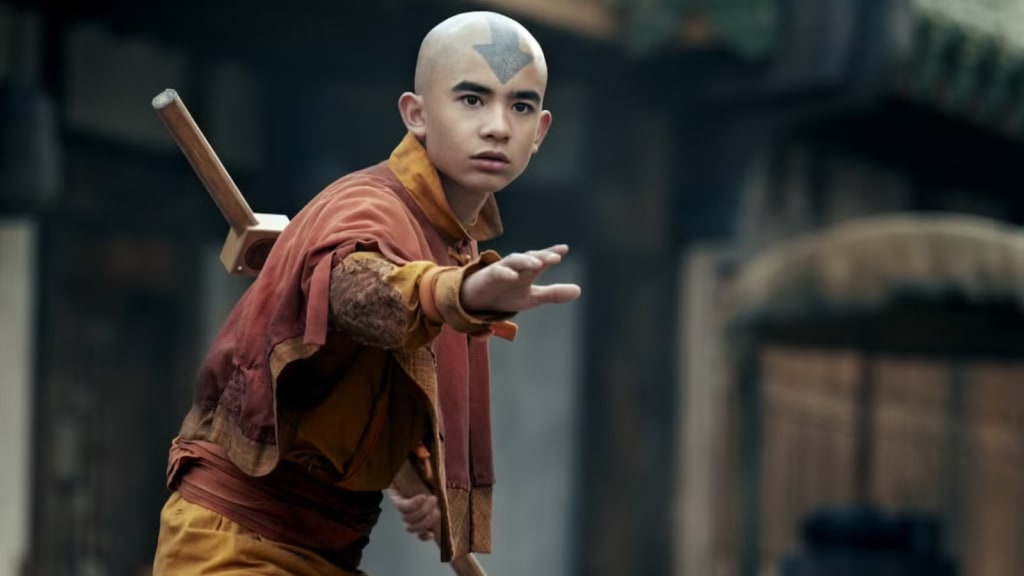
A teaser trailer for season two of Netflix's live-action adaptation of the classic animated series Avatar: The Last Airbender has arrived. For the most part, fans have been pleased with the trailer, particularly the introduction of fan favourite Toph Beifong and the unique visual representation of how she uses her Earthbending powers despite her blindness.
Unfortunately, there is one element in which some fans are struggling to suspend disbelief: the age of the series lead.
You have one year..

In both the original animated series and the live-action remake, Aang is biologically 12 years old (chronologically 112, after his time in the iceberg) when the main plot begins. The entirety of the animated series takes place over a single year. This fact is important to the plot, as Aang's initial goal is to master all four elements, become a fully realised Avatar and defeat the Fire Lord before Sozin's Comet, which supercharges Firebenders as it passes, arrives at the end of the year.
The problem? Due to the gap between the release of Avatar: The Last Airbender's first season, and Netflix's decision to renew it, Gordon Cormier, who plays Aang in the series, has grown considerably. Rumour has it the show will incorporate a time jump to compensate, however, there is also a piece of existing lore from the animated series and expanded material that could be used to explain Aang's seemingly rapid growth.
The Rules of the Avatar State
In both the animated and live-action series, the Avatar's most powerful ability is entering the Avatar state, effectively a sort of super mode. While in the Avatar State, Aang can channel the energy of all the past Avatars, and perform extraordinary feats of bending he may not have been able to accomplish on his own. Initially, the Avatar State is triggered involuntarily as a defense mechanism when Aang is in danger, or seriously angry.
In the live-action series, the Avatar State can also allow Aang to channel a single past Avatar directly if he contacts them while meditating.
However, the Avatar State is not without it's downsides. Firstly, it is not intended to be sustained over long periods of time. Second, the Avatar State is the Avatar at his or her most powerful, but they are not invulnerable. If an Avatar dies while in the Avatar State, the Avatar Cycle ends, and there will be no new Avatar born.
Aang was in the Avatar State for too long
As mentioned above, the Avatar State is not meant to be sustained for long periods of time. However, the only reason Aang was able to survive in the iceberg is that he remained in the Avatar State for a full hundred years.
Usually, an Avatar will have a greatly extended lifespan compared to the average human. Avatar Kyoshi, for example, lived to be 230. However, Avatar: The Last Airbender's sequel series, The Legend of Korra, reveals that Aang died very young for an Avatar, at the age of 66.
The generally accepted reason for Aang's early death is that his century in the Avatar State drained a lot of his life force. While this did not come up in the original animated series, Aang's extra expenditure of life force while trapped in the iceberg could be incorporated early in the live-action remake to explain why Aang looks older than he should.
We'll find out more when season two of Netflix's Avatar: The Last Airbender remake arrives sometime in 2026.
About the Creator
Kristy Anderson
Passionate About all things Entertainment!
Keep reading
More stories from Kristy Anderson and writers in Geeks and other communities.
SPOILERS! Why Eleven Didn't Call Hopper 'Dad' In That Emotional 'Stranger Things' S5 Scene
WARNING: SPOILERS for Stranger Things season five, Vol.1 With the vast majority of fans having already finished watching the first four episodes of Stranger Things fifth and final season, attention has turned to discussing and analysing the content of those four episodes, and, of course, speculating and theorising on what's to come in the three episodes comprising Vol.2, arriving at Christmas, and the movie length grand finale at New Year.
By Kristy Anderson3 months ago in Geeks
A Knight of the Seven Kingdoms Series Review (Season 1)
As one of the biggest properties in fantasy, A Song of Ice and Fire remains immensely popular with audiences. After reaching far into the past with House of the Dragon, a second spin-off was on the cards. A Knight of the Seven Kingdoms serves up a bite-sized slice of action and drama, but it still claims a spot among the best small-screen titles.
By Robert Caina day ago in Geeks
I was in a Toxic Relationship, with my Workplace
“You got that?” My ex yelled. His hands were balled into fists at his side. At six foot three, he towered over me. A normal person would have been afraid, but I looked up a video of George Lopez repeatedly saying, “I got this,” and showed it to him. I had grown used to this treatment, so much so that I didn’t blink when he ripped the phone from my hand and threw it across the room.
By Jade M.2 days ago in Confessions




Comments
There are no comments for this story
Be the first to respond and start the conversation.