

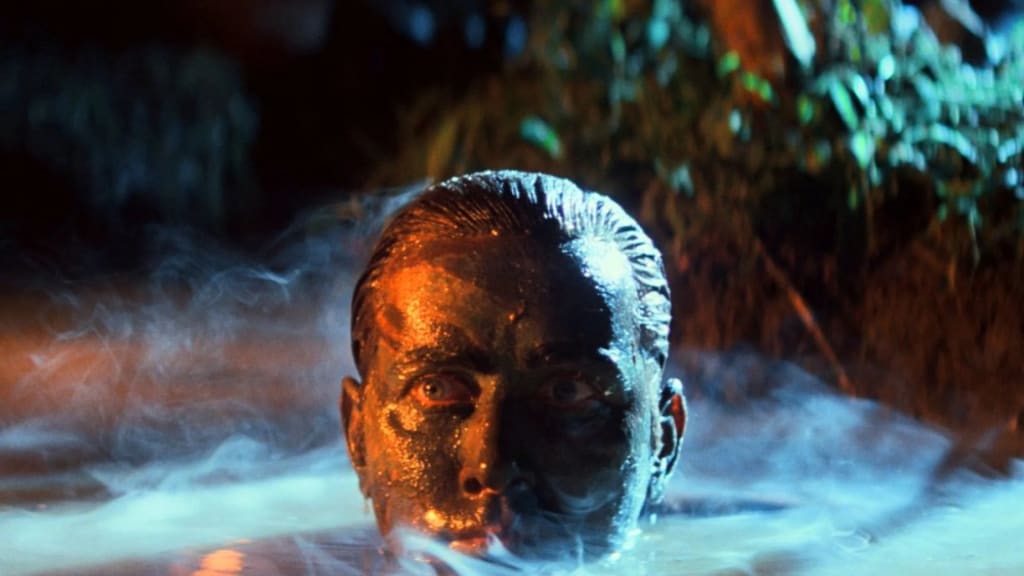
During the Vietnam War, young Captain Benjamin L. Willard (Martin Sheen), a US Army intelligence officer, is tasked with entering Cambodia on a dangerous mission to eliminate Colonel Walter E. Kurtz (Marlon Brando). ), a renegade colonel who has gone mad. Captain Willard must navigate the river to the heart of the jungle, where Kurtz reigns as a despotic Buddha over the members of the Montagnard tribe, who worship him as a god.
With photography by Vittorio Storaro and a screenplay adapted by John Milius and Francis Ford Coppola from Joseph Conrad 's Heart of Darkness novella . Music by Carmine Coppola and Francis Ford Coppola . The film was released on May 10, 1979 in Cannes and on August 15 of the same year throughout the United States.
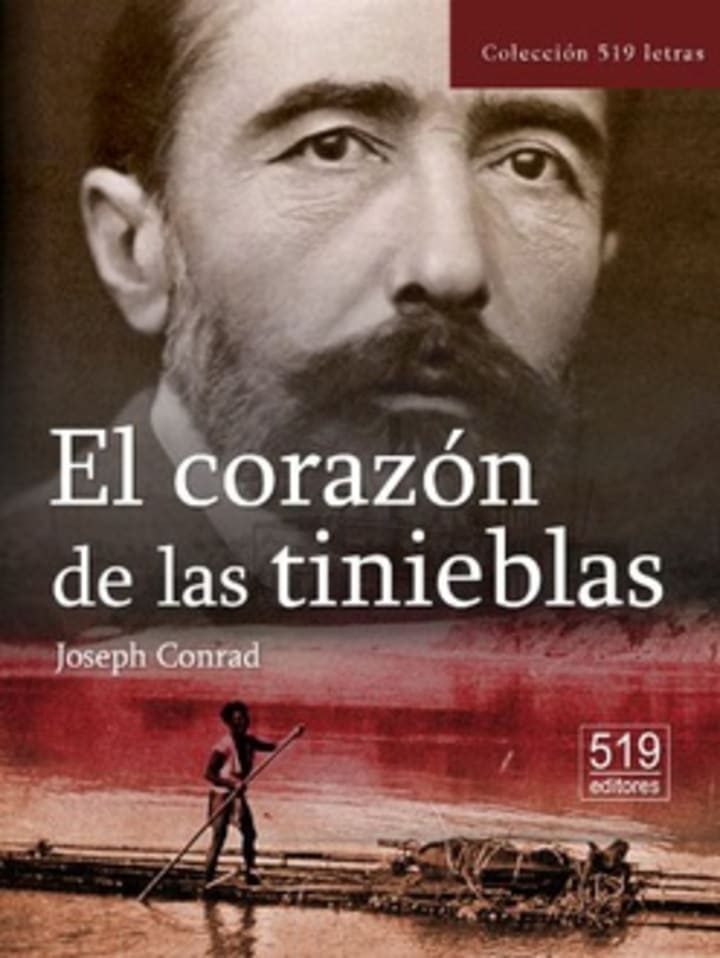
Unlike Conrad 's novel set in Africa at the end of the 19th century, the film moves its field of action to the Vietnam War and shows a clear influence from the film "Aguirre, the wrath of God" by Werner Herzog (1972) .
Winner of two Oscars in the 1979 competition, where she had six nominations. It was also awarded the Palme d'Or at the 1979 Cannes Film Festival. In 2000, the film was deemed "culturally, historically, and aesthetically significant" by the United States Library of Congress and selected for preservation in the National Film Registry . .
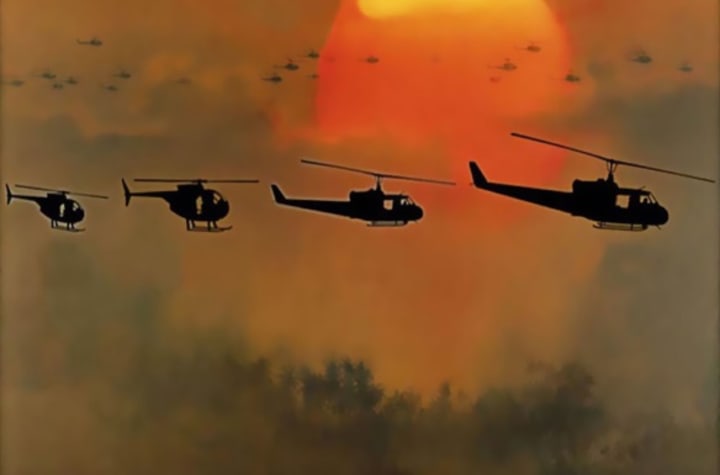
In 2001, Coppola presented, also at the Cannes Film Festival, a new cut of the film, extended to three and a half hours, under the name Apocalypse Now Redux . If the first film became a cult film, the 2001 version did not disappoint critics or former fans. In 2014, The Hollywood Reporter publication gave it seventeenth place in its ranking of the 100 best films in cinema history.
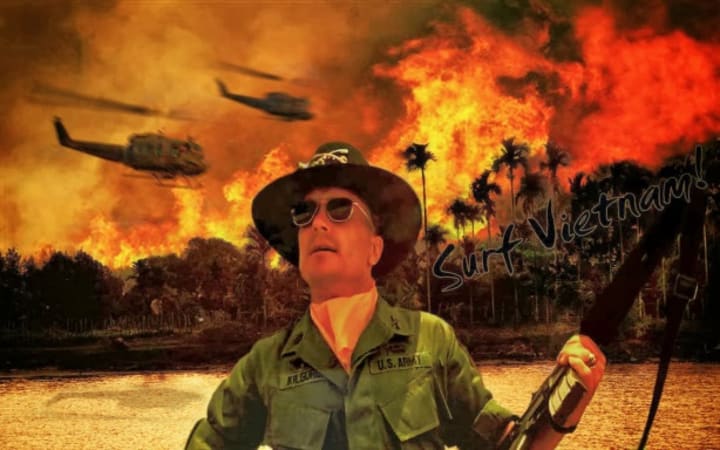
The film has memorable moments within the history of the seventh art, such as its disturbing beginning, where the image of Captain Willard, lying on the bed and looking at the ceiling fan, is mixed with the macabre dance of helicopters flying over the jungle and bombing Napalm , while the song by The End of the group The Doors, serves as a link and gives meaning to the images.
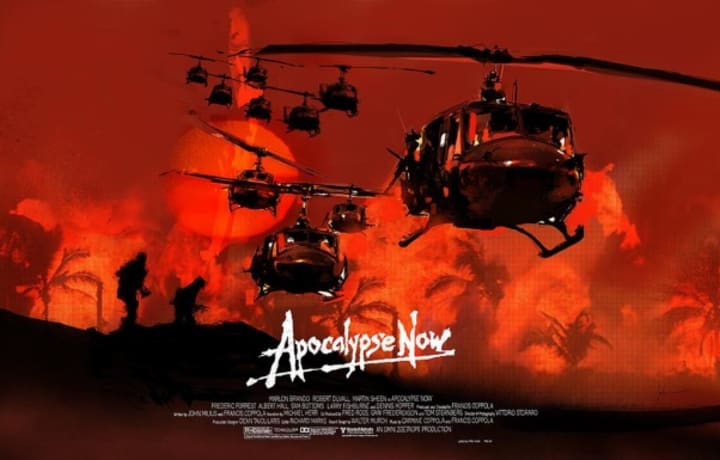
Also noteworthy is the scene in which the helicopters of the Ninth Battalion of the First Cavalry Division (Airborne) bombard the Vietnamese town, all set to the music of Wagner, the "Ride of the Valkyries ", just as the audiovisuals of the Luftwaffe , for cadet instruction.
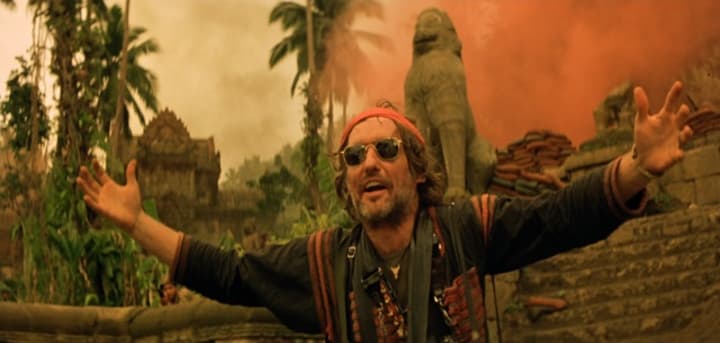
Another unforgettable scene is the one in which Willard is brought before Kurtz to be interrogated, here a combination of light and shadow occurs that partially hides the colonel's face, symbolizing the light and dark sides of the human heart.
In fact, the film narrates in its background the mental and moral processes that occur in people subjected to adverse conditions, and how these conditions affect each of the characters that appear differently, depending on their personality, their actions and their behavior. awareness.
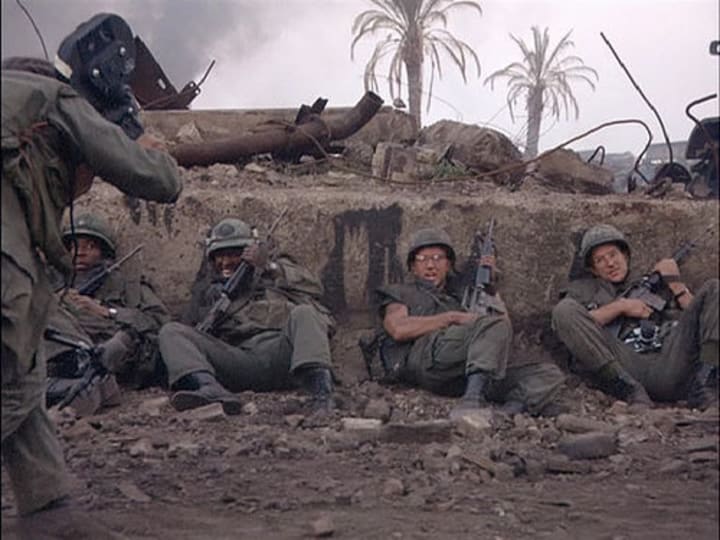
Director Michael Mann expressed about the film "Apocalypse Now":
«Coppola evoked the intense and dark search for identity, a journey that surpasses you; madness and nihilism. All captured with an operatic and concrete narrative, with the highest degree of difficulty. A masterpiece."
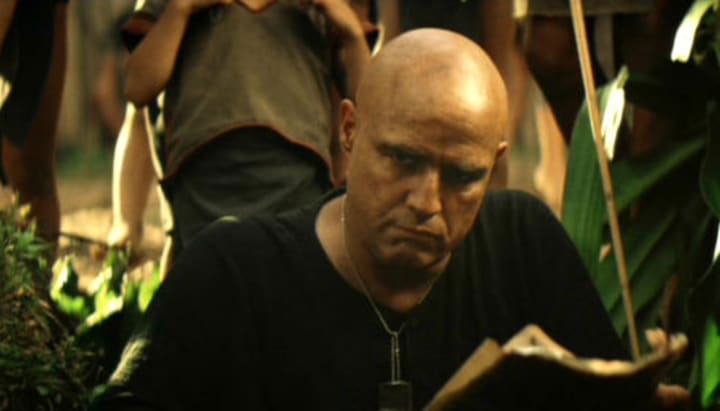
What the critics say:
"Magnificent to watch, exciting, witty, riveting and superbly executed on every level, it's not just one of the best movies of the year or decade, but of all time."
Michael Wilmington: Chicago Tribune
"Its opening, with the sound of circling helicopters interspersed with the anguish of Willard sweating in his hotel bed in Saigon, a jungle burning with napalm..., remains a visual and aural marvel."
Peter Travers: Rolling Stone
About the Creator
Keep reading
More stories from Nouman ul haq and writers in Geeks and other communities.
How Horror Movies Effect Our Brain
Cinema is one of the great passions of many people, as is the horror genre. These types of horror stories have various effects on our brains, some of which you may not have known about. Know what the consequences are after having enjoyed this type of film.
By Nouman ul haq4 years ago in Geeks
The Politics of Playing Dress-Up
Well, to start off I'd like to say a happy world book day to all who celebrate. I know I haven't really posted anything on my socials about it but I'm not a jubilant kind of person. I lay low most of the time. Let's start off with a popular anecdote from the vaults...
By Annie Kapur8 days ago in Geeks
Pan’s Labyrinth
Pan’s Labyrinth was released on December 29, 2006. In the summer of 1944 in Francoist, Spain eleven-year-old Ofelia and her pregnant but sick mother, Carmen, journey to live with Carmen’s new husband, Captain Vidal. Carmen is bedridden and Ofelia finds time to explore. One night she is visited by a fairy who takes her to a faun. There, she discovers she is the lost princess Moanna and will have to complete three tasks before the full moon in order to return to her kingdom. I have been recommended this film countless times and I finally saw it on Netflix. My neighbor liked how I referred to it as a Spanish Narnia. One fact about this film is in Spanish it is called El Laberinto del Fauno which translates in English to The Labyrinth Of The Faun. Despite the English title it was released as, it has nothing to do with the faun called Pan in Greek Mythology which I had originally thought but that did not sway my interest in the slightest. I only found myself imagining I was a little girl again and going on an adventure.
By Melissa Clark5 days ago in Geeks


Comments
There are no comments for this story
Be the first to respond and start the conversation.