
Alexander The Great Movie Review
Alexander The Great Movie Review

It is surprising that a historical character as huge as Alexander the Great has only been made into a film a couple of times, although it is true that the last one was about to be accompanied by a kind of competitor, almost in a duel. I am referring to Oliver Stone 's Alexander , the one starring Colin Farrell with Angelina Jolie as Olympia and Val Kilmer as Philip, which when it was released in 2003 did so under the pressure of a very similar project being prepared by Baz Lührman , a very successful director by then (now it seems to have disappeared) thanks to its peculiar version of Romeo and Juliet and, above all, the no less strange Moulin Rouge .
Without becoming habitual, this duplicity of projects is not anomalous either; there were already previous cases, some very well known and finally finished and premiered in close competition: Dangerous friendships against. Valmont , Robin Hood, Prince of Thieves vs. Robin Hood , Columbus. The discovery and 1492. The conquest of Paradise …
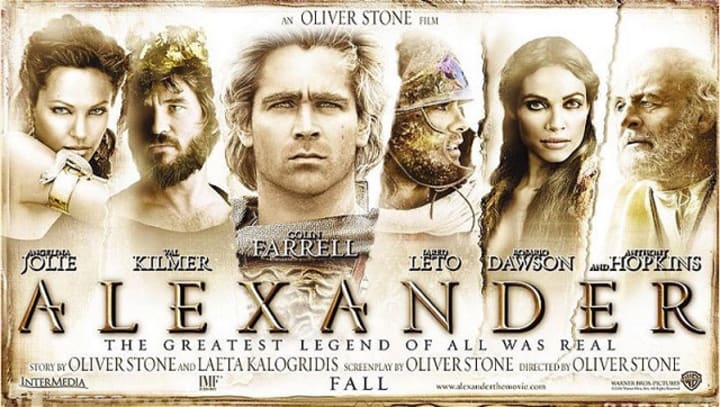
Lührman ended up throwing in the towel , with which those of us who detest his artificial and dizzying style came out winning (and that Stone's version is leaden where they exist), although we also lost because his candidate to play the Macedonian was Leonardo DiCaprio, who would have outplayed Farrell effortlessly; Is there a role that seems more suited to him?
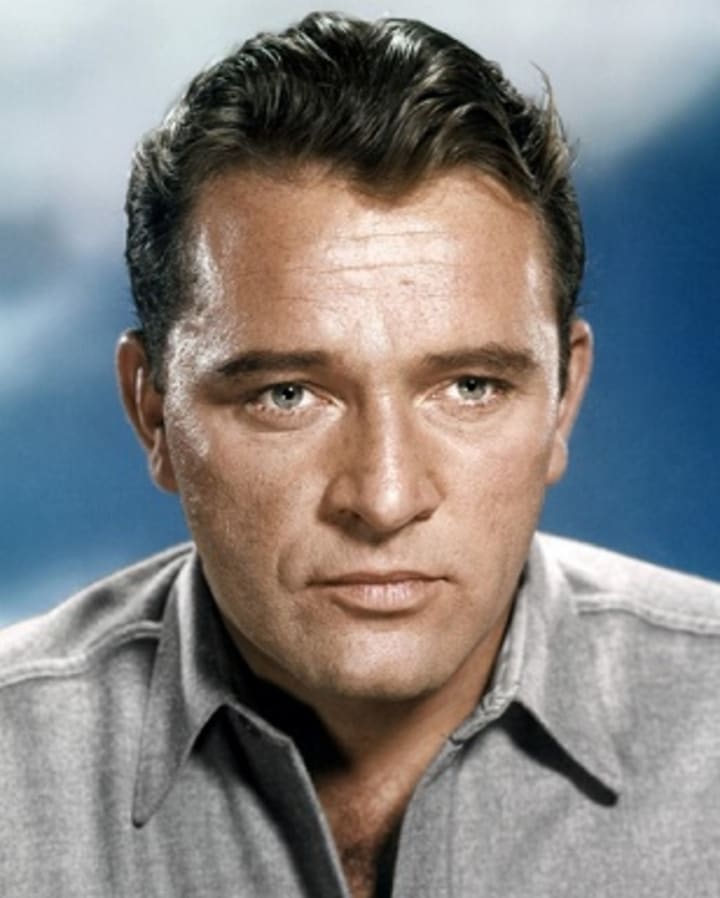
Robert Rossen must have thought something like this in 1955 when he chose to play one of the actors who were beginning to emerge in that decade: Richard Burton, who at that time was the right age for his role, thirty years old, and had not yet starred in his greatest hits or knew Elizabeth Taylor. Burton matched Alejandro's age and appearance, though he was dyed (or was it a wig?) almost as ugly a blonde as Colin Farrell would be years later. Alongside him was an interesting cast including Frederic March as Philip, Claire Bloom as Barsine, Danielle Darrieux as Olympias, Harry Andrews as Darius, Stanley Baker as Attalos, and Peter Cushing as Memnon.

The film is a true rarity . First for its director, who, true to his custom, was also a producer and screenwriter but who is not known for dealing with period films; in fact, the closest thing he did in that sense (and even later, in 1959) was They Arrived in Sanity , a rare western that tells of a US Army raid in Mexico to capture Pancho Villa but that pulls more because of the tension psychological than for the spectacle. Exactly the same as happens in almost all of his works (of which The Politician and The Hustler should be especially highlighted; with all three he won the Oscars for best film, best direction and best screenplay). Alexander the Greatis not an exception.
Indeed, throughout the footage it is verified that what Rossen highlights above all are the dialogues , splendid, with which the clash between the protagonist and his father is highlighted, the defense of his mother before him, the enthusiasm of the Macedonian for achieving the union of the Greeks against the hated Persians, his "transformation" into a god... All this to the detriment of the action scenes , shot apparently without interest and much shorter -sometimes even cut somewhat abruptly - than is usual, especially nowadays (the attack by the falcated chariots in Gaugamela is painful, for example, as is the Granicus pass).
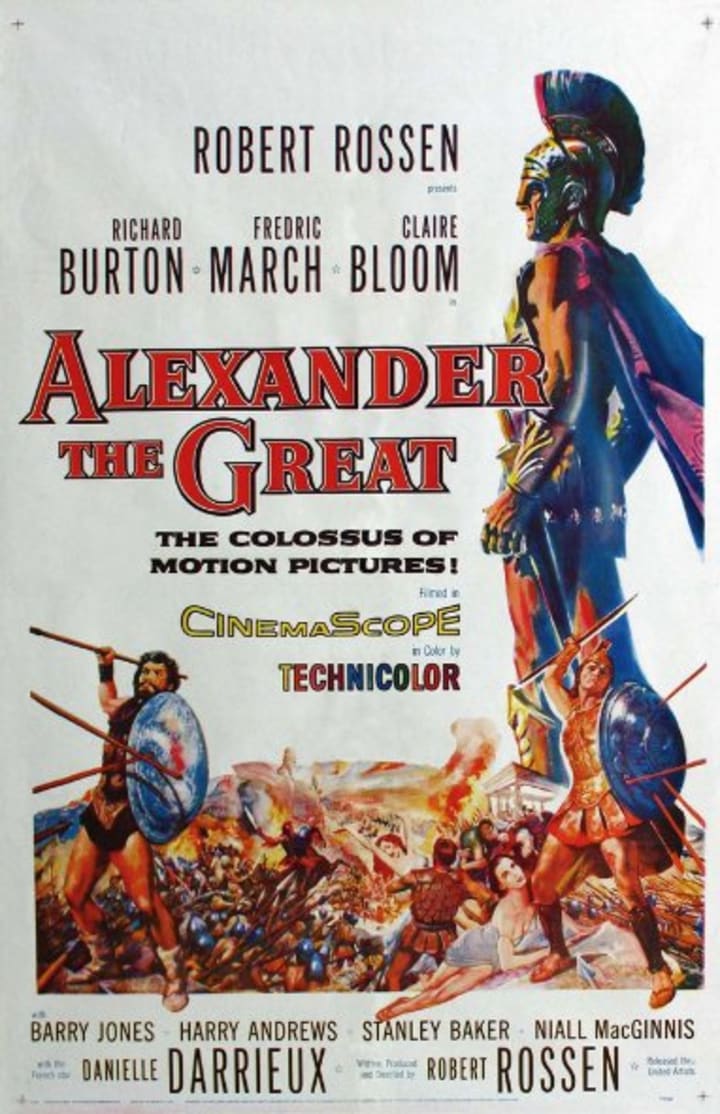
And that there were large masses of extras from the Spanish army: the film was made here, between Madrid (El Molar, Manzanares el Real and Rascafría) and Málaga , inaugurating a stage of filming that, once it was verified that the country was prepared to welcome them (in Alejandro, the Anglo-Saxons on the team brought their own soap and toilet paper, fearing they would not find it in situ ), he did not stop until the 1990s.
In this sense, it must be said that local collaborations were not lacking , not only in the interpretive part (José Nieto, Julio Peña, Teresa del Río...) but also in technique, although many did not appear in the credits (for example, that of the deputy director by law, Eduardo García Maroto, who, yes, acquired the necessary experience to later participate very actively in Espartaco ).
As a consequence of this preference for psychology, Alexander the Great is slow-paced - even more so for today's brainless tastes - and somewhat complex to follow, which is why it was a box office flop . It did not even succeed in Spain, even though its premiere at the Rialto cinema was a show never seen before, with costumed extras. Possibly Robert Rossen was not the right director for such a project, but it is something that is explained by extra-cinematic reasons: he was exiled in Europe, fleeing McCarthy's "witch hunt" and decided to take advantage of the peplum fashionto make one with greater intellectual load in which to highlight the political idealism of the character (paradoxically, Rossen did not know how to match it, since he ended up collaborating with the senator and betraying colleagues).

Perhaps part of the problem is also that the footage was cut by half an hour to make it more commercial (that is, contrary to what is done now, as Oliver Stone's own version proves) and hastily resolved scenes are thus mixed (that of the Gordian knot would be the most obvious case) with enormous ellipses (the passage through Egypt, which forces the character to assume his divine condition not after visiting Siwa but from the beginning) and a somewhat hasty ending (death has hardly been married to Roxana, who is also presented as Darío's daughter to synthesize, merging the character with Barsine).
But, at the same time, above all this prevails a general tone of slowness and coldness. The latter is more noticeable due to the musical limitation; a good soundtrack can convey a certain warmth but the composer, Mario Nascimbene, does not provide -I don't know if it was because he was ordered to do so- any intimate theme for the domestic scenes, limiting himself to the action ones with the typical fanfares, which in any case are less fortunate than the ones he would later do for The Vikings .

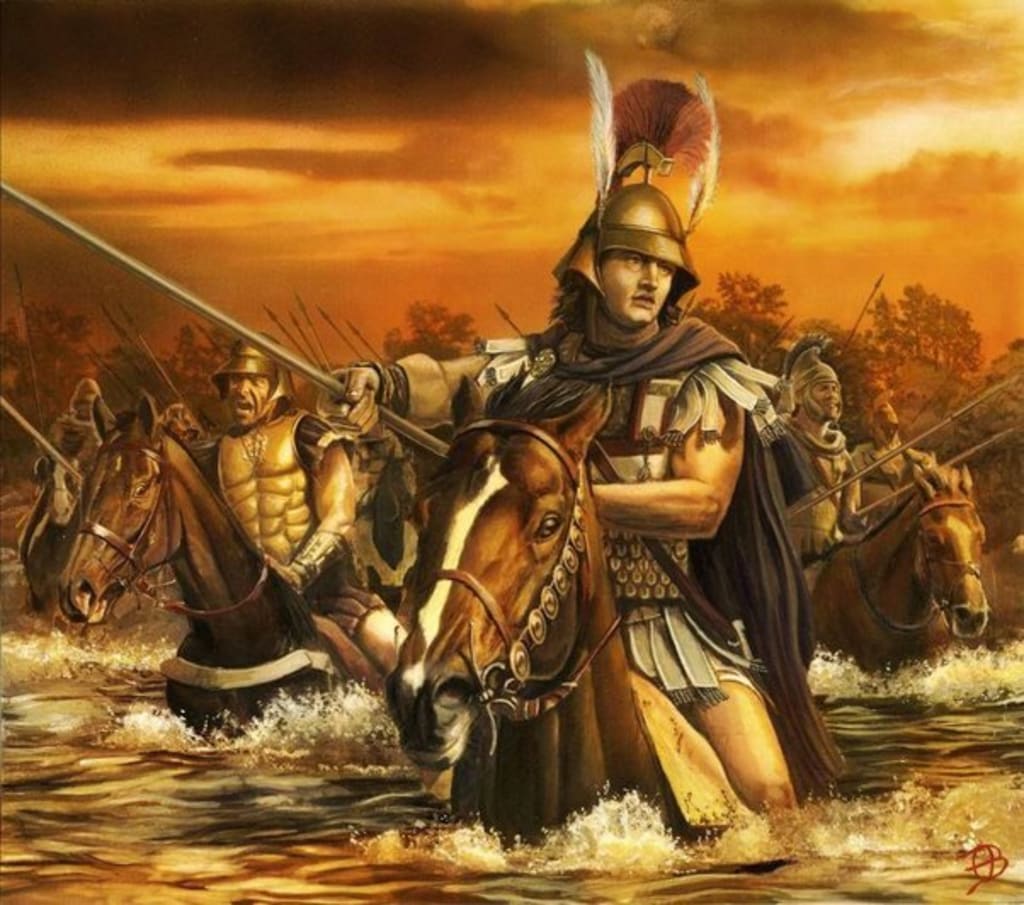
The setting is as sloppy as it used to be in 1950s period movies. Clothes and armor are completely invented, left to the inventiveness of the costume designer (pay attention to the crazy helmets that Alejandro wears, from one made entirely of leather -including the plume- to another of the Corinthian type that opens at the front with two doors!).
On the historical plane , the weapons are possibly compiled from another film and the Macedonian phalanx is barely intuited; in addition, bound books appear, when then they were rolled papyrus. It does succeed, surprisingly, in dispensing with stirrups for horses (they were a medieval invention). The decorations - a few well-distributed Greek columns - combine quite gracefully with the rural architecture of the Spanish towns and the scale models of cities burning in the distance are so ingenuous that they are funny. The reconstruction of the Persian camp, within the inevitable kitsch tone , is more interesting, especially the chariot in which Darius dies.
All this does not mean that there are not also good moments : the aforementioned dialectical confrontations Alejandro-Filipo, the mute accusation of inducing his mother to murder by throwing a bloody knife at her feet, the community wedding with which they aspire to unite the world the western with the eastern, the invocation of Zeus on an altar on the edge of a cliff, Philip dancing drunkenly on the battlefield after his victory at Chaeronea while challenging Demosthenes with burlesque shouts, the overwhelming night vision of the lights of the enemy camp in Gaugamela and the subsequent eclipse, the challenging letters exchanged by Darío and Alejandro…
About the Creator
Faraz
I am psychology writer and researcher.
The Politics of Playing Dress-Up
Well, to start off I'd like to say a happy world book day to all who celebrate. I know I haven't really posted anything on my socials about it but I'm not a jubilant kind of person. I lay low most of the time. Let's start off with a popular anecdote from the vaults...
By Annie Kapur5 days ago in Geeks
Squirtle Exposed: The Tiny Water Pokémon That Makes a Big Splash in Every Battle
Squirtle is one of the most beloved and iconic starter Pokémon in the franchise, offering a perfect blend of charm, strategic depth, and adaptability. As the Water-type counterpart in the original Kanto starter lineup, Squirtle has captured the imagination of trainers for decades. Its small size and approachable design conceal its potential for incredible power and tactical versatility, making it an essential choice for beginners and competitive players alike.
By Lukáš Hrdlička20 minutes ago in Geeks


Comments
There are no comments for this story
Be the first to respond and start the conversation.