
A Filmmaker's Guide to: Connotation
Film Studies (Pt.3)

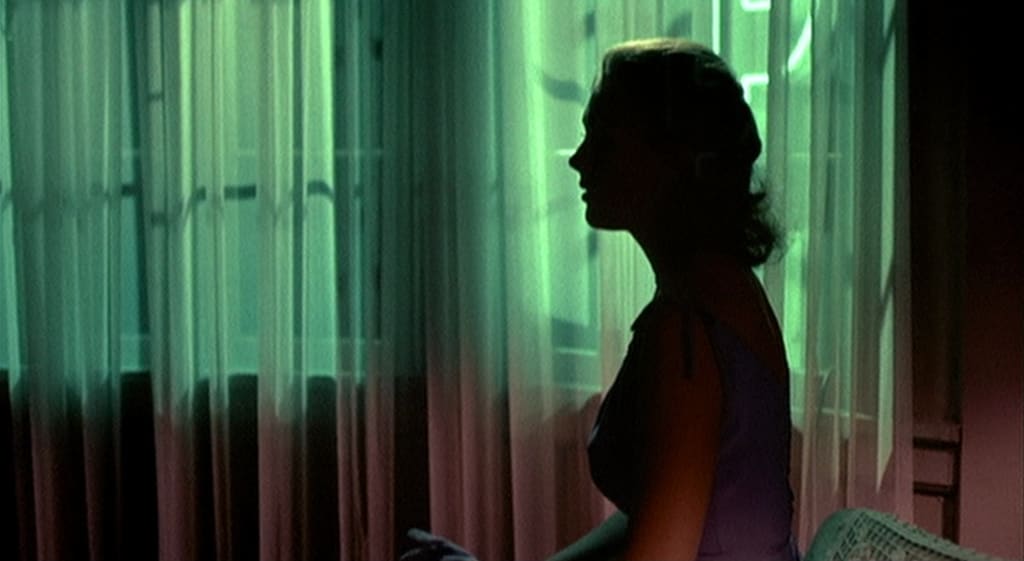
In this chapter of ‘the filmmaker’s guide’ we’re actually going to be learning about literature and film together. I understand that many of you are sitting in university during difficult times and finding it increasingly hard to study and I understand that many of you who are not at university or not planning on it are possibly stuck of what to do, need a break or even need to catch up on learning film before you get to the next level. This guide will be brief but will also contain: new vocabulary, concepts and theories, films to watch and we will be exploring something taboo until now in the ‘filmmaker’s guide’ - academia (abyss opens). Each article will explore a different concept of film, philosophy, literature or bibliography/filmography etc. in order to give you something new to learn each time we see each other. You can use some of the words amongst family and friends to sound clever or you can get back to me (email in bio) and tell me how you’re doing. So, strap in and prepare for the filmmaker’s guide to film studies because it is going to be one wild ride.
Connotation
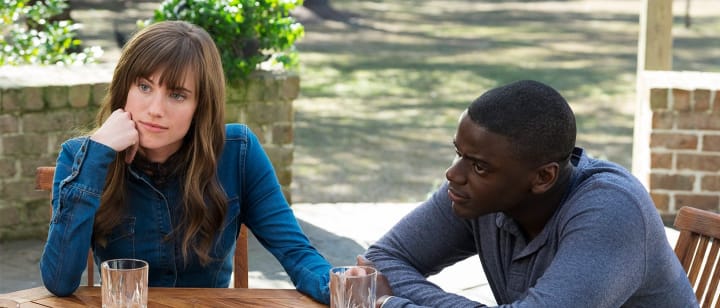
What is a 'connotation'?
A connotation is the 'social' or 'associated' meaning of word. For example: the colour red can be a connotation for love and for violence but as a concrete word, it is just a colour. The connotation is what we associate it with through years of social meanings linking words to ideas and things. Red is linked to love because it is the colour of the heart organ, and it is linked to violence because it is the colour of blood.
How is it used?
There are so many ways that connotation is used in literature. Firstly, we have colour connotations where colours can be feelings or moods. Then, we can have shape connotations where shapes and spaces can depict emotions and psychological states. After this, we can have patterns of speech, descriptions containing overly detailed accounts of crimes and everything from there to eternity could be a connotation if you can justify it using the meaning of the text itself as a whole.
What about in film?
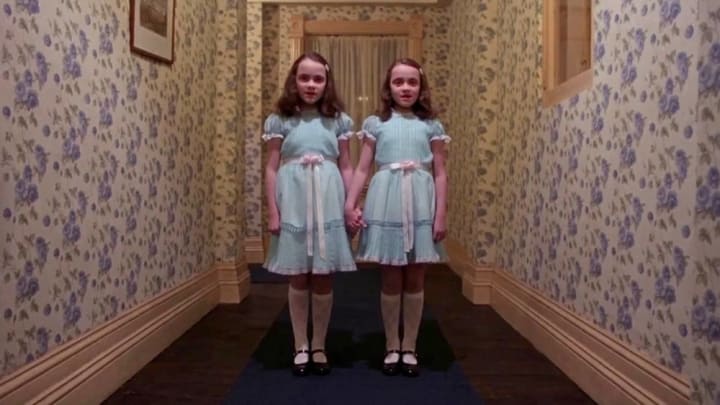
In film it is basically the same but on a more physical level, connotations have a way of containing far more meaning because not only do they have the social meanings we associate with them, but even if the reality is far removed from ours, the physical connotations of the other reality has to be made clear to us somehow. In books, this is normally done through description and explicit reference to difference. In film, this is done by presenting ideas we are familiar with and connotations we know and then we must build on top of this knowledge through the methods of storytelling and characterisation of the film.
Some films you can watch to learn more about the way connotation is used to its full extent include, but are not limited to:
- The Godfather (1972) dir. by Francis Ford Coppola
- JFK (1991) dir. by Oliver Stone
- The Shining (1980) dir. by Stanley Kubrick
- Rosemary's Baby (1968) dir. by Roman Polanski
- Get Out (2017) dir. by Jordan Peele
- Vertigo (1958) dir. by Sir Alfred Hitchcock
- Interview with the Vampire (1994) dir. by Neil Jordan
- The Danish Girl (2015) dir. by Tom Hooper
Connotations are more aptly viewed in films that are more visual and less reliant on dialogue. For example: it is not impossible, but is definitely more difficult to find a connotation of colour or space in a film like "Memento" (2000) which relies on dialogue more than the physical than it would be to find colour connotation in "The Exorcist" (1973) which is much more physical than the previous film.
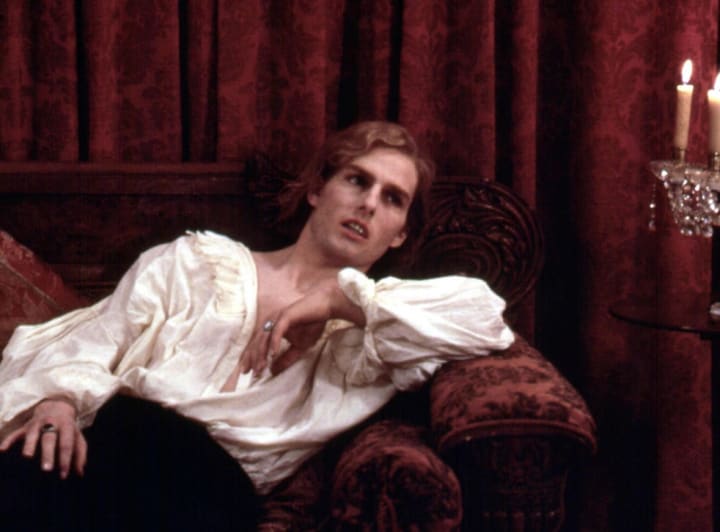
Therefore, when we first watch a film, before we even look for a connotation etc. we need to determine how we would go about this by measuring whether the movie is heavy in the physical or in dialogue. After this, we can begin to deconstruct the social frame of the film and what is hidden within items, colours and characterisation and how the social meaning links to what the film is trying to tell us on the whole.
The best ways to begin your studies into connotations is to study particular time frames and movements, such as: the gothic, the jazz age, the Harlem renaissance etc. Then, move on to looking at more particular historical and socio-political frameworks within those eras in order to create the 'deeper meaning'. For example: in "The Great Gatsby" by F. Scott Fitzgerald, there are itemised references to the masculine nature of Jay Gatsby. If you watch the film (2012), these items are on the screen. If you were to read about masculinity and the masculine image in the Jazz Age then you would be able to connect the two and see exactly why this connotation is there and how it has an impact on the overall meaning of the narrative.
Further Reading:
- Fortin, D.T (2011). Architecture and Science-Fiction Film: Philip K. Dick and the Spectacle of Home. UK: Routledge.
- Guaralda, M. et al (2016). Filming the City: Urban Documents, Design Practices and Social Criticism Through the Lens. USA: Intellect Publications.
- Hogle, J.E (2002). The Cambridge Companion to Gothic Fiction. UK: Cambridge University Press.
- Hutchinson, G (2007). The Cambridge Companion to the Harlem Renaissance. UK: Cambridge University Press.
- Punter, D (2015). A New Companion to the Gothic. UK: Wiley-Blackwell.
- Stierli, M (2013). Las Vegas in the Rearview Mirror: The City in Theory, Photography, and Film. USA: Getty Publications.
- Wynter, K (2020). Critical Race Theory and Jordan Peele's Get Out. USA: Bloomsbury Academic USA.
About the Creator
Annie Kapur
I am:
🙋🏽♀️ Annie
📚 Avid Reader
📝 Reviewer and Commentator
🎓 Post-Grad Millennial (M.A)
***
I have:
📖 280K+ reads on Vocal
🫶🏼 Love for reading & research
🦋/X @AnnieWithBooks
***
🏡 UK
Keep reading
More stories from Annie Kapur and writers in Geeks and other communities.
Robert Pattinson
In this chapter of ‘the filmmaker’s guide’ we’re going to be thinking and rethinking about actors that I have personally called ‘awful’ in the past and seeing why I was wrong, and actors whom I called ‘great’ in the past and seeing why I was wrong. Hopefully, this helps you to identify how your opinion can change as a human being and how, through research and observation, you can make a more informed conclusion even if your previous one was the entire opposite. Film and literature is all about changing our opinions and if our opinions remain static throughout our study then we probably haven’t had the full experience of the subject at hand. We need to be open to change in our thought processes and really, that’s what criticism and theory is about. If we start by opening our opinions up to change on particular base level types, then we can slowly build these up to see how we could possibly change our opinions on a grand scale. I will start by rethinking actors and actresses I have either previously thought as not very good at their job or very good at their job and will be arguing the opposite; demonstrating my change of opinion. So, if you see the ‘rethinking…’ line in my title, you can bet it is a part of this series.
By Annie Kapur5 years ago in Geeks
The Rachels - 2025
Much to my surprise, I have kept a list of the films I‘ve seen this year. I daresay it isn’t complete. There will be films that snuck in on a late night in front of the TV that I would’ve forgotten to note. Or others, that I went to watch at the cinema, but then had a red wine and promptly forgotten about. But it’s not a bad approximation of the films I’ve seen this year. In total, there are 53 films listed, so an average of one a week and one for good luck.
By Rachel Robbins25 days ago in Geeks


Comments
There are no comments for this story
Be the first to respond and start the conversation.