
A Filmmaker's Guide to: Bette Davis
Film Studies (Pt.106)


In this chapter of ‘the filmmaker’s guide’ we’re actually going to be learning about literature and film together. I understand that many of you are sitting in university during difficult times and finding it increasingly hard to study and I understand that many of you who are not at university or not planning on it are possibly stuck of what to do, need a break or even need to catch up on learning film before you get to the next level. This guide will be brief but will also contain: new vocabulary, concepts and theories, films to watch and we will be exploring something taboo until now in the ‘filmmaker’s guide’ - academia (abyss opens). Each article will explore a different concept of film, philosophy, literature or bibliography/filmography etc. in order to give you something new to learn each time we see each other. You can use some of the words amongst family and friends to sound clever or you can get back to me (email in bio) and tell me how you’re doing. So, strap in and prepare for the filmmaker’s guide to film studies because it is going to be one wild ride.
Bette Davis

Who was she?
An American actress born in 1908, Bette Davis became well known for her huge eyes as well as her huge talent. She moved to Hollywood at the age of 22 after living in Massachusetts until then. She failed a few screen tests until 1931 when she made her film debut in "Bad Sister". Known for an incredible work ethic and her rivalry with Joan Crawford, Bette Davis was at the beginning of what would become an incredible career.
What did she do in film?

Known for portraying women with a shady past in situations in which their true colours begin to show - or known for portraying women with criminal intentions, she is a multi-talented actress with a lot to offer when it comes to a number of different types of script. When it comes to the evolution of cinema, Bette Davis is known for breaking the normal characters for women wide open into criminals, femme fatales, three dimensional characters who were in no need of a man and were not secondary to a man. When she would lead, she was given the most lines and screen time and the cases revolved around her, the men normally came second to her.
Let's take a look at some of her best performances in order of when they came out in her career:
Of Human Bondage (1934) dir. by John Cromwell
Known as the role that was her massive breakout on to the cinema screen, turning her into the Bette Davis we have known and loved - she portrays the emotional and complex Mildred in this film based on the novel by W Somerset Maugham.
Dark Victory (1939) dir. by Edmund Golding
Portraying the wronged and betrayed Judith, a patient who falls in love with her doctor and intends to marry him - she is a victim of being lied to and being made to look almost foolish. She goes from being this soft, kind girl to being a hardened woman with a heart of stone who treats people nice in order to keep face. It is a brilliant performance and one of my favourite Bette Davis films.
The Letter (1940) dir. by William Wyler
Again, one of my favourite Bette Davis films, she portrays the suspected criminal Leslie Crosbie. When she goes on trial for shooting a man in self defence, a letter is about to break the case wide open - but for which side is the question. Bette Davis is a detached and paranoid woman who sticks to her story and her gun.
Now, Voyager (1942) dir. by Irving Rapper
Portraying a woman who has her entire life controlled by her mother, she has a nervous breakdown and is sent to a facility, coming out a new woman to go on a cruise. Bette Davis plays one of her most complex and difficult roles from having to go back and forth between the nervous and paranoid daughter to the free woman with a future with much to offer. She does it absolutely brilliantly.
Mr. Skeffington (1944) dir. by Vincent Sherman
Portraying Mrs. Skeffington, the woman with a face that was adored by everyone - she had many lovers after breaking up with her husband and many lovers before her husband. Unable to adjust to married life even though her husband loves her - she is about to learn a lesson she will never forget. Again, Bette Davis portrays complex and self-destructive characters who have questionable ethics when it comes to love.
Conclusion

To this day, Bette Davis is a well respected actress of classic Hollywood. She may not be around anymore, but her movies pay true to her legacy of being a new, modern woman looking for more complex and leading roles in film. She really did open it up for us.
About the Creator
Annie Kapur
I am:
🙋🏽♀️ Annie
📚 Avid Reader
📝 Reviewer and Commentator
🎓 Post-Grad Millennial (M.A)
***
I have:
📖 300K+ reads on Vocal
🫶🏼 Love for reading & research
🦋/X @AnnieWithBooks
***
🏡 UK
Keep reading
More stories from Annie Kapur and writers in Geeks and other communities.
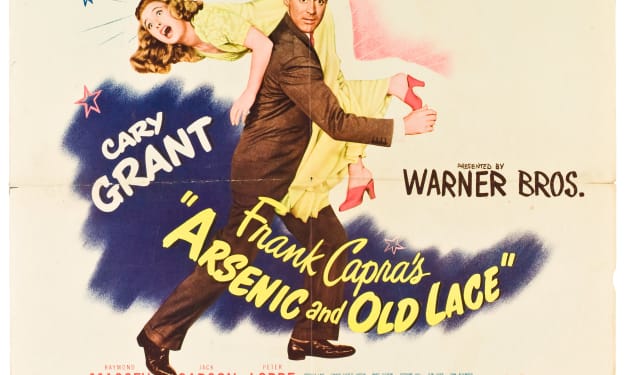
A Filmmaker's Review: "Arsenic and Old Lace" (1944)
An amazingly funny film and possibly one of the funniest dark comedies I have ever seen stars Cary Grant, Peter Lorre, Raymond Massey, Priscilla Lane and Jack Carson in "Arsenic and Old Lace" in which a family filled with murderers and insanity plans and plots against each other whilst all living in the same house. From getting the police involved, to planning a murder against another family member, this sure as hell should not be funny but sure as hell is definitely funny. There is something really hilarious in not only the jokes that are told, but the way in which people act which shows us that script has been brilliantly written to reflect the genre it is based within. A very difficult genre to actually get correct, the dark comedy type has shown to be one of the things that this film does perfectly and yet, at two hours long, it is a constantly brilliance from start to finish.
By Annie Kapur5 years ago in Geeks
Goodbye, Mr. Duvall
It is turning out to be an interesting year. I was in the middle of teaching a class when a pop-up appeared on the screen announcing the death of Mr. Robert Seldon Duvall (yes, that was his full name). I was in the middle of a discussion on the obsession we have with winning when it comes to sports (the Winter Olympics was a theme), and I felt as though things were coming full circle. We had already lost Gene Hackman last year, and along with that titan, it feels though one particular golden age has closed off to be replaced by...?
By Kendall Defoe 25 days ago in Geeks
My Etsy Journey and Listings
In mid-January this year, I opened an Etsy shop and named it 'ArtsforHealingGifts'. As of March 8, 2026, in my shop, I have 68 listings. I am tracking which items are working, which are not. Why success and failure happen? How can I improve the invisible ones?
By Seema Patel5 days ago in Geeks



Comments
There are no comments for this story
Be the first to respond and start the conversation.