
A Defence Of 'The Little Mermaid' Remake's Flounder, Sebastian, And Scuttle
They're really not so bad.


After multiple delays caused by the COVID-19 pandemic, the live-action remake of Disney's classic The Little Mermaid finally made it to theatres on May 26. The lead up to the film's release was mired by controversy, first due to Disney remake fatigue, with some fans questioning why the film should be made at all, and then, of course, the backlash against the casting of African-American singer/actress Halle Bailey as the titular little mermaid, Ariel, who is White in the original animated film.
However, as the film's release grew closer, and promotional material arrived giving a closer look at the wider cast of characters, fans' ire shifted to the appearance of Ariel's three animal sidekicks, Flounder, Sebastian, and Scuttle. All three received rather drastic redesigns for the film, resulting in quite a lot of backlash, sometimes even worse than Bailey's casting as Ariel.
However, there are some good reasons why fans owe the live-action takes on these classic characters a second chance.
Flounder

In both versions of The Little Mermaid, Flounder is Ariel's closest friend and confidan. He is the only other character initially aware of the secret Grotto where Ariel keeps her growing collection of Human items, and the two near inseparable in the early part of the film. The original film's Flounder is a yellow Tropical fish of an undetermined species. Despite his name, he is not actually a Flounder, nor is he a Guppy, as Ariel's playful teasing might suggest. He also does not function exactly as a real fish would, as he regularly pokes his head above water without suffering harm.

With the live-action remake, it was decided to portray the animal characters in the same true-to-life style of other remakes, such as The Jungle Book and The Lion King. This commitment to realism necessitated Flounder, voiced in the remake by Jacob Tremblay, a confirmed species, so it was decided to make him a Sergeant Major, as it most closely resembled the colour and patterns of the animated Flounder. On the downside, the change meant a reduced role for Flounder once Ariel gains her land legs.
When the first character posters for The Little Mermaid remake were revealed, fans slammed Flounder's new design, claiming that the character was not cute enough when compared with his animated counterpart. While that may seem like a winning argument to those who have a sentimental attachment to the animated original and it's characters, it does not take into account the remake's realistic style. The new Flounder fits the world he inhabits in the remake because he is a fish who looks, moves, and behaves like a real-life fish. A cuter, more cartoonish fish would not fit with the hyper-realism of the film's world, and would stand out for all the wrong reasons.
2. Sebastian
In the animated The Little Mermaid, it's two sequels, and the animated series based upon it, Sebastian is a small red crab with a Jamaican accent, voiced by Samuel E. Wright. He is the official court composer for Atlantica, and also often tasked by King Triton with keeping Ariel out of trouble. He performs forms an important function in the original through the fact that he is the only character able to accompany Ariel both underwater and on land, and in both versions of the film, he sings one of it's most iconic songs, 'Under The Sea'.
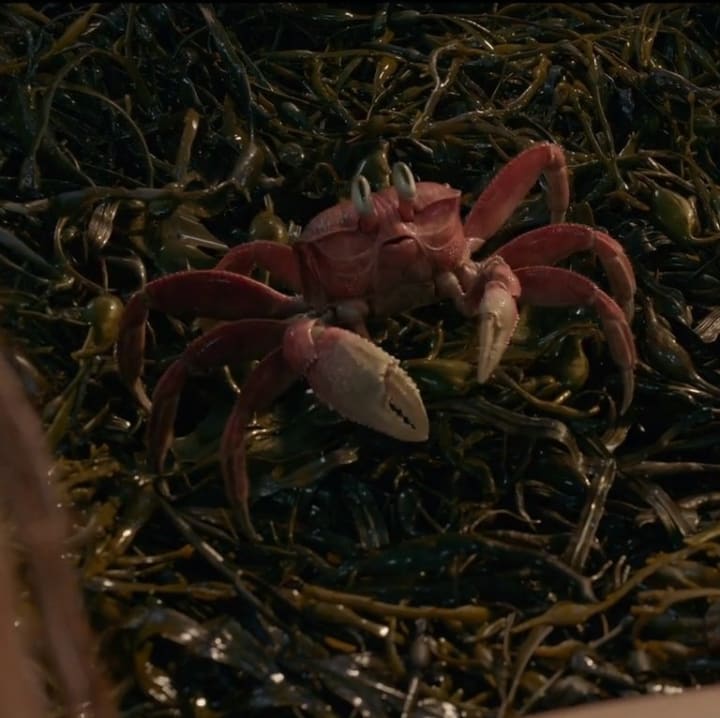
The remake's redesign of Sebastian, now voiced by Daveed Diggs, received similar complaints to that of Flounder, but clever fans have noted that this is far from the most glaring issue with the character. The 2023 film depicts Sebastian as a tropical Ghost Crab, a decision made due to the position of the Ghost Crab's face being easier to work with regarding interactions with other characters, and believing that animators could portray slightly more emotion in such a face. Sebastian provides a similar function to the original, as a character able to accompany Ariel both in and out of the ocean. The problem?
Real Ghost Crabs live solely on land, and will easily drown in water.
While this seems like a rather big slip, it is not entirely indefensible. Despite it's realistic style, The Little Mermaid remake is still based on a fairytale, so some artistic licence is to be expected. In a world where merpeople and sea witches exist, a normally land-dwelling creature able to survive under the sea is far from the most fantastical part of the story. It is also worth noting that, loved as he is, the animated Sebastian is far from perfect. Some modern day reviewers have pointed out that he more closely resembles a lobster than any real-life crab.
Scuttle
In the 1989 classic film, Scuttle appears as a male seagull. He is a self-proclaimed human expert, whom Ariel often visits for insight on her latest batch of human treasures. Unfortunately, and unbeknownst to Ariel, Scuttle's insights are often wrong. More prominent during the scenes set on land, Scuttle plays a vital role in the film's climax, discovering that Ursula is posing as Eric's new fiancee, Vanessa.
In the live-action remake, Scuttle is reimagined as a female Northern Gannet. While the gender swap was mostly accepted, many fans objected to Scuttle's change in species, and dismissed the new version of the character, now voiced by actress/comedian Awkwafina, as too annoying.
While clearly not a popular decision, there is a practical reason behind Scuttle's change in species. A Gannet, unlike a seagull, is a diving bird, which allows live-action Scuttle to play an active role in underwater scenes, where the animated Scuttle could not. Life long fans of the original film may also be letting nostalgia blind them to the fact that Scuttle was always supposed to be annoying. The only reason the live-action version could theoretically be more annoying is that Ariel herself becomes exasperated with her various points in the film, as opposed to animated Ariel who was always rather tolerant of her Scuttle, even when he was annoying everyone else.
A remake will never be exactly the same as the original, and that is not necessarily a bad thing. The best thing any fan can do is accept the new film for the separate entity that it is, and maybe, learn to like it on it's own merits.
About the Creator
Kristy Anderson
Passionate About all things Entertainment!
Keep reading
More stories from Kristy Anderson and writers in Geeks and other communities.
'Secret Invasion': Which Characters Are Most Likely To Be Revealed As Skrull Impostors?
The premiere of Secret Invasion, the latest Marvel Cinematic Universe series set to stream on Disney Plus, is now only a week away. Starring Samuel L. Jackson reprising his now iconic role of Nick Fury, the series main conflict involves a splinter faction of Skrulls under the leadership of Gravik, who, frustrated with Fury and Carol Danvers failure to fulfill the promise of finding them a new home planet, decide to secretly infiltrate Earth and steal resources.
By Kristy Anderson3 years ago in Geeks
History of The Three Stooges (Part I: The Beginnings and Columbia Pictures - 1920s-1936)
I have been itching to write about The Three Stooges on Vocal for close to two years, but I couldn't figure out how to do it. I wanted to do it by third Stooge, but that's a bit complicated. I know this much. I was about eight or nine years old when I first saw The Three Stooges. I remember one of my local channels had the Stooges on for hours, and I tried my damnedest to be up for those shorts. I remember that the Family Channel actually had an hour of the Stooges on from 11PM to midnight, and it was the entire library on during that time.
By Clyde E. Dawkins4 days ago in Geeks
Michael B. Jordan celebrates Oscar win with late-night burger run
The Academy Awards are arguably the highest acclaim that an artist or technician can achieve in the industry of film. Michael B. Jordan captured the ultimate prize for a male actor, the Oscar®. And then he went to a fast food joint. This balance of the greatest accolade in Hollywood history with simple expression of hunger not for a role but for a burger, ranks Jordan as one of the best people in the business.
By Skyler Saundersabout an hour ago in Geeks




Comments
There are no comments for this story
Be the first to respond and start the conversation.