
A Deep Look at "Hogan's Heroes"
A look at the controversial yet popular WWII-based sitcom that dominated CBS during the latter half of the 1960s

I had actually been sitting on any stories about this for a long while. I had patiently waited for the right time to discuss this classic sitcom, and then, I finally decided bout a month or so ago, I decided that the perfect time would be the anniversary of the show's premiere. The 60th anniversary, to be exact.
Hogan's Heroes. What a show. I learned about this show as a kid, but didn't watch an episode until about 18 years ago. When I was a kid, the reruns aired on a local channel, but when I started watching them repeatedly, TVLand had them. It reached a point where I bought the DVDs between 2007 and 2009, I love this show so much. It had long reached a point where I could recite every episode bit by bit, even the ones I don't watch as much as some others.
So here's the history of this epic sitcom:
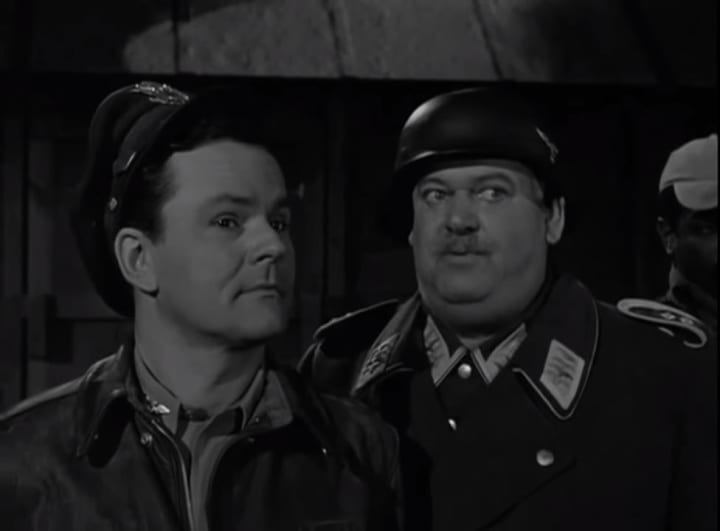
Hogan's Heroes continued a trend that was quite noticeable on TV during the 1960s: reliving World War II. There were already shows like McHale's Navy and Combat! airing on TV that had that same timed setting, but Hogan's Heroes ended up outshining both of them. As we all know, America's direct involvement in WWII began in 1942, and that was the setting revealed in the opening of the series pilot, "The Informer," which aired sixty years ago today, September 17, 1965, on CBS. The episode set up the storyline for the entire series. Stalag 13, the "toughest POW camp in all of Germany," the camp that has boasted an escape-proof record, was actually the centerpiece of an elaborately run operation from the camp's POWs.
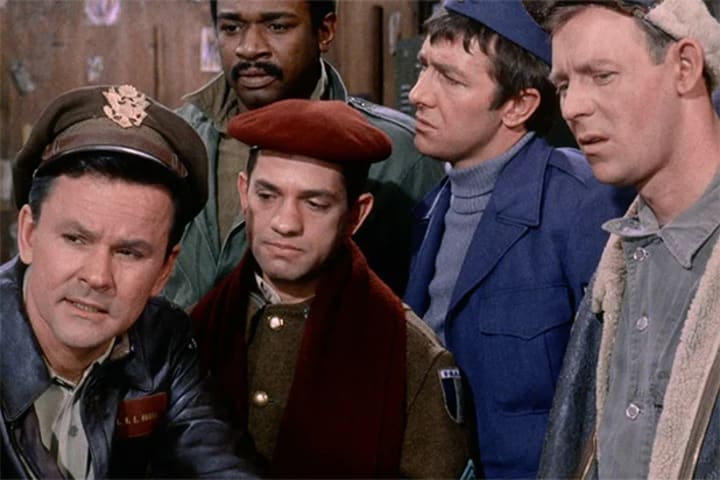
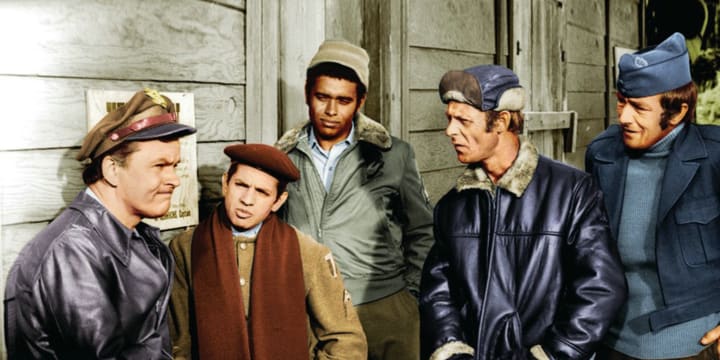
The leader of this outfit is Colonel Robert E. Hogan, and he and his group run an outfit that deals in espionage, getting people out of Germany, and of course, sabotage. Hogan's "Unsung Heroes" consists of French Corporal Louis LeBeau, who is the camp's chef, and his well-cooked meals often play a key role in the group's plans. Corporal Peter Newkirk (of the Royal Air Force) is the group's resident pickpocket, usually tasked with obtaining what's needed as part of their mission. U.S. Sergeant James Kinchloe was in charge of sending and receiving important radio messages from inside the group's emergency tunnel (which was part of a massive system). In the pilot episode, the fifth main member was a Russian named Vladimir, who was a tailor, but from the second episode, "Hold That Tiger," on, U.S. Sergeant Andrew J. Carter served as a permanent fixture, and was in charge of creating the necessary explosives needed for any and all sabotage plans.
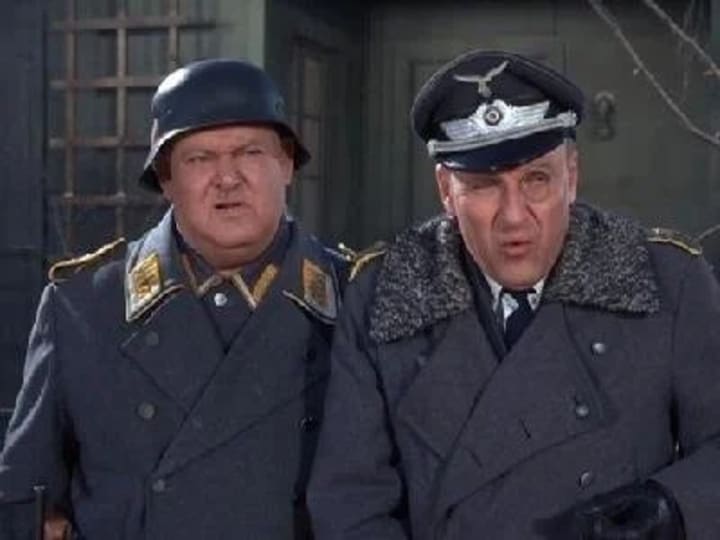
All of this was done under the very nose of the camp's commandant, Colonel Wilhelm Klink, who is as inept as they come. Despite his ineptness, nearly every episode has Klink voicing his expectations of promotions, as well as his boast that no one has ever escaped from Stalag 13. The Heroes, of course, rely on Klink's ineptness, as well as his presence, and they prevent any chance of promotion or any threat of him being shipped off to the Russian Front, because either outcome would result in a more competent replacement who could easily figure out the Heroes' operation.
The same could be said for the camp's top guard, Sergeant Hans Schultz, who is as inept as his commanding officer is. Schultz's main trait involves spilling secrets to the group in exchange for bribes, usually edible ones. According to Hogan in the episode, "The Flight of the Valkyrie," the group only bribed Schultz's once, and since then, they tell him things he shouldn't know. Of course, this (as well as stumbling into a Heroes mission) results in Schultz's signature catchphrase: "I know nothing!"
Regarding the cast, the series starred Bob Crane as Col. Hogan, and served as Crane's best remembered role. The series also starred Werner Klemperer as the monocle wearing Col. Klink, and prior to this, Klemperer had appeared in several different series and films, usually in dramatic roles. The story of how Klemperer accepted the role always fascinated me. I've read many times that Klink's characteristics were all by Klemperer's design, and it was also stated that Klemperer only accepted the role under his own condition that Hogan and his group always won in the end. Sgt. Schultz was played by John Banner, and here's a fun fact; both Banner and Klemperer appeared together in an episode of Alfred Hitchcock Presents.
Regarding the other Heroes, French actor Robert Clary portrayed Cpl. Louis LeBeau, while Cpl. Peter Newkirk was portrayed by English actor/comedian Richard Dawson. Yes, that Richard Dawson, folks. Ivan Dixon portrayed Sgt. James Kinchloe, and regarding Dixon and his character, the series really made history in that regard. For decades, Black characters were portrayed very negatively with way too many stereotypes, but when it came to Dixon's Kinchloe, he was portrayed as not only having abilities to operate the group's main radio system, he was also multi-lingual, as he was shown speaking English, French, and German. Granted, the series premiered right as the backwards Jim Crow era was ending, but it was still a not-so-progressive period, so the portrayal of Kinch on the series was a huge positive. Larry Hovis portrayed Sgt. Carter, whose little blunders did make things difficult for the Heroes' missions, but he would always come through.
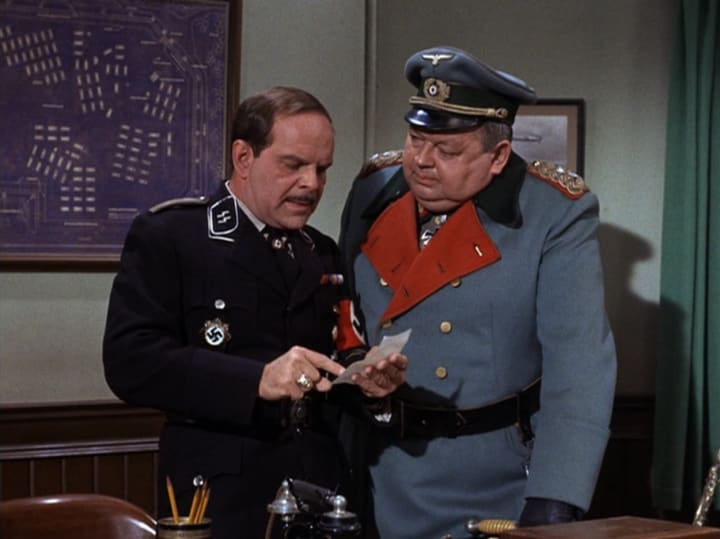
The series definitely had its other regular characters, with the two main ones being General Burkhalter and Major Hochstetter. General Albert Burkhalter first appeared in the pilot episode and was introduced as a colonel, but was clearly promoted to general afterwards. Portrayed by Leon Askin, Burkhalter was Klink's main superior, and was often on the receiving end of Klink's sycophantic boasts and conduct, which annoyed Burkhalter to no end. Burkhalter always knew how incompetent Klink was, and often let him know it. It always seemed that he respected Hogan more than Klink, and of course, it was often Burkhalter who delivered the threats to send Klink to the Russian Front. Well, that wasn't the only threat: he also tried many times to set Klink up with his sister, Gertrude Linkmyer. As LeBeau once said in an episode, "Klink's better off at the Russian Front."
Another regular character was Major Wolfgang Hochstetter, played by Howard Caine, who's first appearances on the show were interesting. Caine first appeared in Season One's "Happy Birthday, Adolph," as Luftwaffe Major Keitel, and it was in Season Two's "The Battle of Stalag 13," that Caine appeared as Gestapo Major Feldkamp. In the latter, Feldkamp served as the precursor to Caine's more familiar Hochstetter character, from the mannerisms to the catchphrases. Feldkamp's appearance saw him shout his familiar line, "Who is this man?!," regarding Hogan, and that trait remained when Caine made his official first appearance as Hochstetter in "Heil Klink." From Season Three on, Hochstetter's line changed to, "What is this man doing here?!," and that same season would see Burkhalter and Hochstetter reference each other, before starting to appear together in Season Four.
The show was known for the memorable female characters as well. Throughout the series, Klink had a secretary, Helga, in Season One, who was played by Cynthia Lynn, but from Season Two on, a different woman, Hilda, served as Klink's secretary. Hilda was played by Patricia Olsen (who was credited as Sigrid Valdis), who later became the real-life wife of Bob Crane. Both Helga and Hilda actually played small roles in Hogan's plans, with Hogan often giving nylons and jewelry as incentive. I mentioned Gertrude Linkmyer, she appeared in five episodes of the series; played by Kathleen Freeman in four of them, and played by Alice Ghostley in Season Four's "Watch the Trains Go By."
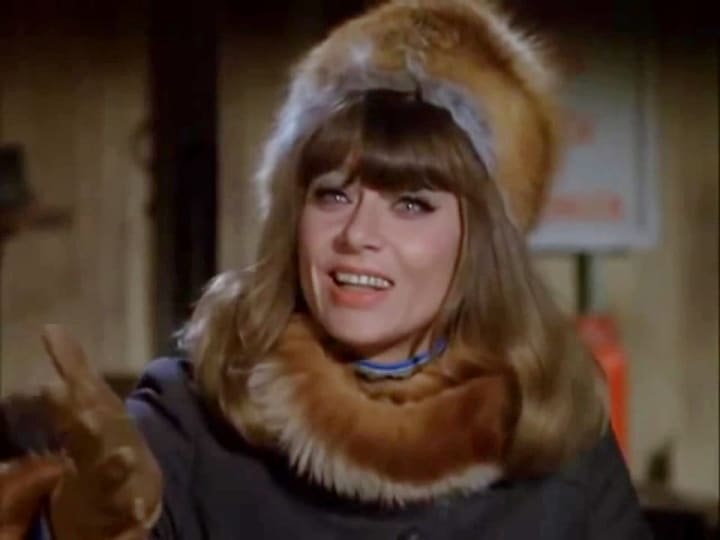
The second-ever episode, "Hold That Tiger," introduced us to the titular Tiger, a female Underground agent who was a strong ally to the Heroes. She was played by Arlene Martel, who also played a few different characters on the series. However, the most known female character on the show has to be Marya, who was introduced in the two-part episode, "A Tiger Hunt in Paris." Marya was an enigmatic Russian woman who helped Hogan and LeBeau free Tiger from the Gestapo in Paris, and she would become a bit of a staple after that. Every appearance went as follows: Marya would be seen with some high level German, always leading Hogan (who was always wary of Marya) to display immense distrust in Marya, even believing that Marya turned heel and defected to the Germans. This was never the case, Marya was always revealed to be in Hogan's corner, and she was often using whatever German she was with to help the Heroes.
More traits in Marya's episodes included her affections for not only Hogan, but LeBeau as well, with the French latter always being excited to see Marya. Marya was played very well by Nita Talbot, the only surviving semi-regular actress from the series. She appeared in seven episodes of the series, and was nominated for an Emmy for her appearance in Season Three's "The Hostage."
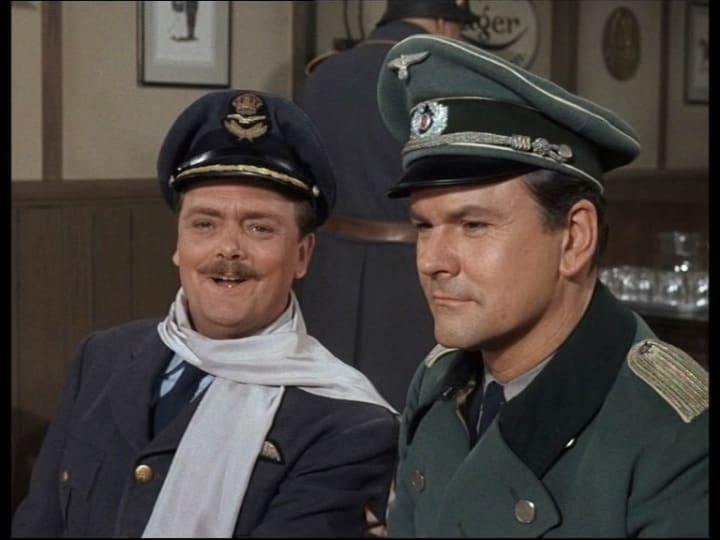
Of course, I have to mention Colonel Crittendon. I have to. Another character who popped up quite a bit was Col. Rodney Crittendon, played humorously by Bernard Fox. Crittendon was introduced in Season One's "The Flight of the Valkyrie," where Klink reveals to Hogan that he had Crittendon transferred to Stalag 13 just to mess with Hogan, mainly because Crittendon's date of rank places him higher than Hogan. It gets worse after Hogan makes cryptic statements to Crittendon about an outfit that engages in espionage. Crittendon stated that such actions are "bad show," and that he'd report any such activities to Klink, while adding that a prisoner's only duty is to escape.
That would change later in the season when Crittendon returned in "The Assassin." Crittendon was inadvertently dragged into the camp by Kinch, via the emergency tunnel, while the guy they intended to bring in was captured. Crittendon emerges, having seen everything, and is not only impressed, he wants in. That was the formula from that point on. However, I always referred to Crittendon as the "Allies equivalent of Klink," because Crittendon is quite inept and has nearly caused mission to go wrong because of his incompetence. In fact, a running gag always saw Crittendon mention the many times he failed to escape.
As I mentioned before, Hogan's Heroes premiered on September 17, 1965 with "The Informer," the series' lone black-and-white episode. The Heroes' plans always bordered on the impossible, with plots including abducting a German general to gain access to his contacts, having Carter pose as Hitler as a distraction so the Heroes could deliver important film to England, getting various high profile people out of Germany, and even actually convincing the Germans that WWII was over--among many other schemes.
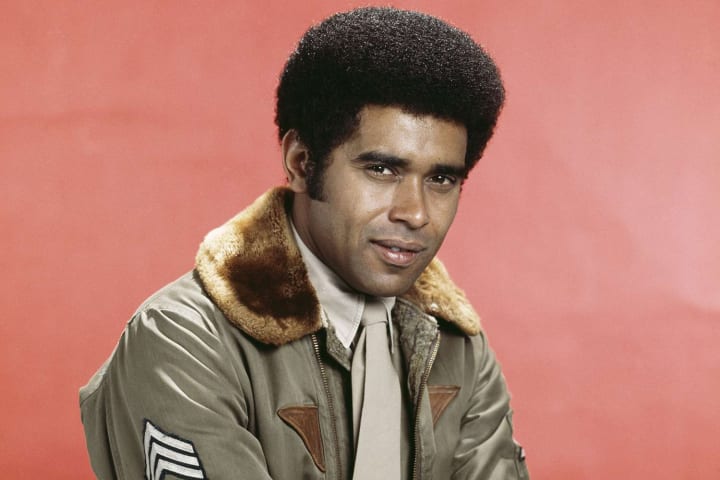
The cast underwent a significant change entering Season Six. After five seasons, Ivan Dixon left the series, and for Season Six (1970-71), the void was filled by Kenneth Washington, who played Sgt. Richard Baker. Baker had the same duties that Kinch had; mainly being in charge of receiving and sending messages in the system's main radio. Baker was a good addition to Season Six, I also liked how the show's music stings drastically changed for that year as well, it was like watching a whole different program.
Season Six ended up being the show's last, as CBS pulled the plug on the series in 1971. Regarding a reason, I've read many times (including one instance where Howard Caine--whose last appearance came in "The Kamikazes Are Coming"--actually stated this) that CBS' wanted to go with a more family friendly approach for the 1971-72 season, and, well, reliving the Second World War isn't exactly family friendly. "Rockets or Romance," the 168th and final episode of the series, aired on CBS on April 4, 1971, and reruns of the show aired on the network until exactly three months later.
Hogan's Heroes wasn't without controversy. I remember learning about the casting controversy a long time ago, and I'm going to have to be blunt. I say "Germans" in this, but the characters were Nazis--in fact, "Nazis" is said quite a bit on the series. A good bit of them were played by Jewish actors; in fact, the main four--Klink, Schultz, Burkhalter, and Hochstetter--were all played by Jewish actors, with other guest actors such as Alan Oppenheimer, Harold Gould, and Harold J. Stone also playing Nazi characters.
Jewish actors playing the very horrible group who constantly persecuted them is quite a trait, but while it was controversial, the reason for this was simple: it was done to completely mock those filthy Nazis. A number of the actors had their real life stories. Werner Klemperer and his family escaped from Nazi Germany when Klemperer was a child. Leon Askin was arrested by the Gestapo and fled Austria. Robert Clary was imprisoned in Buchenwald, a concentration camp. So yeah, they took those roles to completely obliterate that awful cult. As stated before, Klemperer took the role of Klink under the condition that Klink be portrayed as a bumbling moron and that Hogan and his crew always succeeded. Same was said regarding Askin playing Burkhalter; he wanted to use that role to fully mock and bury the very people who persecuted him. That's what Hogan's Heroes did: the show mocked, laughed at, and totally obliterated the Nazi "regime." And guess what: the show's popular as hell in Germany.
I still watch the reruns religiously. I have the DVDs, and most of the episodes are currently up on Amazon Prime, while the entire series is on PlutoTV. I love Hogan's Heroes with a passion; from the theme, the hijinks, the many ways the boys fuck with Klink and Schultz, you name it. One of the reasons why I saw Inglorious Basterds in 2009 is because it was basically Hogan's Heroes on steroids. The show remains an absolute landmark in TV history, even now, 60 years to the day after the show's premiere.
About the Creator
Clyde E. Dawkins
I'm a big sports fan, especially hockey, and I've been a fan of villainesses since I was eight! My favorite shows are The Simpsons and Family Guy, etc.
Keep reading
More stories from Clyde E. Dawkins and writers in Geeks and other communities.
"Beyond the Gates" Week 26 Review
Please forgive my lateness for this recap, because once again, CBS placed Beyond the Gates on yet another hiatus. While the end of August saw more new episodes, the beginning of September didn't. The first five days of September came and went, with no new episodes of Beyond the Gates. This is the third time we've seen a hiatus like this, and the soap's only been on for a hair over six months. I'll just say it: the hiatuses are racially motivated. Why is BTG being put on these random breaks, but Y&R and B&B run uninterrupted? CBS has been targeting any shows with representation for while now. Yes, BTG's getting another season, but still. There's only one good reason to pre-empt anything from CBS Daytime, and that's the beginning of March Madness. Other than that: run it!
By Clyde E. Dawkins4 months ago in Geeks
The Rachels - 2025
Much to my surprise, I have kept a list of the films I‘ve seen this year. I daresay it isn’t complete. There will be films that snuck in on a late night in front of the TV that I would’ve forgotten to note. Or others, that I went to watch at the cinema, but then had a red wine and promptly forgotten about. But it’s not a bad approximation of the films I’ve seen this year. In total, there are 53 films listed, so an average of one a week and one for good luck.
By Rachel Robbins20 days ago in Geeks
The Tragic Heart of Tristan and Isolde: Revisiting the 2006 Movie
Plot Summary Set during the Dark Ages, Tristan & Isolde follows the story of Tristan, a loyal knight, and Isolde, an Irish princess whose marriage is meant to unite divided kingdoms. When fate brings them together, they fall in love, challenging loyalty, honor, and duty. Torn between passion and obligation, they must navigate political intrigue, betrayal and rigid expectations of their society.
By TheScreenAnalyst6 days ago in Geeks



Comments (1)
Wow you do in depth reviews. This is really well done.