
9 Anime for People Who Don't Like Anime
A Non-Otaku's Guide to What To Watch and Why

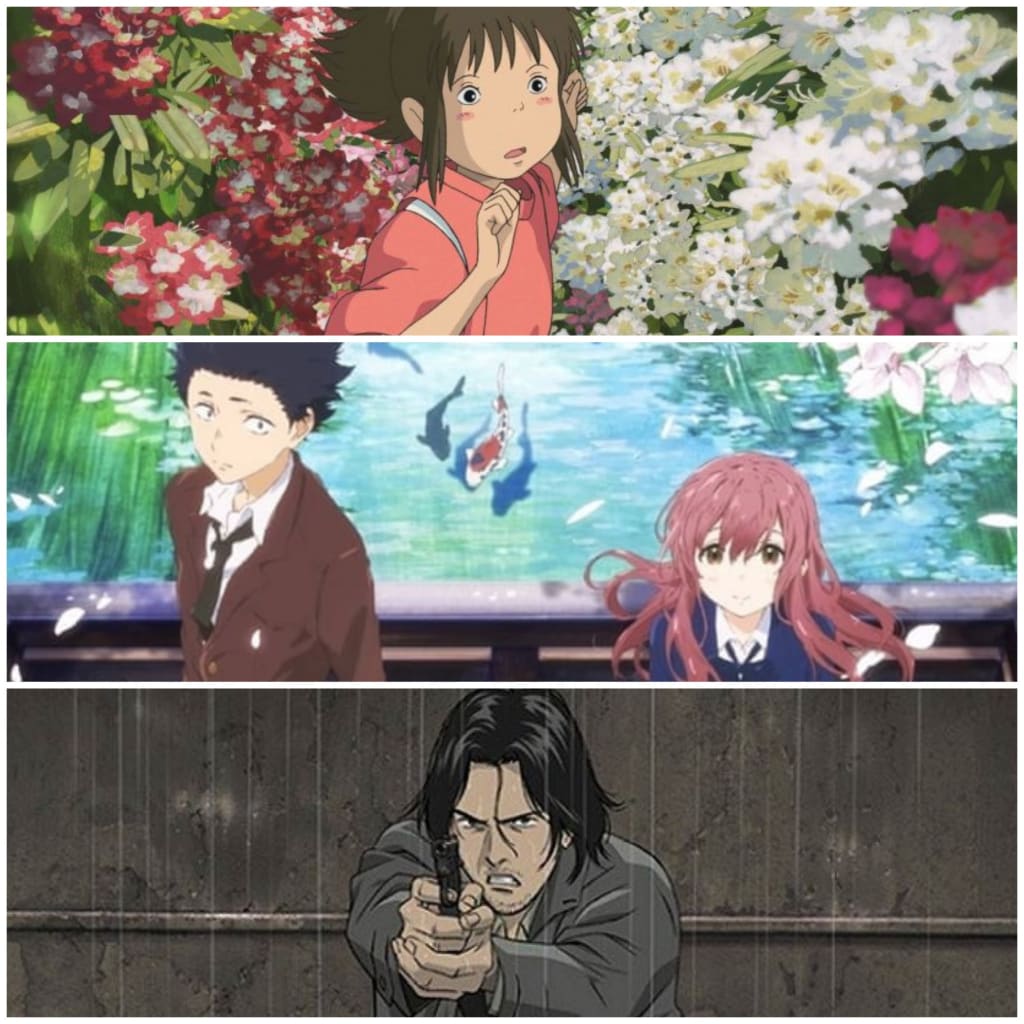
"I don't like anime." A phrase pretty commonly heard when you give suggestions on things to watch. I realize that when people say this, what they really mean is: "I don't like the art style of anime" or "I don't like the overdramatic voice acting" or "I don't like the obvious fan-service." And, I'll be honest, these are all valid reasons to not want to watch certain anime. Is there a lot of slop, smut, and cringe content in many anime? Yes, yes, and yes.
However, there's also a lot of truly beautiful pieces of art that I feel people would give a chance to if they didn't happen to fall under the anime umbrella.
See, anime is not just one genre--it is just the Japanese word for "animation." So when western anime fans refer to "anime" 95% of the time they are referring to animation that comes from Japan--and not just one singular style or genre. Anime as a whole is more of an umbrella term embodying Japanese animation. Underneath that umbrella there are many different genres, just like there are in western animation: Kids' shows, action shows, drama, comedy, romance, mystery, etc,.
I love anime, but I'll admit that many anime shows have tropes that are annoying or unappealing to people who don't watch much anime. As much as I love it, I won't put JoJo's Bizarre Adventure on this list, because I can't honestly recommend it to someone who "doesn't like" anime. Instead, I've found some anime that don't embody what the uninitiated tend to think of when they think of anime.
Here are some great anime that I think can be enjoyed by anyone, even people who "don't like" anime:
Monster
This is not only my favorite anime, but it is probably one of my favorite pieces of media of all time--or at least within my top five. While I may be biased in that regard, I don't think it's so niche that it would be unenjoyable to people who aren't usually fans of anime.
The story is about Kenzo Tenma, a prodigious Japanese surgeon living and working in West Germany. He performs life saving surgery on a child who was brought in critical condition with a bullet wound to the head. He defies orders from his superiors to instead operate on the mayor--who arrived after the child--Not wanting a child to die because he didn't hold the same status. Ten years later, Tenma has a run-in with Johan Liebert, the child he saved, who has become a cold, ruthless killer. Tenma vows to destroy the monster he saved. But digging into Johan's past, he discovers many disturbing secrets that may have led Johan to become who he is today.
Monster is a brilliantly philosophical, thought-provoking piece of work. Is evil born, or created? Is killing evil a necessary good, or does the act of killing in any circumstance make one evil? If all life is equal, does that include people who also take the lives of others? Is Johan the titular monster, or is the society that failed to love and protect him the real monster? Is it possible to be entirely pure and good, or does everyone have a little bit of evil living inside of them? These questions are never truly answered--as they shouldn't be. It allows the viewers to think about these things on a deeper level. The characters are incredibly written, and the story is full of twists and turns that will leave you glued to your seat.
Apart from having a suspenseful plot and rich character development, what's also stunning is how real it all feels. The voice acting is natural and not over-the-top. Johan is a soft-spoken, quiet person who easily flies under the radar--as opposed to a loud, flashy, flamboyant anime villain. The drawing style also feels realistic in the sense that these people look like people who would actually exist: No giant sparkly eyes or women with breasts disproportionate to the rest of their body.
Erased
After coming home to find his mother murdered by an intruder, Satoru Fujinuma suddenly gets transported back into his eleven-year-old body. Now living in his past, he tries to save his mother by first saving a troubled classmate who was kidnapped and murdered. Can he prevent both tragedies from happening by making different choices in life this time around?
Erased is not only a great mystery-suspense story; but also a very emotional piece of work that touches on how every small action can drastically change outcome. It is also suspenseful. Its short duration (12 episodes) means no episode is a "filler" episode and everything is important. I watched this with my parents--who are not anime enthusiasts--and they enjoyed it for those aspects.
While the ending tends to be quite polarizing, I and everyone I know who has watched the series, was satisfied with it. Plus, the opening theme is a real banger.
Death Note
Light Yagami, a gifted high school student, sees a mysterious notebook fall out of the sky. Upon closer inspection, he finds out the names of people written in the book will die. Rather than ignore the book, he decides to use the book to cleanse the world of criminals. But when the police force catches on to the mass deaths of criminals, an investigation is opened and Light finds himself in a battle of wits with the quirky, but ingenious, L--the world's most gifted detective. Chaos ensues.
In Japanese society, juvenile delinquency goes unchecked a lot. No matter how vile the crime, if it is committed by a minor, they get practically zero punishment. It's a topic that is explored frequently in Japanese media. At first, Light Yagami is supposed to be relatable for anyone who has a sense of justice. But as the series progresses, he keeps pushing things further and further until there's a huge grey line between how much of what he does is for justice--and how much of it is just to fuel his God complex. (For example: The clip above shows him using the Death Note to sentence an innocent woman to her death for trying to get justice for her fiancé who was also killed by Light via Death Note.)
In this way, it also kind of turns the mirror on the viewers and reveals their own true nature when it comes to such matters as well. Plenty of fans still sympathize with Light up until the very end, while plenty of others wind up hating him by the end. This is why Death Note is a great "Starter Anime" for people who are new to the medium. It isn't just senseless violence or shock value as one might expect. It forces them to think about what they would do if they were given the same power.
Berserk (1997)
Guts, a child born to a hanged corpse, kills his abusive stepfather and runs away. He stumbles upon a group of mercenaries called The Band of the Hawk. Their charismatic leader, Griffith, is impressed by Guts' sword fighting skills, and recruits him. Guts, though aloof and traumatized, forms an emotional bond with the soldiers. Even so, he leaves the Band to focus on his own life path--and Griffith's façade of nobility begins to crack.
Berserk is a manga written and illustrated by Kentaro Miura. It has been running since 1989, and has had several adaptations. However, the 1997 adaptation seems to be the one most worth watching according to fans, even though it ends on a pretty big cliffhanger.
Berserk is truly exciting and has strong character development. Even minor characters are written in such a way that you want to see them succeed. I'm not usually a fan of fantasy or medieval period pieces, but I did enjoy Berserk because the characters made me care. If nothing else, it's an amazing character study. It's less about the battles being fought, and more about the bond between the characters.
The protagonist, Guts, is not your typical anime hero. In fact, he's a very morally neutral person. The only reason you sympathize with him initially is because childhood flashbacks make him sympathetic. There's also no "Wait guys, violence might be bad :(" moment that can often be found in anime. The story takes place in medieval times and follows a band of mercenaries. So yes, due to time period, they kill out of necessity and often think nothing of it. But even so, the focus is more on their relationships with one another, and less on the horrors of the wars they're fighting.
Your Name
Taki, a city boy in Tokyo, switches bodies with Mitsuha--a rural countryside girl. The two have never met, and have no idea why they keep switching bodies with one another. But after living in each other's shoes, they start to fall for each other.
A mixture of time warp films like The Lake House and body switch movies, Your Name takes the best features from both of these genres and mixes them into a beautifully poetic film that covers love, fate, and soul mates. The beautiful animation and rousing soundtrack provided by RADWIMPS, is the cherry on top!
Admittedly, it's been awhile since I've watched this movie. But I do know my friend, who doesn't like anime at all, really enjoyed it and the love story around it. You'll laugh and cry and long for a fateful love as sincere as what's presented.
A Silent Voice
As a child, Shoya Ishida and his classmates relentlessly bullied Shouko Nishimiya--a deaf girl in their class. When she changes schools to escape the bullying, the rest of the class blames Ishida and turns their bullying onto him. Now that he's a teenager, he has learned sign language so he can apologize to Shouko before he ends his life. However, Shouko not only forgives him, but also wants to become his friend.
No piece of media explores the "othering" of a collective society, in such an emotional, gut-wrenching way. Not only is the art absolutely beautiful, but within the first twenty minutes you'll already have bawled your eyes completely dry. (I was stupid and watched this while at work at my desk job and was trying very hard not to make my crying obvious...But it was.)
It's a real whirlwind of emotions throughout, but by the end it will be worth it.
Perfect Blue
Mima is a pop idol who leaves her music career behind to become an actress. However, there is someone doesn't want her to succeed in acting and will go to great lengths to destroy her new career.
Many people claim Satoshi Kon, the director and writer of this story, predicted social media. There is definitely a look at "personas" people put on vs. their true selves. People indeed do have a hard time distinguishing reality from internet.
While there is definitely some overlap, the film is more about idol culture in Japan. Pop idols, like Mima, in Japan are supposed to be bastions of purity and innocence. They're put on a pedestal and expected to live up to some pretty unrealistic standards. As such, when Mima walks away from that life and into a new one where she plays roles that are much more mature, it's seen as a betrayal to her fanbase. Mima begins to question her identity, and we go along on this ride with her. There's points where everything meshes together and we can't tell what's actually happening and what's just part of a scene she's acting in.
Satoshi Kon was a genius. He's also created works like Paprika, Paranoia Agent, and Tokyo Godfathers. The character design--much like Monster--follows realistic standards. The people look like people who might exist. Even though the horror is very much psychological, there's also a lot of realism to the movie. To the point that it could have just as easily been created as a live action film.
In fact, Darren Aronofsky's Black Swan was heavily inspired by Perfect Blue. Though that movie deals more with the internal struggle of perfectionism and impostor syndrome. Perfect Blue is more of a comment on how Japanese society treats the stars they claim to idolize, and the mental toll it can take on them.
Spirited Away
Chihiro wanders away from her parents during a road trip and finds herself in the spirit world, where she takes on the job of being an attendant for a bath house whose main clientele is spirits.
Studio Ghibli has a lot of movies that are great anime for people who don't like anime--mostly because Hayao Miyazaki also hates anime (or rather, the culture of it.) So he doesn't make films solely for people who are versed in anime--he makes them for everyone. Spirited Away, however, is probably the best received of all of them. It was the first anime feature film to win an Oscar.
It's easy to see why, it has everything you could want in a good movie: Great soundtrack, great characters, it is visually stunning, and has fantastic worldbuilding.
The cool thing about Miyazaki is that he is a feminist. Which for a man his age is already uncommon, and in a country like Japan, even more so. Even though it takes place around a bath house, there's no sexualization of any of the female characters. Well duh, it's also supposed to appeal to a younger audience. But there's no jokes or comments about women that might fly over a kid's head. Not like you might see in some other films for younger audiences. (Disney has so many there's full listicles and videos about them.) It is truly 100% family friendly and not degrading to anyone at all.
Neon Genesis Evangelion
Fourteen-year-old Shinji Ikari receives a call from his estranged father who is head of NERV--an agency that uses children to pilot large mecha robots to protect Tokyo. It turns out his father only wanted him so he could act as a new pilot. Wanting to win his father's approval, Shinji reluctantly agrees. But there may be something more sinister behind the origins of these robots.
You know the phrase: "Great art should disturb the comforted, and comfort the disturbed"? That's exactly what Evangelion is. What you think you're getting is a regular mecha fighting anime. But what you're actually getting is a surrealist deep dive into the psyches of multiple traumatized individuals and shown how their trauma manifests in different ways.
The emotions are raw and unfiltered--because Shinji is creator Hideki Anno's self-insert. Creating Evangelion was like therapy for him. Anyone who has ever felt a despairing sense of loneliness and isolation will find comfort in the show. But it's not just about the show's feelings--it's also a masterclass on how to make visually stunning animation.
The takeaway from the show isn't the "power of friendship saves the day" trope you'll find in a lot of shonen anime. It's actually the exact opposite of that: In the end, you're the only person you can truly count on, and who truly knows who you are, so be kind to yourself, stop seeking validation from external sources, etc,.
About the Creator
Jennifer Childers
I just write thoughts on anime, games, music, movies, or other things that are on my mind. Occasionally a poem or short story might come up.
Keep reading
More stories from Jennifer Childers and writers in Geeks and other communities.
Know Your Anime and Manga Demographic Groups
There are thousands upon thousands of manga magazines in Japan, and they each are made to appeal to a certain demographic based on gender and age. So whenever a new manga (or anime) comes into the fold, it is quickly assigned a demographic so it can be pitched to the correct magazine or television time slot. It will be either shonen, seinen, shojo, josei, or kodomo-muke.
By Jennifer Childers2 years ago in Geeks
The Politics of Playing Dress-Up
Well, to start off I'd like to say a happy world book day to all who celebrate. I know I haven't really posted anything on my socials about it but I'm not a jubilant kind of person. I lay low most of the time. Let's start off with a popular anecdote from the vaults...
By Annie Kapur8 days ago in Geeks
Private Lives by Noel Coward
Background and Context: I first read Private Lives in my late teens whilst I was doing work experience at an independent theatre somewhere in my hometown. All I can say is that it smelt like burning wood inside, I ended up getting sick from what I can only describe as a damp atmosphere and the words 'the show must go on' were carved on a beam above your head as you walked backstage. Until a fractured my wrist, I actually really enjoyed myself.
By Annie Kapur7 days ago in Geeks


Comments