
7 Iconic Movie Characters Who Were Played By Multiple Actors
Even the most iconic actors may come and go but iconic characters always stand the test of time. It goes to show that portraying a character isn’t always just a one person job.

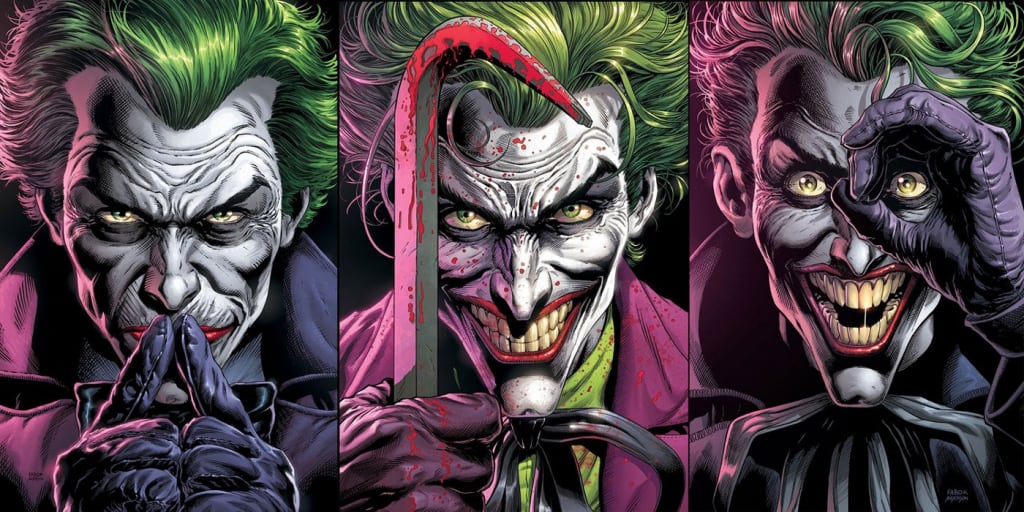
As people who watch and enjoy films, we’ve seen our share of long standing franchises, reboots, remakes, sequels and prequels. Over the years, we have grown to realise that one character cannot always be confined to being played by one actor. Sometimes, the plot of a story may require multiple actors to play a single character such as in a prequel or if the story deals with time travel or alternate realities.
Other times, outside factors may necessitate the need to recast a role. Actors may die in between instalments, may leave due to disagreements behind the scenes or may no longer be physically able to play a certain role. Other times, a franchise may be rebooted and the entire cast may be reset. In this list, we will look into 7 of the most notable recasts of iconic movie characters.
7. Terrence Howard to Don Cheadle as War Machine (Marvel Cinematic Universe)

One thing you’ll soon notice about this list is that it features characters from the Superhero genre more than any other. After all, superhero movies are more frequently rebooted than basically any other film genre and even if they are not, their storylines and plots may often necessitate the need for more than one person to play a single character. That’s where the character of the War Machine (alias of James Rhodes) stands out.
Played by Terrence Howard in the first Iron Man film and then by Don Cheadle in every subsequent appearance, the casting change was not brought about by a reboot or plot point as is the norm of superhero films. Instead, the change was made purely for financial reasons. Howard had received the largest pay day amongst all his co-stars in the first Iron Man film. However by the time of Iron Man 2, Robert Downey Jr had firmly reestablished himself as one of Hollywood’s most in demand actors and commanded a salary worthy of his reputation. Howard was not only able to secure a pay-check comparable to that of the film’s main character but was offered less money than before. Dissatisfied, Howard left the one-time role for good.
Don Cheadle was then brought in as a last minute replacement and has remained in the role for over a decade now. Unlike Howard, Cheadle was more willing to play the supporting part to RDJ’s main hero and did not attempt to assert himself into the top-billing. Cheadle admitted to being unfamiliar with the Marvel Universe unlike Howard who was a big fan of the War Machine character and the creator’s first choice. Ironically, despite his self admitted unfamiliarity, it was Cheadle who first donned the War Machine armor on the big screen and is to most fans, the better suited actor for the role of Tony Stark’s best friends. Now some eleven years since Cheadle donned his armor, he has six movies and counting under his belt as well as a series starring him in the works. Not bad for a last minute replacement.
6. Edward Norton to Mark Ruffalo Bruce Banner/ The Hulk (Marvel Cinematic Universe)

War Machine may have been the first MCU casting change but by no means was it the last. In fact, one could say it was not even as significant as the change from Edward Norton to Mark Ruffalo as the character of Bruce Banner and his alter ego, the Incredible Hulk. Switching out a supporting cast member is one thing but a main character is a whole other story.
For the record, Norton and Ruffalo are not the only two men to have portrayed the Hulk on screen. Eric Bana had portrayed the character in the unrelated, non-MCU film in 2003 while Bill Bixby and Lou Ferrigno shared the role in the 1970s. However, the earlier casting changes were just simple cases of rebooting and long hiatuses which necessitated newer actors. Thus, only the change between Norton and Ruffalo will be looked at since they are meant to portray the exact same character in the exact same continuity.
Norton first took the role of Banner in 2008’s Hulk movie, released shortly after Iron Man, it was not as successful but did well nonetheless. Norton’s performance was looked at favourably and to date, his portrayal of Bruce Banner/The Hulk is the only one to have had its own dedicated film. However, massive creative differences between Norton and the studio led to him walking out of the role before the character was recast for 2012’s The Avengers. Ruffalo has remained as MCU’s Hulk ever since then and has grown into the role with a rather different take on the character.
While many feel that Ruffalo’s Hulk was too lighthearted especially compared to the grittier “Jekyll and Hyde“ type conflict seen in Norton’s role, it was a step in the character’s evolution that was also in line with the MCU’s direction. While Norton was better at showing the anguish and struggles of Bruce Banner, the man, Ruffalo could be said to be the better superhero. Effectively showing and then later fusing both Banner and the Hulk, Ruffalo was able to keep the Hulk as a mainstay in the MCU even without having to be in a film of his own.
5. Richard Harris to Michael Gambon as Albus Dumbledore (Harry Potter Series)

Moving away briefly from the superhero genre and into the world of magic and fantasy, we have the character of Albus Dumbledore from the Harry Potter movies. One of the series’ most recognisable characters, three men have taken up the role of Hogwarts’ headmaster: Richard Harris, Michael Gambon and Jude Law. Since the transition from Gambon to Law was a simple case of replacing an older actor with a younger one for a sequel, we will focus more on the transition between Harris and Gambon.
Richard Harris was already at the tail-end of an acclaimed career and had been facing a decline in health, a result of many years of hard living. However, he took on the role of Dumbledore at the insistence of his young granddaughter who threatened to never speak to him again if he refused. Despite his failing health, Harris played Dumbledore to perfection. Establishing him as a warm and wise figure in the first two instalments of the mainline Harry Potter films. Harris’ death after Harry Potter and the Chamber of Secrets seemed to have coincided with the series’ gradual shift into a darker direction. Had Harris been alive, it would have been difficult to picture him shedding the grandfatherly image he had established for a more gritty persona or partake in the more physically demanding scenes that came with Dumbeldore’s growing involvement in the story.
That is where Harris’ replacement Michael Gambon shone. Although Harris’ family had requested his friend Peter O’Toole to serve as his replacement, the studio however was worried that he too would die before the end of the franchise. So, the decision was made to cast Gambon, who was ten years younger than Harris, into the role. Aesthetically, it was a seamless transition as the long flowing robes and equally long beard allowed both actors to bear a convincing enough resemblance to each other while playing the role.
However, Gambon brought a level of aggression to the character that Harris never showed. Although fitting with the tonal shift of the franchise, it did start out admittedly a bit overdone (that scene in Goblet Of Fire especially!). However, in subsequent instalments, Gambon was soon able to balance out Dumbledore’s more intense qualities with the wisdom and whimsicalness first introduced by Harris in the earlier movies.
Despite being a necessary recasting brought about by an actor’s death, what I find most interesting was how well suited both Harris and Gambon were to their roles. Despite playing the same character in the same continuity, their portrayals were distinct yet equally fitting in the movies they were in. For us fans who grew up with the Harry Potter movies, Harris’ Dumbledore was the perfect introduction to our ideal version of a wizard while Gambon’s Dumbledore showed us as we matured, the man behind said wizard. Basically, Gambon could not have played Dumbledore in the first two movies as Harris did and vice-versa.
4. Heath Ledger to Various Actors as Tony Shepard (The Imaginarium of Doctor Parnassus)
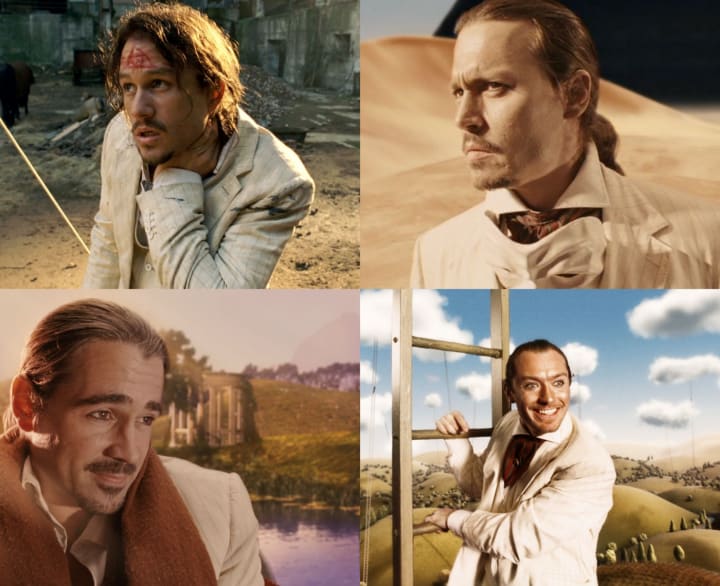
In our previous entry, the character of Dumbledore was a very known example of a somewhat normal occurrence, recasting a role for a subsequent film because the earlier actor had died. It’s happened in the years before and should the need arise, will happen again. What is more uncommon though, is replacing an actor who has passed away midway into production. Even rarer still, replacing him with three other actors.
This is what happened in 2009’s Terry Gilliam directed fantasy movie, The Imaginarium of Doctor Parnassus. The legendary Heath Ledger, in what was his final film appearance, was cast in a leading role. After filming just around half of his scenes, Ledger passed away suddenly from an accidental prescription drug overdose. Upon hearing the news, Gilliam initially believed that there was no way to move further with the film but then considered the possibility of using CGI to project Ledger’s likeness onto a double. Eventually, a far more unique decision was reached. Instead of attempting to copy Ledger’s likeness, Johnny Depp, Jude Law and Colin Farell all agreed to come on board to share the load of carrying on the role of Tony Shepard.
It was both innovative and heartwarming. On the one hand, it saved the production of the movie itself without compromising on the quality of the final product. Rather than taking a step back with an unconvincing CGI face or a masked body double, the decision to cast multiple established actors to fill in the gaps created for a more natural performance while also making the most use of the movie’s fantasy genre by incorporating a storyline of the character undergoing multiple transformations in order to explain the changing actors.
On the other hand it allowed a group of talented actors the opportunity to pay tribute to their departed friend and contemporary. What made it even more heartfelt was the decision of Depp, Law and Farell to forgo their pay for the movie and instead donate it to Ledger’s young daughter. One of cinema’s most profound and ingenious casting changes, The Imaginarium of Doctor Parnassus went on to become a critical and commercial success with all four actors playing a part in it.
3. Various Actors as James Bond (James Bond franchise)
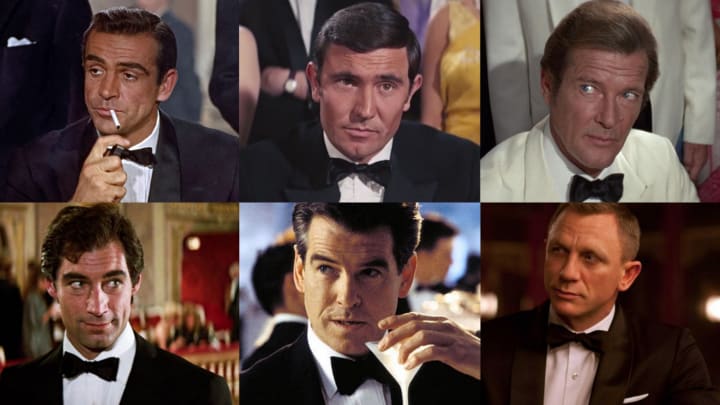
Cinema’s most famous spy and one of the most enduring movie characters of all time, James Bond is as relevant today as he was when he first hit the big screen in 1962’s Dr.No. Played by six men over 25 mainline films spanning 59 years, the Bond franchise is one of the longest running cinematic franchises both in terms of instalments and overall length.
Over the years, the titular role was shifted from actor to actor for various reasons ranging from pay disputes, a desire to not get typecast and the inevitability of ageing. Sean Connery was the first man to take on the role, starring in the first four Bond films. The role made him a star and launched the spy genre into the mainstream. Following his departure, George Lazenby, another relatively unknown actor at the time inherited the suit and pistol but left after only one film. Connery then returned to the role once more but again left after a single film, vowing to never play the character again. The role then passed to Roger Moore who starred in seven straight Bond films. At the same time Connery broke his vow and starred as Bond one final time in the non-Eon produced film, Never Say Never Again. Following Moore’s teure, Timothy Dalton took on the role for two movies and then was succeeded by Pierce Brosnan for another three. Daniel Craig, the latest actor to take the role, went on to star in the last five Bond movies with No Time to Die, being his last .
What made each recast of every Bond character so notable was how each actor was able to grow into the role and make it their own and keep the character relevant in spite of the notable constraints that came with playing the renowned spy. Essentially, the first five actors were playing the exact same person in the exact same, albeit somewhat loose continuity. Craig’s tenure as Bond marked a soft reboot for the franchise but for all intents and purposes he was the same person. On top of that, the majority of Bond films often followed a similar formula with various recurring themes and motifs.
Thus, each actor should be credited for not only keeping the role from going stale but to keep it so firmly entrenched in the mainstream for as long as it has been. Be it Connery or Brosnan’s suaveness, Lazenby’s sentimentality, Moore’s lightheartedness or the grittier Bonds we’ve seen from Dalton and Craig, whoever dons the suit next, will have large shoes to fill
2. Various Actors as The Joker (Batman Movies/DCEU)

Be it in comics, television, video games or on the big screen, few villains are as iconic as the Clown Prince of Crime himself. The last entry in this list from the superhero genre, I picked the Joker over his arch-nemesis the Batman for a few reasons. Firstly, if we covered Batman, we’d basically be repeating the things I covered in the entry for James Bond. An iconic character, whose role had been recast among various talented actors who were able to put their own little spin over the clear cut formula of the character they portrayed. The Joker on the other hand, was vastly different with each portrayal but despite this, was never out of line with the character’s nature. Also, while there have been a couple of underwhelming Batmen, Joker has always fared far better on the big screen.
In total five actors have played the Joker in various Batman and DC related movies as well as a single stand-alone film. Almost all of the Joker’s appearances take place in completely different universes and continuities. Unlike Batman, whose backstory remains virtually the same in each reboot, the Joker has had a series of origins, goals and even secret identities with each appearance. Thus, each actor was able to portray the Joker differently based on their own strengths as well as the overall storyline and tone of the film they were in.
Caesar Romero, who also played the Joker in the 1960s Batman sitcom, was the first man to play the Joker on the big screen in 1966. Keeping in line with the show’s family friendly and light hearted nature, Romero’s Joker dove deep into the “prankster” aspect of the Joker. With simpler goals like robbing banks or just making life difficult for Batman with a series of ridiculous schemes, Romero set the template for many of his successors with his over the top monologues and notable laugh.
When Jack Nicholson took over the role in Tim Burton’s 1989 Batman film, the series had gone back to it’s dark roots. Nicholson, who was always at his best playing strange and eccentric characters was the perfect man for the job. Re-imagined as a vain gangster, driven mad after falling into a vat of chemicals, Nicholson was able to balance between the Joker’s over the top antics and more malicious tendencies. No longer a bumbling villain, Nicholson’s Joker was a criminal mastermind whose madness never got in the way of him being a competent gangster. To further establish him as a villain with no redeeming qualities as opposed to a mischievous troublemaker looking for fun, an added backstory to the character revealed that he was the person who shot Bruce Wayne’s parents, unknowingly creating his own worst enemy.
For almost twenty years, nobody played the Joker on screen until 2008’s The Dark Knight. Arguably, the most famous portrayal of The Joker to date, the late, great Heath Ledger took the role to even darker places yet. Scarred, unkempt and far more unstable, Ledger’s Joker abandoned the character’s more flamboyant characteristics with a more sociopathic, intellectual character. While others who played the Joker did well in highlighting his chaotic nature, Ledger took the character to the next level and portrayed the character as the very personification of chaos itself. Ledger’s Joker was disturbing and unsettling in all the right places. While the Joker himself has become one of cinema’s most iconic characters, Heath Ledger’s incarnation of the Clown Prince of Crime will always stand one level above the others.
When the DCEU got into full swing, the Joker was brought back. This time played by Jared Leto, this version of the Joker has yet to assert himself as the main focus of the movies he has appeared in. However, unlike his contemporaries, Leto’s Joker has appeared in more than one film and is likely to appear in more to come. Leto’s Joker was a complete 180 from Ledger’s Joker and received varying responses as a result. Leto’s Joker returned to the Joker’s loud, in-your face roots and gave him an equally wild look to match. With heavy tattoos, grills and shaved eyebrows, Leto’s Joker seemed to be a reinvention of the character for a newer audience. Despite what people may feel about him, he remains a very talked about aspect of each movie he is in and still has ample opportunity to deliver an iconic performance on par with that of his contemporaries.
Lastly, we have Joaquin Phoenix’s genre-transcending portrayal of Arthur Fleck in 2019s Joker film. Unlike other actors who dove right into Joker’s criminal roots, Phoenix gave the audience a good, long look at the man behind the makeup and his descent into madness. There was no need for high action or larger than life super-villainy in this film, but hard hitting, gritty reality. It showed us that anyone is capable of spiralling into madness if pushed too far. For the first time, most audiences saw the Joker as ill instead of evil, a victim of circumstance pushed one time too many and most of all, a sympathetic figure. The fact that Phoenix could take the character out of the superhero genre and into a psychological and dramatic direction without compromising the character’s integrity is a testament to his ability as an actor. It would not be far-fetched to say that 2019’s Joker sits up there as one of, if not the best origin story of all time.
The Joker’s legacy continues to endure today in literally any known form of media and we definitely have not seen the last of him on the big screen. To play a character as multi-faceted and with as much depth as the Joker has always required actor’s of the highest standing. Thankfully, none of them disappointed and did the character justice. The role of the Joker is only the second of two instances where two different actors won Oscars for portraying the same character. Heath Ledger posthumously won the award for Best Supporting Actor in 2009 while Joaquin Phoenix won the award for Best Actor in 2020.
Marlon Brando to Robert DeNiro as Vito Corleone (The Godfather franchise)
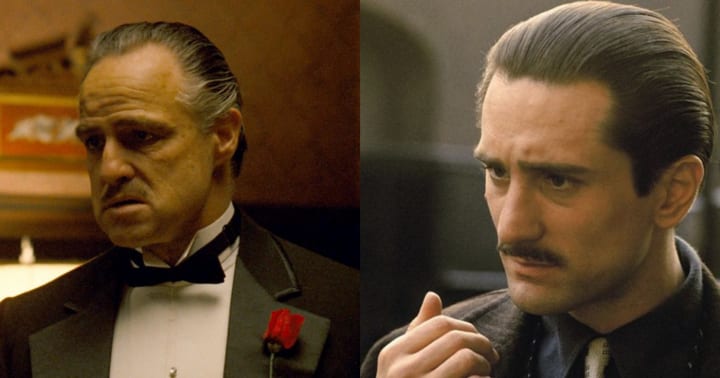
While every other character in this list has been part of long running franchises with multiple instalments or are still a fixture on the big screen today, The Godfather’s Vito Corleone has appeared in only two films, the last of which being 1974’s The Godfather Part II. It goes to show just how iconic the character of Vito Corleone is for us to still be talking about him 47 years after his last appearance on the big screen.
In the character’s first appearance in 1972’s The Godfather, Marlon Brando played the role of the older Don Corleone. At this point, Brando had built a reputation for becoming increasingly difficult to work with and was considered a has-been after a string of unsuccessful films. He was far from being the studio’s first choice to play the role. However, at the insistence of director Francis Ford Coppola, Brando was casted and delivered a legendary performance which put him right back on top of the Hollywood pecking order.
The character’s signature look, voice and expressions were a combination of heavy make-up designed to make Brando look older and a mouth-piece which gave him a slurred, raspy voice. Brando was able to effectively portray both of Vito’s defining traits, that of an ageing mobster and the other of a loving family man. Every scene he was in from the movie’s opening sequence right up to his “perfect” death from a heart attack was done to perfection and any other actor who had to take on the roles certainly had very large shoes to fill.
When the Godfather Part II was released two years later, audiences got to see Vito Corleone in another light. Being both a sequel and a prequel, another actor had to be casted in the role of Vito Corleone. Despite being younger than the Vito he portrayed in the first film, Brando was at this point 52 and too old to be playing a younger man in his 20s-30s. Thus, the decision was made to cast Robert DeNiro in the role instead. Still fairly early into his career as an actor, DeNiro was the right age to play the character without the need for heavy makeup or effects. He was also no stranger to the films as well having been a fan of the original Godfather and unsuccessfully auditioning for the role of Sonny Corleone.
Thanks to the fact that Vito’s role in the second film took place decades in the past, DeNiro did not have to face the insurmountable task of having to play the exact same character that Brando perfected. Instead, De Niro was tasked with showing us the humble beginnings of the imposing figure we saw in the first movie. He was able to play a far more active and physical role than Brando while still being consistent with the character of Vito Corleone overall. Being able to convincingly imitate the Godfather’s signature voice and effectively fitting the physical description of the character he was playing, DeNiro was as perfect an actor to play the younger Vito as Brando was for the older incarnation of the character.
The fact that we see images of Vito Corleone today and still talk about him after almost a half century is a testament to the ability of the men who portrayed him. So talented were both Brando and DeNiro that they became the first pair of actors to win Oscars for playing the same character with Brando winning Best Actor for the first Godfather and DeNiro winning Best Supporting Actor for the second.
This list goes to show that sometimes, it takes way more than one person to play a character. If anything, it might even be the better choice for multiple actors to take on a single role. Different actors can play characters at different ages or capture different aspects of their personality and the ability for more than one actor to play a single character allows for that character to not be written out when an actor is no longer available to play the role. Perhaps the fact that characters do not need to be bound by one actor may be what allows them to stand the test of time.
About the Creator
Isa Nan
Written accounts of life, death and everything in between
Thank You, John Cena
When December 13, 2025 arrived, I welcomed it. I welcomed it with open arms. The reason was simple: I wanted to see how John Felix Anthony Cena, Jr, someone who I've been a fan of for over 20 years, would end his iconic and legendary career.
By Clyde E. Dawkins29 days ago in Geeks
Premier League in India: How to Watch
The 2025–26 Premier League season is underway, marking the 34th edition of the competition and the 127th year of top-flight English football. Liverpool start their title defense with confidence after lifting their second Premier League trophy last season, but the return of Leeds United, Burnley, and Sunderland ensures fresh rivalries – including the long-awaited Tyne–Wear derby, back for the first time since 2015–16.
By David Cook2 days ago in Geeks




Comments
There are no comments for this story
Be the first to respond and start the conversation.