
10 Comfort Films that will Boost your Serotonin
What to watch during lockdown?

In light of COVID-19, our social environments have never felt more disrupted and alienating. With self-isolation, extended lockdowns and school, jobs and education shifting to a virtual format, it is not a stretch to say that 2020 & 2021 have been some difficult years. In that context, many of us may find ourselves debating what film to watch among the millions of movies currently streaming to pass the time and boost our spirits. Movies provide a window into a better time to come, a respite, or an escape from present adversity. They provide a sense of possibility, escapism and a portal into a world that’s become elusive.
Considering this, Comfort and Feel-good films have never been more appreciated nor merited. In recent years, the Feel-good film genre has become one of the most widespread typologies in popular cinema discourses. Such films can be grouped by their shared uplifting emotive cues, nostalgia, and overall warm and fuzzy feeling they arouse. Comfort films may not necessarily require great critical analysis. They are assigned to evoke a sense of childhood wonder, feelings of warmth, cosiness and even the luxury of a smile. So, grab a hot chocolate and a blanket and immerse yourself in these 10 comfort films that are guaranteed to boost your serotonin!

I cannot possibly make a comf ort movie list without mentioning the work of Wes Anderson. Known for his distinctive whimsical aesthetic and cinematography, the film producer has undoubtedly distinguished himself as an icon within the film industry. The Grand Budapest Hotel is his 2014 comedy-drama film. Within it, an opulent hotel is represented in miniature against a snowy backdrop. Set in the fictional Republic of Zubrowka, the Hotel is brimming with eccentric characters, each harbouring fascinating tales layered on top of their regular vocations at the Grand Budapest Hotel. These include stories of love, murder, and theft. While the movie continually signals its comedy, it also renders the terrible charmingly cartoonish.
Still not convinced to watch it? If you are not tempted by the plot then you must simply see it for the rosy-hued filter, beautiful colour-pallete, and magical cinematography. It will leave you romanticising for days.

Ratatouille is a 2007 animated comedy film written and directed by Brad Bird. It stars a rat called Remy (voiced by Patton Oswalt) who is surprisingly a culinary genius. Arriving at a top Paris restaurant, Remy soon becomes the puppet master of Linguini (Lou Romano), a lowly kitchen boy. Hiding beneath Linguini chef's hat, the rat communicates his gift for cooking by tugging at the kitchen boy’s hair. This enables Remy to guide Linguini marionette-style throughout the kitchen as he prepares gourmet leek and potato soup and his infamous ratatouille dish. The diners of Gusteau's love Remy's cuisine while lavishing Linguini with all the credit. While the film mostly takes place in a kitchen, the cultivated visual and sensory experience makes you feel like you can smell the food on the screen.
A memorable scene is when Remy’s cooking returns the cutthroat food critic Anton Ego—a gaunt, sour-faced man who composes his bitter reviews in a darkly lit coffin-shaped room—to the idyllic memories of his childhood. It is the first time we see the most acclaimed food connoisseur in Paris generally smile. It is by Ego that the moral of Ratatouille is delivered. “Not everyone can be a great artist,” he deliberates. “But a great artist can come from anywhere.”
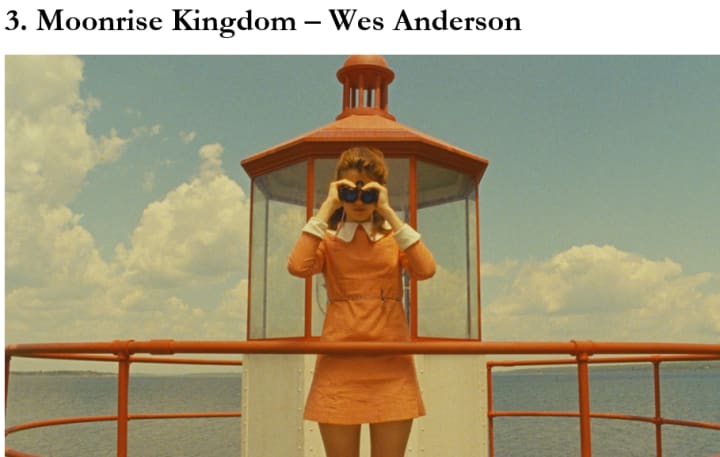
Moonrise Kingdom is a 2012 coming-of-age comedy-drama film directed by Wes Anderson. Like any Wes Anderson film, the sublime symmetry of the movie will sweep you away. The storyline is simple and poignant and yet dives into the power of young love. It features Sam (Jared Gilman) an orphan boy, whose an expert in scouting and always sporting a pair of oversized glasses over his solemn expression. He soon meets Suzy (Kara Hayward) a bookish dreamer who wears a pink dress, long white socks, and mary jane sneakers. She also carries her signature black binoculars, a yellow suitcase, and a white flower bouquet. The two young outcasts plot to run away from home to be together. During their secret rendezvous in a meadow on the island, they are soon pursued by khaki scouts, the police, and an assemblage of angry parents. Lit by the familiar candy-coloured, retro-tinted style of Anderson’s oeuvre’s, Moonrise Kingdom is a heartfelt pleasure that evokes some of the terrors and joys of childhood.

If anyone can capture a sense of childhood wonder it is Hayao Miyazaki. His 2001 2001 Japanese animated fantasy film Spiriting Away is a work of magic that you shouldn’t miss. It tells the tale of 10-year-old Chihiro Ogino (Hiiragi), who, while moving to a new neighbourhood, enters the world of Kami—spirits of Japanese Shinto folklore. When her parents are mysteriously transformed into pigs by the witch Yubaba (Natsuki), Chihiro takes a job working in Yubaba's bathhouse to find a way to free her parents and return to the human world.
I digress there is truly no film like Hayao Miyazaki’s Spirited Away. The story, the visuals, the characters, the score, the sound, the imaginative lore, the world-building, the themes and motifs, the fantastic creatures and more are all masterfully interwoven into one unforgettable experience.

There is something deeply blanketing to the soul about My Neighbour Totoro—a 1988 Japanese animated fantasy film written and directed by Hayao Miyazaki and animated by Studio Ghibli. The film tells the tale of a professor's two young daughters—Satsuki and Mei—and their move to their new country home. After exploring the neighbouring woods, the two girls encounter Totoro, a friendly wood spirit in post-war rural Japan.
Something that should be noted is that typically in Western animated pictures, any child that wanders alone into the forest is subjected to multiple fears and dangers. Yet in Totoro, nature is depicted as something magical to be explored and appreciated. The journey of Satsuki and Mei is heart-warming, surreal and filled with imaginative details: from awe-inspiring scenes of flying through the sky with Totoro to a grinning, twelve-legged cat with a hollow body that serves as a bus. Once again, Miyazaki’s imagination dazzles our vision with exquisite, quaint, and colourful images that is brimming with spiritual nuances.

Delve into the wonderful mind of Tim Burton in his 1990 fantasy romance film Edward Scissorhands. The movie takes place in an artificial world, where a gothic castle bows on a mountaintop high above a storybook suburb, a sitcom neighbourhood where all of the houses are clonelike shades of pastel. Within the haunting castle, we are introduced to Edward (Jonny Depp) a synthetic man with scissor hands. His creator—the scientist Vincent Price—dies before he can finish assembling Edward, leaving the young man with a set of freakish scissor blades instead of hands. Suburban saleswoman Peg (Dianne Wiest) discovers Edward and takes him home, where he falls for Peg's teen daughter (Winona Ryder). However, despite his gentle nature and kindness, Edward's hands make him an outsider.
As with nearly all Burton films, Edward Scissorhands is beautiful to behold with stunning cinematography, art design, costume design and production values. Here Burton's distinctive filmography bears the hallmarks of a visual style often defined as Burtonesque.

Based on Brian Selznick's beautiful 2007 book (half prose tale & half graphic novel) The Invention of Hugo Cabret, the 2011 adventure drama film Hugo is directed and produced by Martin Scorsese. It tells the story of a 14-year old boy—Hugo Cabret (Asa Butterfield)—who lives alone in the Gare Montparnasse railway station in 1930’s Paris, only to become embroiled in a mystery surrounding his late father's automaton and the pioneering filmmaker Georges Méliès.
The way Hugo deals with Melies is enchanting in itself—bringing to life the innovations and creativity behind his motion pictures. The film celebrates the birth of the cinema and the preservation of old films, providing a great defence of the cinema as a dream world—a transformative force to the mundanity of reality. In one heart-breaking scene, we learn that Méliès, convinced his work had been forgotten and time had passed, melted down countless films so that their celluloid could be used to manufacture the heels of women's shoes. But they were not all melted, and thanks to the determinism of young Hugo they never will be.
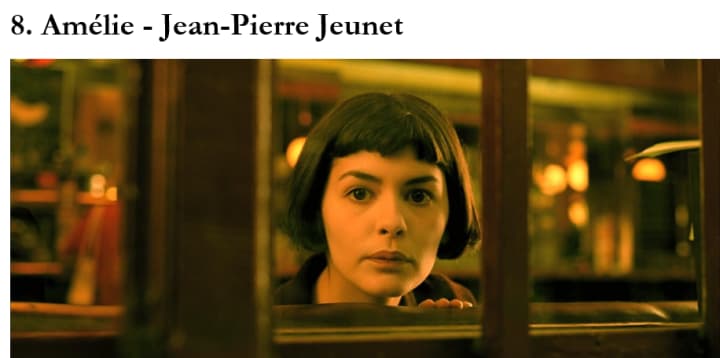
One hidden gem you must watch is the French 2001 romantic comedy film Amélie (also known as Le Fabuleux Destin d'Amélie Poulain); directed by Jean-Pierre Jeunet. The film is a whimsical depiction of contemporary Parisian life, set in Montmartre. It tells the story of Little Amelie Poulain (Audrey Tautou), a fabulously quirky and imaginative waitress who decides to change the lives of those around her for the better. Her quest to spread joy leads her on a beautifully introspective journey across Paris. The character Amelie is fascinatingly unique: she is philanthropic but lonely, shy but mischievous.
Much of the magic of the film lies in its fantastical atmosphere. It is partly created using the highly distinctive, warmly tinted colour-pallet throughout the film. The deeply saturated and vibrant hues of yellow, green and red that dominate the film are guaranteed to leave you feeling all warm inside.

Based on the infamous novella, the 2019 coming-of-age period drama Little Woman is directed by Greta Gerwig. It follows the lives of the March sisters—Jo (Saoirse Ronan), Amy (Florence Pugh), Meg (Emma Watson) and Beth (Eliza Scanlen)—during the early 1860s to the aftermath of the civil war. Each sister is gifted with a unique talent: a writer, a sketch artist, a pianist and an aspiring actress.
The movie blends two clashing tones consistently: at times scenes are heart-warming, Christmassy and cosy and others cold and bitter. The cinematography is consistently gorgeous: the houses, the countryside, the dance sequences all come together to produce a compelling film to make you smile.
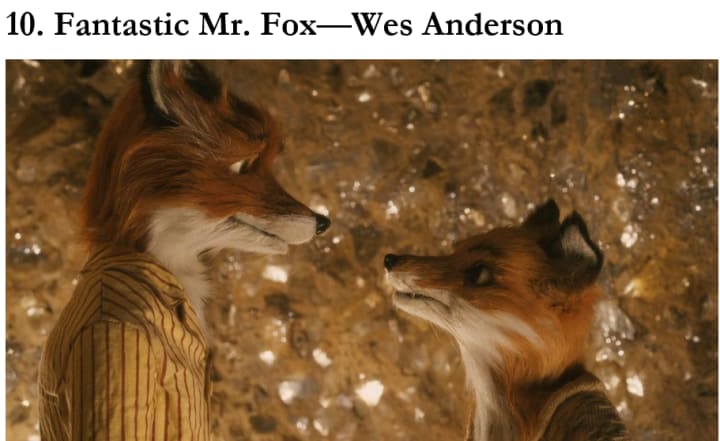
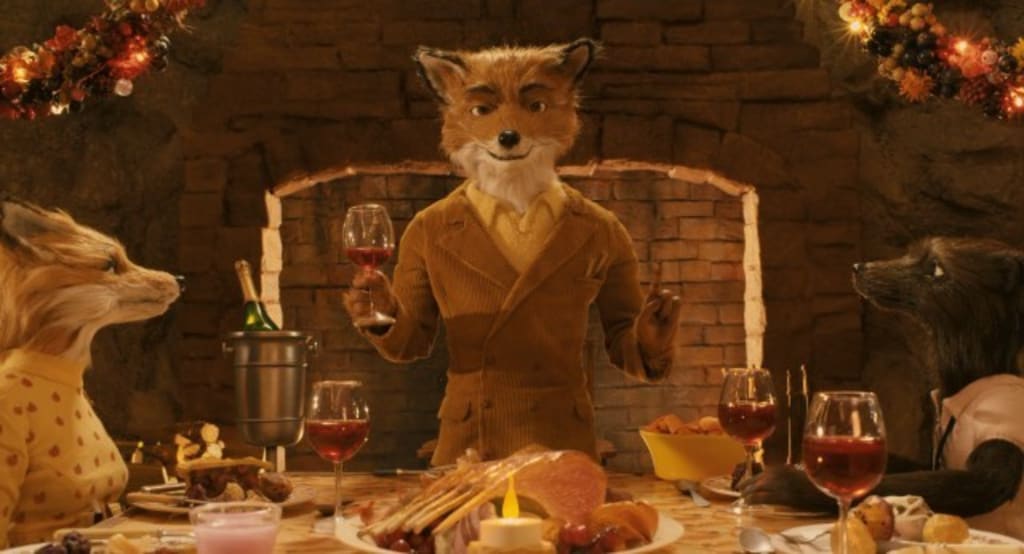
It is only fitting that we end this list with Wes Anderson’s stop-motion adaptation of Roald Dahl’s classic 1970’s children’s book: Fantastic Mr. Fox. The style of this movie Is utterly beguiling and pays a true homage to Anderson’s unique proscenium-style framing, quirky aesthetic and witty dialogue. It tells the story of Mr. Fox (George Clooney) a talking fox who possesses a genius-level intellect. He has given up his innate wildness as a skilled thief to raise his son, Ash (Jason Schwartzman), alongside his wife Mrs. Fox (Meryl Streep) in his new-found vocation as a newspaper journalist. Unbeknownst to his family, Mr. Fox—longing for his thievery days— ropes his best friend Kylie, an opossum, into a spectacular three-part raid on the farms of Boggis, Bunce and Bean: a chicken, duck and apple farmer. They are the three main antagonists, renowned for being ridiculously wealthy and wickedly cruel.
With its charming autumn colour design, lovable characters and sweet natured heart, Fantastic Mr. Fox is a memorable film bound to boost your serotonin and brighten your day!
About the Creator
Wonita Gallagher-Kruger
Hello,
I write Little Stories and Film Reviews. Please join me on my writing crusade. IG: wonita.gallagher.kruger
Keep reading
More stories from Wonita Gallagher-Kruger and writers in Geeks and other communities.
5 Arthouse Films that are Deeply Philosophical
The film has ended, the credits roll, and you sit amongst the crowed utterly speechless. Your thoughts are left to drift in a void of wonder, as you ruminate on the beauty to which you have just borne witness.
By Wonita Gallagher-Kruger5 years ago in Geeks
A Knight of the Seven Kingdoms Series Review (Season 1)
As one of the biggest properties in fantasy, A Song of Ice and Fire remains immensely popular with audiences. After reaching far into the past with House of the Dragon, a second spin-off was on the cards. A Knight of the Seven Kingdoms serves up a bite-sized slice of action and drama, but it still claims a spot among the best small-screen titles.
By Robert Cain4 days ago in Geeks
The Shifting Landscape of the United States Luxury Car Industry at CAGR of 1.2%
A sales consultant reviews overnight inquiries. A returning customer compares trim levels on a tablet. Outside, a silent electric luxury sedan glides past traffic. Inside, leather, brushed aluminum, and ambient lighting signal something more than transportation.
By Ashutosh Srivastava5 days ago in Geeks



Comments
There are no comments for this story
Be the first to respond and start the conversation.