
Yoshi's Island: A true classic
30 years of the greatest platformer of all time

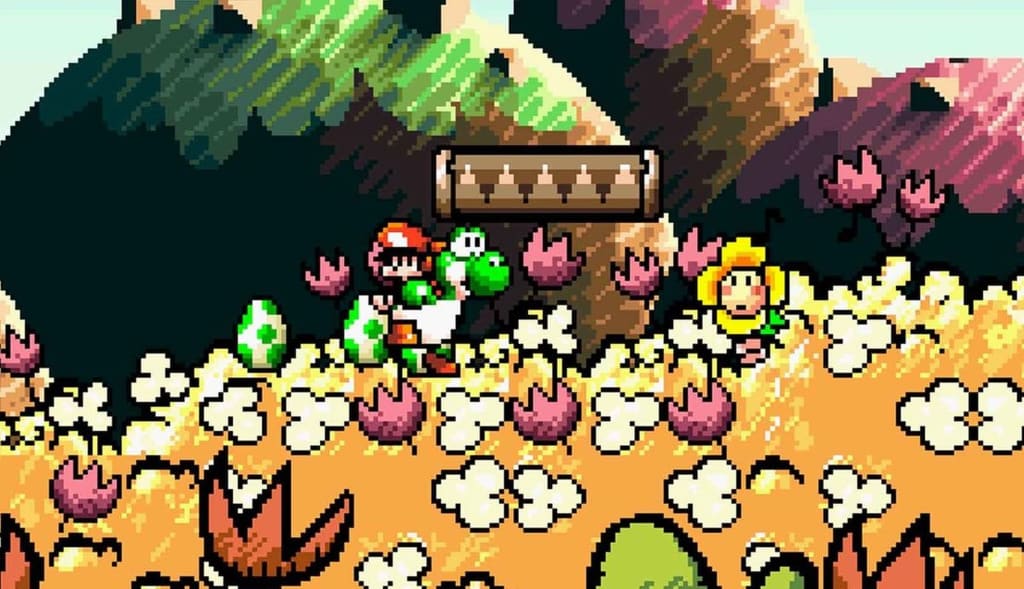
We all have a favourite video game, one that we return to time and again. Whatever your game of choice is, however old or new it is, playing it again takes you back to the first time you played it, while giving you something more than simple nostalgia value: genuinely classic gameplay.
I’m a platformer fan, first and foremost, and was devoted to Nintendo in my youth. I’ve long adored the Super Mario series. For me, the single best game is Super Mario World 2: Yoshi’s Island, released on the Super Nintendo Entertainment System thirty years ago in 1995. The initial Japanese release (Supa Mario: Yossy Airando on the Super Famicom) was on 5th August, with North America and the PAL region in the UK and Europe getting it two months later. It remains, for me, a game of near perfection, and I would happily argue that it represents the pinnacle of 2D platform gaming.
The first Super Mario World had been released in Japan five years earlier, with a staggered release worldwide, PAL systems not getting it until 1992. Super Mario World is an exceptional game in itself (I’d probably rate it as my second favourite, but there’s a lot of competition). It was a long wait for diehard Mario fans, with the sequel having a four-year development process. What finally arrived was a bold and beautiful new take on the signature Super Mario platform gameplay, offering a unique and new experience.

Both Yoshi and Yoshi’s Island had originated in Super Mario World, the former being Mario’s lizard-like steed; the latter, said reptile’s home, and the first world visited in that game. Yoshi’s Island, the game, expanded the setting from a tiny, grassy island with only five levels in the corner of the greater Dinosaur Land, to a large landmass with varied and complex environments of its own. (Indeed, official Mario lore is contradictory over whether the two versions of the island are even the same place).
Yoshi’s a strange creature. Game literature describes him as both a dinosaur and a dragon, yet he has a turtle’s shell, suggesting he’s part of the Koopa clan. Yoshi boasts a chameleon-like tongue, and can lay eggs, in spite of being consistently referred to as male. The name Yoshi refers both to the character, a green dino with red spikes, and to his entire species, also called the Yoshisaurus, who come in a whole rainbow of colours. He can trace his conceptual ancestry back to Tamagon, a green dragon who was the protagonist of Devil World, a lesser-known Nintendo game predating Super Mario Bros. that didn’t even get a North American release (due to being full of allegedly blasphemous Christian imagery).
Shigeru Miyamoto, creator of both the Super Mario series and Devil World (plus Donkey Kong, The Legend of Zelda, Star Fox and many more) was the creative force behind Yoshi’s Island, on which he served as producer. It was Takashi Tezuka who took on the main director duties, returning to the position he held on Super Mario World, where he co-designed Yoshi. Tezuka had been Miyamoto’s right-hand man on the early Super Mario games, The Legend of Zelda and Devil World, being responsible for much of Nintendo’s early video game success. He was joined by co-directors Shigefumi Hino (also character designer on the game, later to direct Pikmin), Hiedki Konno (in charge of level and map design, later director of Luigi’s Mansion); and Toshihiko Nakago (chief programmer of almost all of Nintendo’s hit games in the 1980s and early ‘90s).
What a team they made. They could have gone down the easy route and simply made a straightforward follow-up to Super Mario World, another set of levels with the same mechanics and gameplay. Instead, they took the classic platforming style of Super Mario and added entirely new elements, while also expanding the slowly building mythology of the Mario universe. Instead of a straight-up sequel, Yoshi’s Island is a prequel, set years before the previous games when Mario and Luigi are still babies. As the stork carries them to their parents (yes, it’s that cute), Kamek, an evil Magikoopa swoops in on his broomstick and tries to kidnap them. He only manages to get hold of Luigi, who he spirits away back to the Koopa Kingdom, where his ward Baby Bowser is waiting. Back-up material suggests that Kamek had divined that the Mario Bros. were destined to defeat Bowser in the future, but if anything, he only created the decades-long rivalry. While Luigi is taken, Mario falls through the air to Yoshi’s Island, where a group of Yoshies take turns carrying him, relaying him through the game’s levels on a mission to save Luigi.
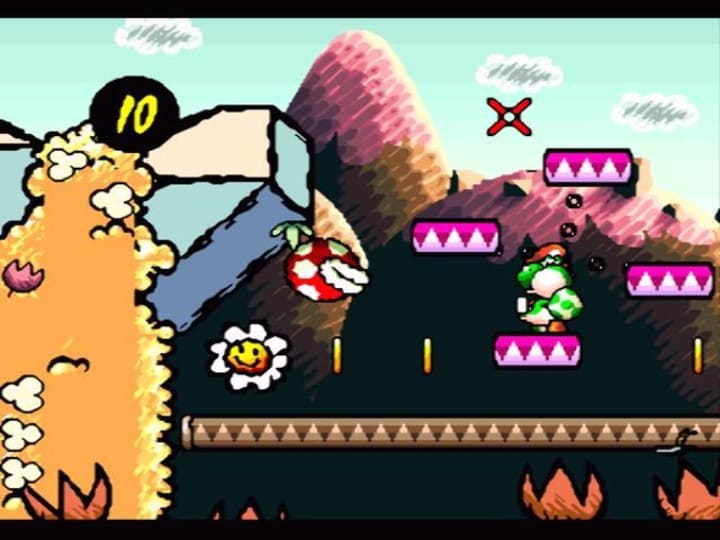
As in his first appearance, Yoshi can capture enemies with his long tongue. You can now choose whether to spit them out or swallow them, with the former turning the captured critter into a projectile to take out others. If Yoshi swallows the enemy, on the other hand, he lays an eggs, which he can use as a far more effective projectile. Effectively a missile, the egg can be aimed and thrown with precision, used to break blocks, free items from clouds, take out enemies or collect items. Yoshi gains other new abilities as well, most notably his now signature flutter jump, which makes it possible to leap across major gaps. Unlike most 2D Super Mario games, there’s no “one hit, two hits, your dead” risk, and there’s a distinct lack of mushrooms to collect. Instead, Yoshi is virtually invulnerable, unless he falls into a pit or onto spikes, thorns or lava, which cause instant death. If he’s hit by an enemy, Yoshi drops Mario, who floats away in a bubble for some reason. There’s a tight countdown before Kamek’s dull-eyed toadies swoop in and kidnap him, ending the level and losing a life.
The timer is set at ten to begin with, but fortunately, Yoshi can collect little yellow stars to add to this, up to a maximum of thirty, although the stars have little legs and try to run away. The usual gold coins are scattered through the levels and, as is traditional, collecting a hundred rewards you with an extra life. There are also twenty red coins to collect in each level; while they’re usually disguised as ordinary gold coins, they’re actually slightly red at all times so aren’t that hard to find. The big collectibles are the smiling flowers, of which there are five in each level; collecting all five also grants an extra life. The levels are long, sprawling and often maze-like, and exploring all the routes, nooks and hidey-holes is essential. You can just play to get to the end of the level and onto the next, but the real challenge comes from finding everything; only by reaching the end of a course with five flowers, twenty red coins and a full timer will award you 100%. This adds a tremendous amount of replay value to the game.

It's not a short game to begin with, being comprised of six worlds of eight levels each, and while it drops the classic world map in favour of a level selection grid, each world has its own overall theme, from the traditional meadow starter through mountains, snowy tundra, and a swampy jungle. Trying for 100% motivates continued play, especially as completing every level in a world unlocks a secret level and a bonus game. What really keeps you coming back, though, is the sheer joy of playing. Yoshi's Island is an infectiously fun game, challenging but rarely punishing, and filled to the brim with charm. It looks and sounds fantastic, as well. While Donkey Kong Country had revolutionised the graphical capabilities of the SNES, Yoshi's Island eschewed the pre-rendered look in favour of a hand-drawn style, a world of crayon and felt tip. The character designs are astonishingly cute, the landscapes impeccably detailed, and the then state-of-the-art Super FX2 chip built into the cartridge allows complex graphical effects, intrinsic to the gameplay. The music, composed by the legendary Koji Kondo, is among his most charming scores.
Each world boasts a fortress with a mini-boss and a castle with a big boss, and these are usually regular enemies granted enormous size by Kamek’s magic. The monsters in the game are a hugely varied bunch, including returning creatures like goombas, Koopa Troopas and many variants of Shy Guy; and new oddities like fuzzy balls of fluff that get Yoshi high, distorting the screen, or bouncy penguins that knock him off icy ledges. This, along with a truly creative approach to boss battles, adds much needed variety to the fights compared to earlier Super Mario games. The first mini-boss, Burt the Bashful, is a huge, ball-like character who bounces around the stage, until Yoshi hits him with enough eggs to make his trousers fall off. After this, Yoshi fights giant slimes, battles a supersized Koopa Trooper, gets swallowed by a hungry frog, tangles with a nest of piranha plants, and scraps with a raven on the Moon. Finally, he battles Baby Bowser, inflated to Godzilla-like proportions, in one of the best final boss fights in video game history.

As if all this wasn't enough, Yoshi's Island throws in an array of new and inventive power-ups. Yoshi can swallow watermelons that let him spit seeds like bullets, with varieties that let him breathe fire or frost. He can transform, for specially designed sections, into vehicles: a stilt-wheeled car, a helicopter, a submarine,a steam train, and a mechanical mole. As if Mario riding Yoshi through the game wasn;t enough, Yoshi gets his own steed, the bizarre toadstool-textured dog, Poochy, who's even more impervious to harm. Occasionally, Yoshi gets to take a breather, with Mario taking over; the ubiquitous Super Star from previous games is reworked and combined with Super Mario World's cape, turning Baby Mario into an unstoppable, speed-running, parachuting toddler tornado. There's even a skiing level. It's immensely fun.
Yoshi's Island arrived towards the end of the 16-bit era, with the SNES already being overshadowed by the Playstation and Sega Saturn, and soon to be replaced by the Nintendo 64. This was the end of the golden age of 2D platformers. Not to say they disappeared; Yoshi's Island itself spawned numerous sequels, beginning with Yoshi's Story on the N64 in 1998. Originally billed as Yoshi's Island 64, the follow-up was aimed at younger players and upped the cuteness level from charming to nauseating.The original game was remade for the Game Boy Advance as Yoshi's Island: Super Mario Advance 3, adding extra super secret unlockable levels and some gameplay tweaks. Yoshi's Universal Gravitation, published as Yoshi Topsy-Turvy in the US, was released in 2004, utilising the GBA's motion control and tilt sensor for a new style of platform gameplay.
In 2006, Yoshi's Island DS, originally called Yoshi's Island 2, came close to achieving the original's acclaim, adding baby versions of Princess Peach, Wario and Donkey Kong for new gameplay elements and utilising the twin screen of the Nintendo DS for a large playing field. New Super Mario Bros. arrived on the NDS that same year, not only relaunching the classic Super Mario 2D line, but reinvigorating the 2D platform genre as a whole. Yoshi games, however, fell by the wayside, with the “2.5D” games Yoshi's New Island on the 3DS and Yoshi's Woolly World on the WiiU aiming for the same impact as Yoshi's Island but receiving a mixed reception. The latest Yoshi game, Yoshi's Crafted World for the Switch, came out in 2019.
There are rumours that Nintendo is working on a new Yoshi adventure for the Switch 2, either a new take on the 2D platformer or the long-awaited fully 3D Yoshi game. If and when this materialises, it's hard to see it comparing to Yoshi's Island. There was nothing quite like it before and nothing has measured up since.

Super Mario World 2: Yoshi's Island is included in the SNES Classic Mini console, still available to buy if you don't mind paying a pretty serious price tag. Both the original version and Super Mario Advance 3 are available through the Nintendo Classics download service on Switch and Switch 2.
About the Creator
Daniel Tessier
I'm a terrible geek living in sunny Brighton on the Sussex coast in England. I enjoy writing about TV, comics, movies, LGBTQ issues and science.
Keep reading
More stories from Daniel Tessier and writers in Gamers and other communities.
Donkey Kong Land: a retrospective
Donkey Kong Land has a special place in my heart. It was the very first video game that I went out and bought, brand new, with my own money. In fact, it was money I’d received that day for my twelfth birthday. I walked to Woolworths with my best friend Paul (best-friendship still going strong) and bought myself my very own new game, in a special banana yellow cartridge.
By Daniel Tessier8 months ago in Gamers
Sea of Thieves Will Make You Feel Like a True Pirate in a Dangerous Open World
Few modern games capture the spirit of adventure quite like Sea of Thieves. Developed by Rare and published by Xbox Game Studios, this Xbox experience throws players into a shared world where freedom, risk, and cooperation define every moment. It is not just about reaching a destination, but about the unpredictable journey that unfolds along the way.
By Lukáš Hrdlička2 days ago in Gamers
I was in a Toxic Relationship, with my Workplace
“You got that?” My ex yelled. His hands were balled into fists at his side. At six foot three, he towered over me. A normal person would have been afraid, but I looked up a video of George Lopez repeatedly saying, “I got this,” and showed it to him. I had grown used to this treatment, so much so that I didn’t blink when he ripped the phone from my hand and threw it across the room.
By Jade M.7 days ago in Confessions



Comments
There are no comments for this story
Be the first to respond and start the conversation.