
Donkey Kong Land: a retrospective
30 years of a Game Boy classic


Donkey Kong Land has a special place in my heart. It was the very first video game that I went out and bought, brand new, with my own money. In fact, it was money I’d received that day for my twelfth birthday. I walked to Woolworths with my best friend Paul (best-friendship still going strong) and bought myself my very own new game, in a special banana yellow cartridge.
Donkey Kong Land was released in the US on 26th June 1995, making it thirty years old this month. It came out officially in Japan the next day, under the name Super Donkey Kong GB (only, you know, in Japanese). We in the UK didn’t get it till almost a month later, a scandalous oversight considering that the game’s developer, Rare, is a British company. Then I had to wait till February of ’96 to get my hands on it.
Thirty years later, it remains one of the best games on the Game Boy; a classic platformer. It’s not without its flaws, of course, but it remains both a fantastically entertaining game and an impressive technical achievement.
The original Donkey Kong, back in 1981, was a landmark game. Arguably the first platform game (it depends on precisely how you define the term), it had a huge influence on game development and pretty much made Nintendo a global success, rather than merely a Japanese one. By 1994, though, the character had become a footnote, until two games launched him back into the public eye. Nintendo’s own Donkey Kong for the Game Boy was released first, updating and vastly expanding the original Donkey Kong. Later in the year came Donkey Kong Country, Rare’s magnum opus.
Donkey Kong Country (Super Donkey Kong in Japan) stormed onto the Super NES/Super Famicom with revolutionary graphics, unparalleled sound quality and compelling gameplay. Rare, which had developed from Ultimate Play the Game (creators of influential early games including Jetpac, Sabre Wulf and Knight Lore), had impressed Nintendo with their technical innovations and their work on the Battletoads game series. Having become one of Nintendo’s key games developers by 1993, Rare founders Tim and Chris Stamper were offered to revamp a character from Nintendo’s back catalogue. They chose Donkey Kong, working with their team for eighteen months to create a new platform game that took inspiration from, but sought to surpass, 1990’s Super Mario World.

During the development of Country, the Stampers tasked their Game Boy programmer Paul Machacek to begin work on porting the game to the handheld console. Machacek had been given a similar task with Battletoads for the Game Boy, instead creating an entirely new game under the same title. He argued that doing the same for Donkey Kong would require little more time and work than simply porting Country, and the new game could be better tailored to the Game Boy’s limitations. Machacek reworked the game engine he’d developed for Battletoads to handle the increased load of the new Donkey Kong Land (doubtless named in reference to the Game Boy’s Super Mario Land platform series).
Either porting or reworking Country to the Game Boy posed similar, daunting technical challenges. The Super NES was a 16-bit machine, with twice the processing power of the 8-bit Game Boy. Country pushed the limits of what the SNES could do, being favourably compared with the output of 32-bit machines such as the Playstation, Sega Saturn and Sega 32X. While the gameplay was the reason Country did so well, it’s exceptional graphics and musical score were also big factors in its popularity. Rare used state-of-the-art data compression to convert 3D pre-rendered image models into sprites, and squeezing the graphic and audio data onto the Game Boy’s much less powerful system was challenging.
Machacek began as a team of one while Country was being developed, amassing more members until there was a fifteen-man team working on Donkey Kong Land. Machacek had been right to dismiss the idea of porting Country to the Game Boy. The handheld, while arguably the most popular portable console of all time, had an extremely limited display. Unlike the full colour graphics of the SNES played on a TV screen, the Game Boy only had four colours, and all of them were green. The cramped, lower-res screen simply couldn’t play Country’s graphics clearly, and trying to dodge enemies and obstacles from the original game would be downright impossible. In fairness, there are moments when it’s almost impossible to see enemies coming at you in Land, but for the most part, Machacek’s new levels, all designed from scratch in the style of Country, beautifully capture the gameplay of the original while scaling it down to the constraints of the Game Boy.

Making it work on a reduced system was such a challenge that it became the basis of the game’s story. Donkey Kong and his monkey sidekick Diddy Kong get back from rescuing their banana stash from the evil King K. Rool, and celebrate a game well done. Cranky Kong, who is officially the original Donkey Kong from the 80s games, dismisses them, saying that the game was only a hit because of its fancy graphics and modern music. He bets that they can’t do it again on a monochrome 8-bit system like the Game Boy. Of course, DK vows to do just that, even getting the Kremlings – K. Rool’s reptilian henchmen – steal his bananas again and hide them in new places.
In fact, Donkey Kong Land just might be an even better game than Country. The thirty new levels are lengthy, elaborate and highly challenging, with an array of new enemies including flying pigs and a nautilus that chases the Kongs through the underwater levels. While the game starts out in the familiar jungle levels, the first world also incorporates snowy areas and the rigging of Gangplank Galleon, the pirate ship which would be a major setting in Donkey Kong Country 2: Diddy’s Kong Quest. World two is Kremlantis, a sunken civilisation that mixes underwater levels and ancient ruins, where potentially deadly whirlwinds have to be used to bounce to new sections. World three includes both Monkey Mountains and Chimpanzee Clouds, the latter being quite surreal levels where floating platforms take the Kongs precariously between clouds in a dreamlike landscape. The final world is Big Ape City, a place of towers and girders that calls back to the original Donkey Kong before ending up on K. Rool’s airship.
The conversion to the Game Boy isn’t without its drawbacks, though. The graphics, while being less detailed than those in Country, still suffer from moments of severe slowdown, blurring and poor visibility on the small screen. There’s a spectacularly frustrating glitch that causes the game to “forget” where platforms are when they’re off screen, so that jumping or falling from one point to a safe space that you know is there can actually lead to instant death. Other limitations are deliberate decisions to conserve data: there are only two animal buddies in this game, Expresso the Ostrich and Rambi the Rhino, unlike the five in Country, and the fan favourite minecart levels are absent entirely. The bosses are new, but very limited; although, to be fair, the ones on Country weren’t exactly complex for the most part.
Land also features a completely different use for the KONG letters that are scattered through each level. Unlike the other Country and Land games, the letters don’t reward an extra life: instead, you have to collect all four of them in order to save your spot when completing a level. Whether this is more or less infuriating than waiting to reach a designated save point on the map is a matter of preference. Also lacking the inter-world mechanism of Funky’s Flights, Land has every level linked together in a single long network of pathways. Many times I finally finished a particularly challenging level with one life left, schlepping back to the beginning so I could replenish lives and save safely.
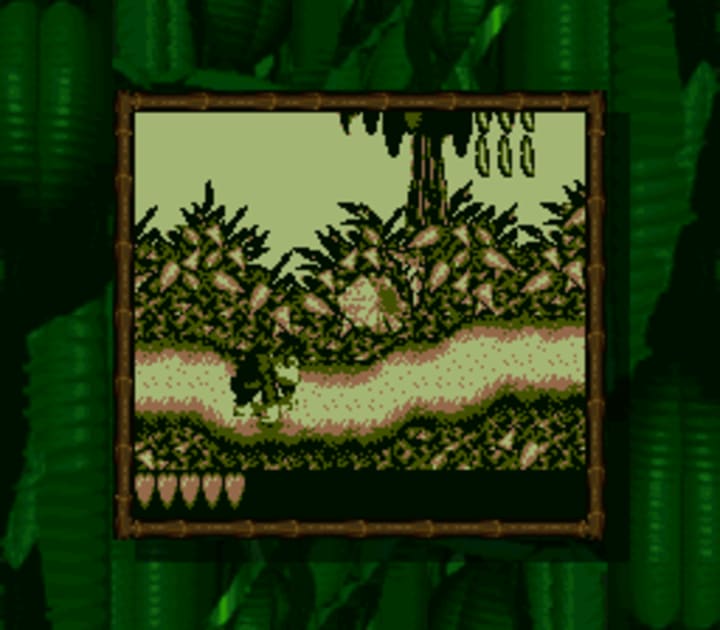
For all its limitations, though, Donkey Kong Land is a top platformer, combining fun and difficulty as the Kongs make their way to the swirling wormholes that mark the end of each level. The sound quality is remarkable for the Game Boy, with catchy tunes on a par with the original’s. It was released alongside the Super Game Boy, a plug-in adaptor that allowed Game Boy games to be played on a TV screen through the SNES. Played like this, with the graphics enhanced with four distinct colours rather than shades of green, the graphical limitations fade away. Most modern emulators have the option to use Super Game Boy optimised colours, while last year’s gratefully received download for the Switch allows easy playing on a modern screen.
Donkey Kong Land was followed by Donkey Kong Land 2 and Donkey Kong Land III (with their infuriatingly inconsistent numbering), each released a year after the previous game. They’re both great games, but neither is as inventive as the first Land, both trying too hard to emulate the SNES games that they’re based on, although neither is a direct port. It came full circle in 2000, when Country was recreated for the Game Boy Colour, using Land’s graphics, sound and architecture as building blocks. None of these really came close to the ingenious fun of Donkey Kong Land, standing as its own unique entry in the DK series.
Screenshots taken from Nintendo Life.
About the Creator
Daniel Tessier
I'm a terrible geek living in sunny Brighton on the Sussex coast in England. I enjoy writing about TV, comics, movies, LGBTQ issues and science.
Keep reading
More stories from Daniel Tessier and writers in Gamers and other communities.
Anime Tactical Simulator Review — Strategy, Anime & Roblox
If you’ve ever wondered what would happen if your favorite anime heroes stepped onto a battlefield together and had to defend a base against endless waves of enemies, Anime Tactical Simulator pretty much turns that idea into a playable reality. Built on the Roblox platform, this game mixes tower defense mechanics with anime-inspired strategy in a way that feels both familiar and fresh. It’s one of those experiences that looks simple at first glance but gradually reveals layers of depth the longer you stick with it.
By Serhii Biloshytskyiabout 19 hours ago in Gamers
This Is What I Do When People Throw Rocks At Me
Rocks have been thrown at me for a greater part of my life. Some have been small and missed hitting me. When people don't get a reaction from me, they throw bigger rocks with a better aim. Many have been hurled at me with precision over the years. For a long time, I thought my only options were to dodge them or be crushed by them.
By Margaret Minnicks2 days ago in Confessions


Comments
There are no comments for this story
Be the first to respond and start the conversation.