
What Makes a Blockchain Game Truly ‘Decentralized’?
Exploring the Core Principles Behind Ownership, Governance, and Transparency in Web3 Gaming

It’s easy to slap “Web3” on a game and call it decentralized. But real decentralization? That’s harder and far more valuable.
In a space flooded with buzzwords, true decentralized games stand out not just for their blockchain integration but for how deeply they empower players. Whether it’s through NFT decentralization, on-chain logic, or DAO governance, the future of gaming hinges on the principle that control must shift from studios to communities.
But what exactly makes a blockchain game decentralized? Let’s explore the intricacies of Blockchain game development and what makes a game truly decentralized.
Decentralized Games vs Games That Use Crypto
First and foremost, let’s get one thing straight. A game that uses NFTs for skins or rewards players with tokens is not automatically decentralized. True decentralization means letting users vote on crucial decisions through a DAO. They are not identified by tokens or NFTs, but by where the control resides.
If players can:
- Own their assets
- Influence game rules or mechanics
- Interact directly with the protocol
- Continue to play even if the developer shuts down
Then, it is a decentralized game.
The Pillars of True Blockchain Decentralization
So, what does that control actually look like in practice? Let’s break it down into four core components.
1. Asset Ownership via NFT Decentralization
The first layer of decentralization happens at the asset level. Most Web3 games boast NFTs, but can the developer modify or revoke them? If yes, the asset is not truly decentralized.
True NFT decentralization requires:
- Immutable metadata or IPFS hosting (not just centralized image servers)
- On-chain minting and transferability
- Permissionless marketplace trading
- Asset utility that is not dependent on a centralized API
Games like Loot and Treasure have shown how NFTs can become building blocks across projects, not just limited to a single title.
2. Blockchain Game Logic: On-Chain or Bust
Another critical pillar is how the game operates. Blockchain game logic means that core mechanics like crafting, battles, or economy rules are executed through smart contracts, not backend servers. This allows:
- Verifiable outcomes (no cheating or manipulation)
- Transparent updates
- Community auditability
That being said, putting everything on-chain is expensive and sometimes unnecessary. The goal is not total immutability; it’s trustless core mechanics.
3. DAO Governance
DAO Governance is the most powerful tool for decentralization. A Decentralized Autonomous Organization (DAO) allows players and token holders to:
- Propose and vote on game changes
- Allocate treasury fund for content, rewards, or partnership
- Decide on upgrades, forks, or expansions
- Moderate in-game behavior through community consensus
DAO governance ensures the game’s future is not dependent on a CEO or dev team; it’s community-owned and community-led. But not every player wants to vote on every proposal. The best decentralized games build layered governance with delegate models, topic-specific working groups, and quadratic or weighted voting to prevent whale domination.
4. Open Infrastructure and Interoperability
Decentralization is about more than gameplay; it’s actually about permissionless development. If a game’s logic, assets, and governance are composable by anyone, it’s more than just a product; it’s a platform. This is where decentralization becomes exponential and the game becomes a foundation others can build on. True decentralized games allow:
- Third-party UIs or frontends
- Open APIs or SDKs
- Community-built mods, quests, or even forks
- Interoperability of assets across ecosystems
Also Read: How Blockchain is Unlocking New Monetization Models in Play-to-Earn Games?
Features That Are Not Truly Decentralized
Let’s break down the features that often claim to be decentralized but are nothing more than just a gimmick.
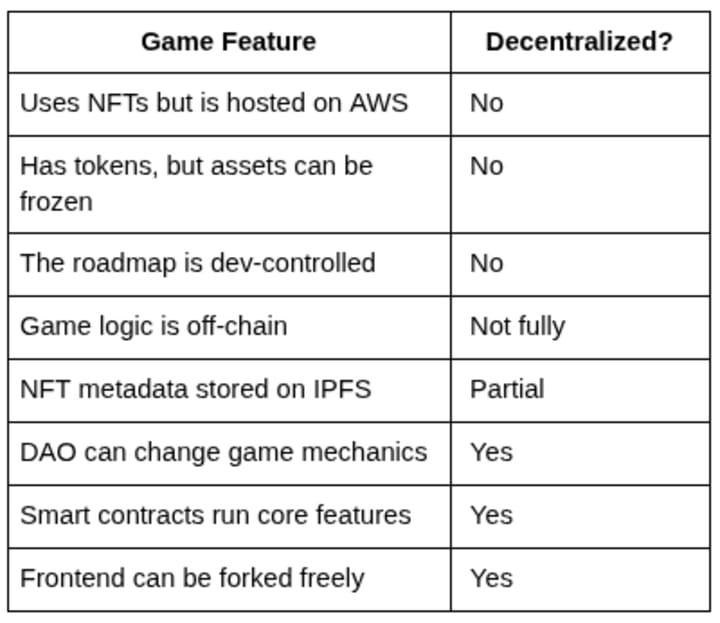
What is True Decentralization?
Most Blockchain games today are semi-decentralized at best. And that’s completely alright. This shift to full decentralization takes time, community maturity, and a commitment to transparency. Here is how it happens:
- Stage 1: Centralized Control: Devs control assets, logic, and governance.
- Stage 2: Progressive Decentralization: Community gets input, and some logic moves on-chain
- Stage 3: Autonomous Game Worlds: DAO governs, smart contracts run gameplay, and frontends are forkable.
Games like Skyweaver and Aurory are in Stage 2, while Treasure DAO is in Stage 3.
Why Player Sovereignty Matters?
Decentralization is not just about technology; it is about player psychology. Players stop being consumers and start being co-owners. They invest time, money, and effort, and then vote on major game decisions. That’s how you build games that last a decade, instead of a product that can be easily replaced. When you decentralize a game, you decentralize:
- Decision-making
- Economic Power
- Cultural direction
- Creative input
Final Words
A truly decentralized Blockchain game does not need to promise ‘play-to-earn’ or hype a token drop. Its value comes from the community’s control, the code’s transparency, and the permanence of the assets. It’s not about what’s on the surface; it’s about what's on the chain. If you are building the future of gaming, decentralization is not just a feature; it’s your foundation.
About the Creator
Avloire Games
Avloire Webs Gaming is a UAE-based game development company at the forefront of integrating artificial intelligence with immersive entertainment. We harness cutting-edge technologies - like AI, machine learning, blockchain, NFTs, and AR/VR.
Keep reading
More stories from Avloire Games and writers in Gamers and other communities.
How End-to-End Game Development Services Work: A Startup’s Guide
The global gaming industry is booming with opportunities for startups, growing faster than ever. But while game ideas are limitless, turning them into playable, scalable, and profitable realities is a serious undertaking. That’s where end-to-end game development services provide a holistic solution that helps startups navigate every stage of game creation.
By Avloire Games8 months ago in Gamers
Slay the Spire 2 Review: A Worthy Sequel That Builds on a Legendary Roguelike
If you’re a fan of deck-building roguelikes, chances are you’ve already heard about Slay the Spire 2. The sequel to the beloved Slay the Spire has been one of the most anticipated strategy games in recent years, especially among players who love card-based combat systems mixed with roguelike progression.
By Bella Anderson6 days ago in Gamers
Top tipple tricks
Been thinking a lot about drinking, lately. Not least because of a recent episode of over-indulgence and the inevitable after effects. Some readers may recall the earlier articles I wrote about beating the booze. Here I set out an experiment in techniques for cutting down on my alcohol intake. The experiment was successful, the techniques worked, and I have armed myself with an arsenal of weapons in the war against the demon drink. I have yet to fire the first round however. It's all a question of timing (perhaps procrastination).
By Raymond G. Taylor3 days ago in Psyche



Comments
There are no comments for this story
Be the first to respond and start the conversation.