
How End-to-End Game Development Services Work: A Startup’s Guide
Understanding the Complete Game Development Pipeline

The global gaming industry is booming with opportunities for startups, growing faster than ever. But while game ideas are limitless, turning them into playable, scalable, and profitable realities is a serious undertaking. That’s where end-to-end game development services provide a holistic solution that helps startups navigate every stage of game creation.
In this game development guide, we will walk you through how full-cycle game dev works, what services are involved, and how to streamline your launch from concept to market.
What is End-to-End Game Development?
End-to-end game development, also known as full-cycle game development, refers to the complete process of building a video game from scratch. It covers every stage, from conceptualization and game design to deployment, post-launch support, and beyond.
Unlike modular or partial services, game startup services that follow the end-to-end model handle everything, so you can focus on the vision while experts manage execution.
Why Full-Cycle Game Dev Matters for Startups?
For startups, resources are limited. You cannot afford to stumble through inefficient workflows, disjointed teams, or mismatched technology stacks. End-to-end development offers:
- Streamlined production under a unified team
- Consistent quality control across all phases
- Accelerated time to market
- Cost-efficiency through bundled services
- Strategic guidance from pre-production to live ops
Phases of End-to-End Game Development Services
Here is a breakdown of each phase of the game design process as it unfolds in a full-cycle service model:
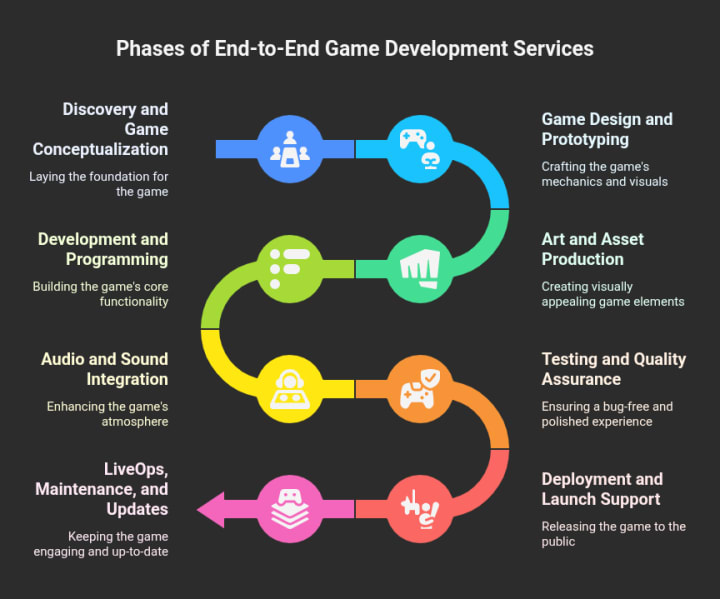
1. Discovery and Game Conceptualization
This is the brainstorming and research phase. A development partner will collaborate with your startup to shape your ideas into a feasible, market-ready concept. It includes activities like:
- Defining game genre, style, and platform (mobile, consoles, PC)
- Competitor and market analysis
- Initial storyline and character sketches
- Monetization and retention strategies
The primary goal is to validate your idea, set realistic expectations, and build a creative foundation.
2. Game Design and Prototyping
Once the concept is approved, designers and system architects get to work. This phase covers the structural heart of your game. This process primarily revolves around creating a working prototype to test core gameplay elements before full production. Prototyping includes:
- Game mechanics and core gameplay loop design
- Level design, enemy behavior, and mission structures
- UX/UI wireframes and screen flows
- Prototype development to test mechanics and player engagement
3. Art and Asset Production
The visual identity of your game is built here. Whether it’s 2D sprites or hyper-realistic 3D models, the art team brings your game world to life. It is necessary to ensure that the art style matches both your brand and the target audience’s expectations. Art design services consist of:
- Concept art and storyboarding
- Character modeling, rigging, and animation
- Environment design and VFX
- UI elements and icons
4. Development and Programming
In this phase, the dev team starts building the full game using your chosen game engine (Unity, Unreal, Godot, etc.). For startups, it is best to choose a full-stack game service provider as it gives you access to diverse professionals like backend coders, frontend coders, game artists, and quality testers. The key tasks in this phase include:
- Gameplay programming and mechanics implementation
- AI behavior and pathfinding
- Physics, interactions, and UI logic
- Backend systems (multiplayer or online)
5. Audio and Sound Integration
Sound is often underestimated, but it plays a crucial role in game immersion. Great audio design can significantly boost player retention and emotional engagement. This includes:
- Background scores and adaptive music
- SFX for actions, movements, menus, etc
- Voiceovers and localization
6. Testing and Quality Assurance
Before releasing your game, it is necessary to conduct extensive testing to ensure proper performance. A professional QA team ensures your final product meets industry standards and avoids reputation-damaging bugs. There are various types of testing conducted in game development, including:
- Functional testing for bugs and logic errors
- Performance testing for FPS, loading times, and device compatibility
- User experience testing to refine gameplay flow
- Multiplayer testing for latency, server stability, and matchmaking
7. Deployment and Launch Support
Once the QA phase is completed, it is time to release your game. A good game development provider does not stop at launch. It also provides post-release services to maintain the game. Some common launch services include:
- App Store and Steam Deployment
- Marketing material creation (trailers, press kits)
- ASO (App Store Optimization)
- Backend/server configuration for live games
8. LiveOps, Maintenance, and Updates
The real work begins after launch. Full-cycle studios provide continuous support to keep your game competitive. Some startups benefit greatly from this ongoing support, which helps increase retention and monetization without having to build a separate team. LiveOps services include:
- Patch and content updates
- In-game events and A/B testing
- Community management tools
- Analytics integration for user insights
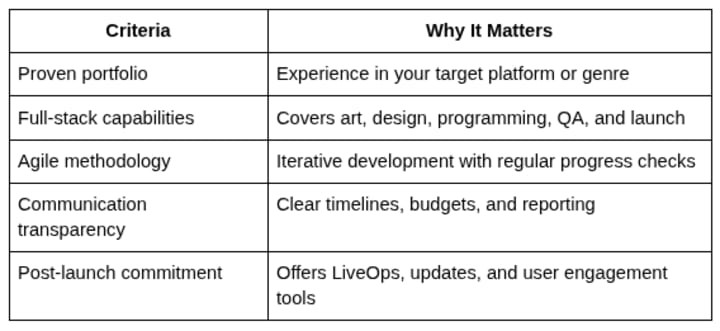
How to Choose the Right End-to-End Game Development Partner?
Here is a table that breaks down the primary factors that you should consider when choosing game startup services.
Related Article: What Makes a Game Development Partner Truly Reliable?
Final Words
For any game startup, building from the ground up is intimidating, but it does not have to be overwhelming. By partnering with an experienced end-to-end development team, you gain access to deep technical expertise, streamlined production, and faster time to market.
This game development guide has shown how full-cycle game dev works in phases, from design and development to beyond. With the right strategy and team, your game can not only launch successfully but thrive in a competitive market. If you are a founder with a vision, investing in the right game startup services is the smartest first move you will make.
About the Creator
Avloire Games
Avloire Webs Gaming is a UAE-based game development company at the forefront of integrating artificial intelligence with immersive entertainment. We harness cutting-edge technologies - like AI, machine learning, blockchain, NFTs, and AR/VR.
Keep reading
More stories from Avloire Games and writers in Gamers and other communities.
What Investors Expect From AAA Game Development Studios?
In this technology-driven gaming world, AAA games play a vital role in shaping the industry. This has created a vast demand for game investment in 2025. However, investors are now smart enough to expect not only a great ROI, but also creativity, innovation, strategic planning, risk management, and more.
By Avloire Games9 months ago in Gamers
Knights of the Old Republic II
A long time ago, on a writing platform far, far away, I wrote a review for Knights of the Old Republic. It was part of my Star Wars content for May 2024. My final verdict on that one was that it was great fun. It wasn't perfect, but I had a great time playing it. Now, it's time to look at the sequel - yes, there's a sequel.
By Greg Seebregtsabout 19 hours ago in Gamers
📢 Raise Your Voice Thread: 03/05/2026
Our “Raise Your Voice Threads” are hosted most alternating Thursdays at 12PM ET to offer creators more avenues to uncover exceptional stories on Vocal. As we are continuously searching for fresh creators and inspiring stories, this thread provides an opportunity to exchange and discuss the stories that have moved and motivated us on Vocal.
By Raise Your Voice by Vocal7 days ago in Resources


Comments
There are no comments for this story
Be the first to respond and start the conversation.