
What is Valorant?
Valorant is an FPS game. But how is it unique, what are the basics of it, and what are some ways to understand when watching the pros?

“What is Valorant?”
That is a question I have been repeatedly asked when describing the game I’ve spent years playing and analyzing. In this article, I will be explaining the basics of the game and strategies to understand when watching professional games. This article is a reference for any new readers of mine who are interested in understanding how to succeed in the game.
In this article:
- My Qualifications
- Valorant Basics
- How to get better at Valorant
- Strategy
My Qualifications:
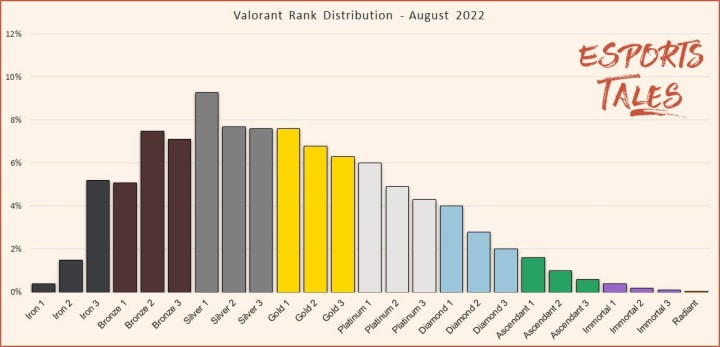
You may not have complete trust in me because I am only ranked diamond ('in game' skill level fig.1), but one of the largest Valorant analysts on youtube, named ThinkingMansValorant, is Platinum (or at least that is what his mods say on his live streams). This being said, I don’t need to have the position of a pro or have a super high rank to give my two cents on the game. However, according to an article in August 2022 (when this article is being written) the fact that I am diamond puts me in about the top 13% of players, so I am not terrible by any means. So trust what I say, but remember that most of what I say is my opinion and not fact.
Valorant Basics:
I will go a little more in depth as the article continues, but starting with basics: Valorant is a tactical FPS game that is played in teams of five. The objective is for the attackers to "plant the spike" and the defenders to not let it explode. "Spike" is Riot's nice way of saying bomb. You plant the spike by getting to a bombsite that is defended by the opposing team and holding 4 (the plant button) until the spike goes down. The defenders then have 45 seconds to defuse the bomb. The act of diffusing takes 7 seconds. The 7 different maps have different looks and can even have a different number of bomb sites. The game is best of 25 rounds (until one team wins 13 rounds) and each player gets to choose an "agent" (fig.2 below). Agents are characters with unique roles and abilities. One ability recharges and is a signature to the character and the others must be bought. Speaking of buying, Valorant's "Economy" is a feature that, while not unique, makes it even more strategic. You get money from various things like planting the spike, winning rounds, and killing people. You then use the money to buy abilities, shields, and guns. There are many ways that different teams use their economy that can give an edge or ruin their chances.

Wading a little deeper, Valorant has 18 agents. They are split into 4 categories based on the properties of their utility: Duelist, Controller, Sentinel, and Initiator. You can use the descriptions below to decide which kind of agent would fit your play style.
Duelists are aggressive. The point of their utility is to get the team onto the site and set up fights with the enemies. For example, Jett's dash and Raze's satchels allow you to get onto site faster and get space for your team. Getting space is the main role for a duelist. This is when you use your abilities to be aggressive and move as far onto site as you can. This allows your team to know where is safe and follow you onto the bombsite.
Controllers can be passive or aggressive (depending on the agent, the map, and if you are attacking or defending). On attack, their job is to use their utility to block the opponents line of sight and/or disrupt their ability to defend the bombsite. On defense, they use their utility to delay the attackers from getting onto the bombsite and help their teammates with their utility.
Sentinels are the most passive of the agent types (for the most part). Sentinels’ job is to hold one spot. On defense, their utility is like a wall (literally for sage), creating a barrier that is hard for attackers to get through. On attack, their utility keeps opponents from getting behind your team without you knowing. The exception to the passivity is an agent called Chamber. He can set up two anchors which allow him to teleport from the nearest one to the farthest. It allows him to be very aggressive and the best agent to use the Operator (the sniper rifle in the game).
Initiators are the supports of the team. While you can be aggressive with them, their main purpose is having useful utility to help your team. Initiators have utility that is based around revealing where your opponents are, temporarily blinding your opponents, or just in general allowing you entry onto site. Initiators all are unique in what they can do for the team and some are much more passive than others.
How to get better at Valorant:
You may notice that I did not explain any controls, movement, or gunplay. This is for a simple reason: I want this to be a short article. If I explained every detail, this article would triple in length. You can use this video by ProGuides to learn the basic controls, gunplay, etc. It explains not only the basic movement, but also some other basics I have not listed. It will be a valuable resource.
For anyone who already knows what I have explained or wants to learn more strategies on how to get better, I will begin to talk about strategy and how to get better at the game. At first, very basic, but then more intermediate with the pro strategies. I will not go into too much detail now, but will make separate articles on each section I have below.
There are three main things you need to get better at Valorant (at least at a lower level). Gunfight mechanics (like aim, positioning, etc.), macro game sense (teamplay, map control, rotates, etc.), and micro game sense (utility usage, clutches, economy, etc.).
Gunplay mechanics are hard to improve, but they are a vital part of improving at Valorant. They are so difficult because they take time, practice, and awareness. It is hard to notice bad traits in yourself when it comes to positioning. Sometimes it takes a friend or finding a coach to tell you your mistakes. If aim is your problem, you are in luck. There are many things you can do to improve your aim. The most basic way is to do an aim routine. Aim routines can be anywhere from 10-30 minutes and are routines you use to improve your muscle memory. You can find many examples of these on Youtube like this one by ChosenOPPA. The other things that have a direct effect on aim are crosshair placement and reaction time. Luckily, reaction time will get better with time played in game, but crosshair placement is something you must work on. Focus on your crosshair always being where an opponent could peek you from and at the level that their head will be.
Game sense will be explained in another article to keep this article short, but here are the basics: Micro game sense are things that you can improve that better yourself and have a major effect on you. These are things like utility lineups, when to push to find timings, and when to take a fight vs survive. Macro game sense are things that you can do to improve your team’s chances of winning and have a major effect on the team’s coordination. These are things like how much utility to use vs save, economy, and other things that have a large impact on the teamplay. These can both be improved by watching streamers, pro games, or even just playing often.
Strategy Basics:
When thinking about Valorant strategy and understanding pro play, there are a few things that must be on the forefront of your mind:
- What map is it? Is the map defense sided or attack sided? (Which side typically wins more rounds)
- What are the team compositions? (Do the teams have the correct duelist for the map? Two controllers? Two initiators? etc.)
- Where do the teams like to default? (a default is controlling multiple parts of the map rather than rushing one spot) If a team has a usual strategy the other team can take advantage of that by changing how they are playing and defaulting.
These are just three of the many things to be thinking about when watching a match, or even when in a match. I will go more in depth about strategy in future articles, but for now, these are three basic things to be thinking about when deciding how to play or while watching a game of Valorant.
Vincenzo Milenna. “Valorant Rank Distribution and Players Percentage”. Esportstales, Aug. 18 2022, https://www.esportstales.com/valorant/rank-distribution-and-percentage-of-players-by-tier.
About the Creator
Colten Hodgkin
I want to become a Valorant analyst/coach and I spend a lot of time analyzing the VCT games and playing valorant.
I will be writing three series of stories:
How to get better at Valorant
Map meta/team strats and defaults
Pro game reviews.
Keep reading
More stories from writers in Gamers and other communities.
I Am Future On PS5 : Now available on PlayStation 5
Survival games are often defined by tension. Hunger meters tick down, enemies lurk in the shadows, and every mistake feels costly. I Am Future: Cozy Apocalypse Survival, now available on PlayStation 5, takes a very different approach. Instead of stressing players with constant danger, it invites them to slow down, breathe, and rebuild. It’s a survival game where optimism, creativity, and calm take centre stage — and on PS5, it feels right at home.
By Games Mode On5 days ago in Gamers
Wild Card Weekend Recap: What Happens Now?
I think I figured out why I love Wild Card Weekend so much. It's because it's the first playoff anything of the calendar year. The NFL season starts in the fall, and once upon a time, the champion was crowned either on or slightly before New Year's. The evolution of the NFL schedule has resulted in the playoffs starting just into the New Year, and currently, the final week of the season falls on the first weekend of the New Year, with Wild Card Weekend coming a week after that. So yes, chronologically, the NFL's Wild Card Weekend serves as the first playoff anything of the calendar year.
By Clyde E. Dawkins5 days ago in Unbalanced



Comments
There are no comments for this story
Be the first to respond and start the conversation.