
THE STORY OF CARL LEWIS AND HIS IMPACT ON SPRINTING AND LONG JUMP
Carl Lewis:A Legendary Influence on Sprinting and Long Jump Excellence.

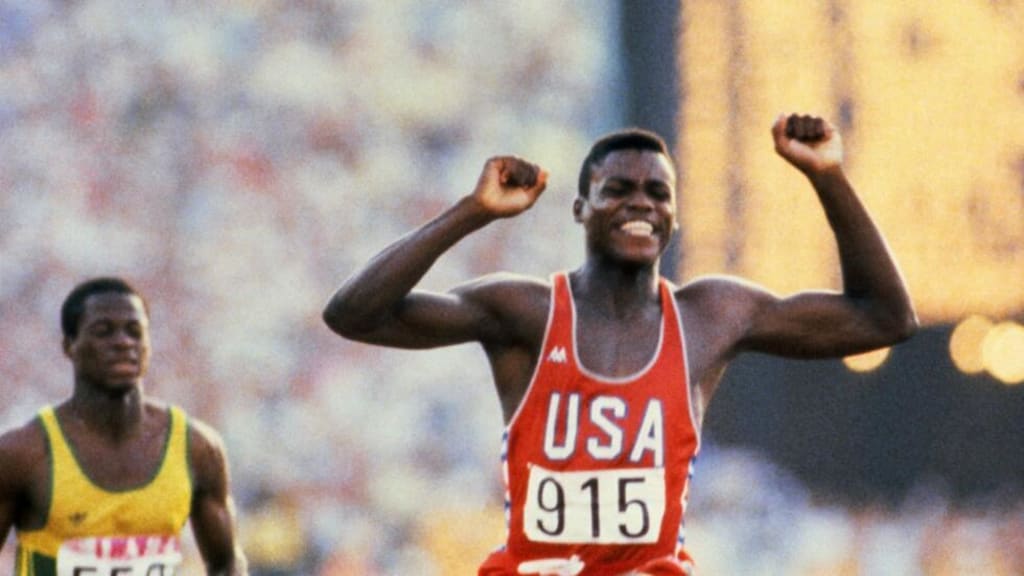
Carl Lewis is widely regarded as one of the greatest track and field athletes in history, with an unparalleled legacy in both sprinting and long jump. Over the course of his career, he achieved extraordinary feats that reshaped the landscape of athletics, particularly in the Olympics, where he garnered 9 Olympic gold medals across four Olympic Games (1980–1996). His impressive career includes 10 Olympic medals, a record for male athletes at the time, with his long jump dominance being a standout feature of his legacy
Lewis made his Olympic debut in 1980, although he did not compete due to the U.S. boycott of the Moscow Games. However, he made a spectacular return in 1984 in Los Angeles, where he won four gold medals in a single Olympic Games. His performances in the 100 meters, 200 meters, and long jump were world-class, setting him on a path toward being recognized as one of the greatest Olympic athletes. His dominance continued, particularly in the long jump, where he became renowned for his consistency and groundbreaking performances
One of Lewis's most impressive achievements was his 65 consecutive victories in the long jump over a decade, a streak that remains one of the longest undefeated stretches in the sport. This was complemented by his breaking of world records in the 100m, 4×100m relay, and 4×200m relay, cementing his place in history. His prowess in the long jump was so dominant that he earned the title of "Athlete of the Century" by the International Association of Athletics Federations
In addition to his athletic achievements, Lewis was a symbol of resilience and versatility, mastering both sprints and field events. He is often credited with bringing attention to the athletic potential of long jumpers in sprints as well, showing that multi-disciplinary success was possible at the highest level. His approach to training and his mental toughness served as inspiration for countless athletes, particularly sprinters and jumpers looking to emulate his balance of speed and power
Carl Lewis's impact extended beyond the track as well. He played a pivotal role in elevating the profile of track and field during the 1980s and 1990s, inspiring future generations of athletes, especially in the U.S. He was celebrated for his iconic rivalries with other athletes, notably in the 100m and long jump events, and for his ability to perform under pressure in major competitions. His career reached a crescendo in 1996, when he competed in his final Olympic Games in Atlanta and won his ninth gold medal
Today, Carl Lewis is remembered not only for his extraordinary achievements but also for his significant influence on track and field.
Carl Lewis's career is often marked by excellence and longevity, with his achievements spanning more than a decade, and his name forever linked to the history of the Olympic Games. His dominant presence in both the 100m, 200m, and long jump events during his prime years has made him an icon of track and field sports.
A unique aspect of Lewis's legacy is his remarkable ability to excel in both sprinting and jumping—an achievement that few athletes can match. His versatility in these two areas has inspired future generations of athletes to push their boundaries across multiple events, rather than focusing on a single specialization. Beyond his Olympic victories, Lewis's influence extended to major world championships, where his consistency and performances helped solidify track and field as a premier sport globally.
Lewis was not only a physical talent but also a mental powerhouse. His ability to handle pressure in the biggest competitions, especially in the long jump, made him an iconic figure. He often performed his best when the stakes were the highest, such as in the 1988 Olympics, where he won a gold medal in the long jump despite fierce competition from his rival Mike Powell. This particular victory highlighted his mental fortitude and unwavering determination
While his athletic achievements are certainly remarkable, Lewis's contributions to the sport also include his involvement in promoting track and field through his media presence and post-competition work. He has served as an inspiration for sprinters, jumpers, and athletes in other sports who admire his versatility, training methods, and resilience. Lewis's role as a cultural ambassador for track and field through the 1980s and 1990s continues to inspire young athletes and fans alike. His popularity and impact have extended far beyond the track, into the realm of public speaking, and even into political and social causes where his voice has been influential
In sum, Carl Lewis’s influence on sprinting and the long jump, coupled with his resilience, mental toughness, and ability to perform under pressure, has earned him a place as one of the most legendary figures in Olympic history. His contributions to track and field and his role in inspiring future generations are immeasurable, making him a true icon of the sport.
About the Creator
Badhan Sen
Myself Badhan, I am a professional writer.I like to share some stories with my friends.
Keep reading
More stories from Badhan Sen and writers in Gamers and other communities.
THE INFLUENCE OF ALLYSON FELIX ON OLYMPIC TRACK AND FIELD
Allyson Felix stands as one of the most influential figures in the history of Olympic track and field. Her illustrious career, which spanned over two decades, transcends athletic success, making her a role model for athletes globally. From dominating sprint events to becoming an advocate for women’s rights and athlete welfare, Felix's legacy extends far beyond medals.
By Badhan Senabout a year ago in Gamers
Lessons from the Golf Course: Discipline, Focus, and the Art of Performance
Golf was never meant to teach me anything about performance. At first, it was simply a way to slow down. A walk across wide green space, the sound of a clean strike, the quiet challenge of sending a small white ball toward a distant target.
By Andreas Szakacsabout 12 hours ago in Gamers




Comments (1)
wow