
THE RISE OF E-SPORTS:WILL THE OLYMPICS EMBRACE THEM?
Exploring the Future of Competitive Gaming on the Olympic Stage.

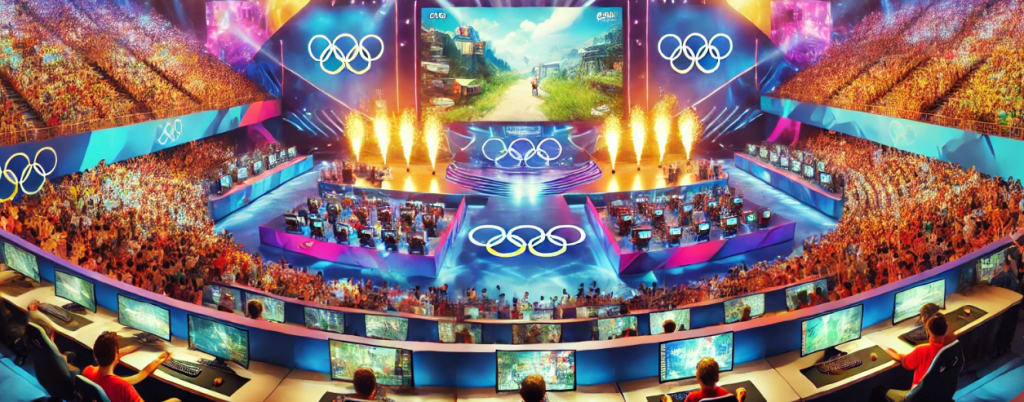
E-sports, or electronic sports, has witnessed a meteoric rise in popularity over the past two decades, transitioning from a niche hobby to a global phenomenon. With millions of viewers, professional players, and large-scale tournaments, e-sports has carved its own place in the world of entertainment and competition. But as the world of gaming continues to expand, a significant question arises: will e-sports ever be embraced by the Olympics?
(I)The Growing Popularity of E-Sports
The landscape of competitive gaming has evolved rapidly. What started as small LAN (local area network) tournaments in the 1990s has transformed into an expansive industry worth billions of dollars. Major games like League of Legends, Counter-Strike: Global Offensive, Dota 2, and Fortnite have large player bases, with annual prize pools running into the millions of dollars. Platforms like Twitch and YouTube provide live streaming services, giving e-sports fans access to real-time coverage of events, further cementing its place in modern entertainment culture.
The popularity of e-sports is not just limited to gamers; it attracts a global audience that is diverse in age, geography, and gender. In 2021, the global e-sports audience was estimated to exceed 474 million people, with a significant portion of them regularly watching events. This audience is comparable to, and in some cases, surpasses traditional sports in terms of engagement, especially among younger generations.
(II)E-Sports and the Olympics: A Natural Fit?
The idea of e-sports becoming part of the Olympics may seem unusual at first glance. The Olympics has long been associated with physical prowess, endurance, and athleticism, qualities that are often perceived as incompatible with video games. However, the modern Olympics has always embraced innovation and change. Over the years, we’ve seen the inclusion of sports like snowboarding, skateboarding, and surfing—activities that, at one time, were considered unconventional. This opens the door for considering e-sports as the next frontier in Olympic competition.
The International Olympic Committee (IOC) has already expressed interest in the growing field of e-sports. In 2018, the IOC held a session where e-sports and its potential inclusion in the Olympic Games were discussed. Thomas Bach, the IOC President, acknowledged the rapid development of e-sports and noted that it has the potential to attract a younger, more digitally-savvy demographic, which is important for the Olympics in the long term. In fact, the IOC views e-sports as a potential bridge to connect with the next generation of sports fans.
Moreover, there have been instances where e-sports has been part of the Olympic ecosystem, albeit on a smaller scale. For example, the 2018 Asian Games included e-sports as a demonstration sport, which was a huge step forward for its legitimacy in the world of international sports. The event showcased games like League of Legends and Pro Evolution Soccer, which were played in a competitive format. This experiment was seen as a testing ground for the integration of e-sports into larger sports events.
(III)Challenges to Inclusion in the Olympics
Despite the growing popularity and interest from the IOC, there are several challenges that prevent e-sports from being formally included in the Olympics at this stage.
- The Nature of E-Sports: The Olympics traditionally celebrates physical activities, whereas e-sports is based on mental agility, strategy, and hand-eye coordination. Some critics argue that e-sports should not be categorized alongside traditional sports because it lacks the physical exertion that is a key component of Olympic competition.
- Regulation and Governance: E-sports is a rapidly changing landscape with hundreds of game developers, varying rules, and fragmented structures. Unlike traditional sports, where governing bodies are well-established, e-sports lacks a singular global regulatory body. The IOC has stringent criteria for admitting new sports, and the fragmented nature of e-sports presents a challenge for creating a consistent and standardized competitive environment.
- Violence in Video Games: Many popular e-sports titles, such as Counter-Strike and Call of Duty, are centered around combat and violence. This raises concerns about whether these games align with the Olympic values of promoting peace, respect, and harmony. The IOC may hesitate to include games that are perceived as promoting violent behavior, especially given the emphasis on inclusivity and positivity in the Olympic movement.
(III)The Future of E-Sports in the Olympics
Despite these challenges, the potential for e-sports to make its Olympic debut is not out of the question. The global appeal of e-sports, the increasing interest among younger audiences, and the IOC's openness to innovation could pave the way for e-sports' inclusion in the future.
One possible scenario is the introduction of e-sports as a demonstration event in the near future, much like how snowboarding and surfing were introduced before becoming fully-fledged Olympic sports. In time, if the regulatory and cultural challenges can be addressed, we may see e-sports take its rightful place alongside traditional sports in the Olympic Games.
In the meantime, the growth of e-sports will continue to shape the future of competitive gaming and may inspire new forms of integration with traditional sports. Whether or not e-sports ever becomes part of the Olympic Games, its impact on global culture and sports entertainment is undeniable.
In The End
The question of whether e-sports will be embraced by the Olympics remains open, but the growing interest in the field cannot be ignored. While there are challenges related to governance, the nature of e-sports, and the IOC's conservative approach to change, the rise of e-sports has created an undeniable cultural force that could eventually influence the Olympic movement.
About the Creator
Badhan Sen
Myself Badhan, I am a professional writer.I like to share some stories with my friends.
Keep reading
More stories from Badhan Sen and writers in Gamers and other communities.
THE IMPACT OF ROBOTICS ON OLYMPIC CEREMONIES AND EVENTS
The Olympic Games have always been a grand spectacle, showcasing the pinnacle of human athleticism, creativity, and culture. As technology continues to evolve, robotics has increasingly become an integral part of the Olympic experience, transforming both the ceremonies and the events themselves. From opening and closing ceremonies to real-time event monitoring, robotics offers innovative ways to enhance the visual appeal, efficiency, and spectator engagement at the Olympics. This article explores the significant impact of robotics on Olympic ceremonies and events, focusing on how robots have elevated the overall experience for athletes, viewers, and organizers.
By Badhan Senabout a year ago in Gamers
Here Again
I know I have been teasing about coming back to content creation and just before, I either get sucked into work or life gets the best of me. 2025 was quite a year and I feel that resonates with everyone. At the begining of the year I got a new vehicle only to lose it about halfway through the year due to an accident. Thankfully no one was injured, and the worst damage done was to my vehicle and my wallet. But I also got a promotion at work, and although it has come with it's challenges I am still powering through it. I also recently lost my mother towards the end of the year and dealt with the emotions that come along with that. So although 2025 was quite rough and I had to really step away and see what was important to me, I believe I have found my way and will be coming back with more content and a new sense of direction. I wanted to create a community where gamers could come together no matter what we played on and honestly there are quite a few ways to complete that goal. I will be streaming four days a week, mostly solo games, and once I complete the story line on Where Winds Meet than that will be the community game as it is not only cross play across systems, but also cross save. I will also introduce PalWorld at some point. For the moment I will be completing out three solo games a week. I will be streaming on Twitch and when able I will upload the video to my Youtube channel. With my schedule, I will only be streaming every other week so as to not burn myself out creativetly. I will also be writing out game reviews as well as game walk throughs on here that will be written through experience of playing. I am also going to use every chance I get to remind people to return to our roots as communities and through these tough times to be a little kinder to one another. I will not entertain or put up with mindless unkindness in my community and those that attempt to do so will not have access to the community that is being built. On that note, I will not turn anyone away that is looking for a helping hand, as I am still growing I am not able to help out financially but I can provide a safe space on Discord and offer a place to play games. I play more than just I will be showcasing on Twitch, and when I am online I am almost always available and up for a game with friends. I have found that since being back in contact with some old friends of mine that I really do wish to come back into the scene and work towards my original goal of working from home. Do not get me wrong, I enjoy what I do for my personal career and I am actually quite fulfilled and rewarded at work. I do see myself being at my "day" job for a good while yet, as soon I wish to start into learning a new field this year. Two of them to be exact, between cyber security and nursing, I wish to further my education so as to further reach my goals. So I appreciate every view, read, comment, and share across my socials. So to wrap things up on this one, every other week I will be streaming on Twitch on Sunday, Monday, Wednesday and Saturday. I look forward to hearing from all of you as well as playing games together!
By Will Besaw4 days ago in Gamers
Dominating with Dual-Wield Pistols in CoD BO7: Tips That Work
Dual-wield pistols have always had a place in Call of Duty, but in Black Ops 7 they feel sharper, faster, and more dangerous than before. With the right setup and mindset, running akimbo pistols is no longer just for flashy clips. It is a real option for close-range control, fast pushes, and aggressive objective play. Players who understand how these weapons behave can turn tight spaces into their own territory and force enemies to fight on uncomfortable terms.
By Smsankar Goswami2 days ago in Gamers


Comments (1)
Interesting article. How would they televise these esports?