
THE OLYMPIC TRUCE AND ITS SYMBOLIC ROLE IN PROMOTING WORLD PEACE
Uniting Nations Through Sport for Harmony and Global Peace.

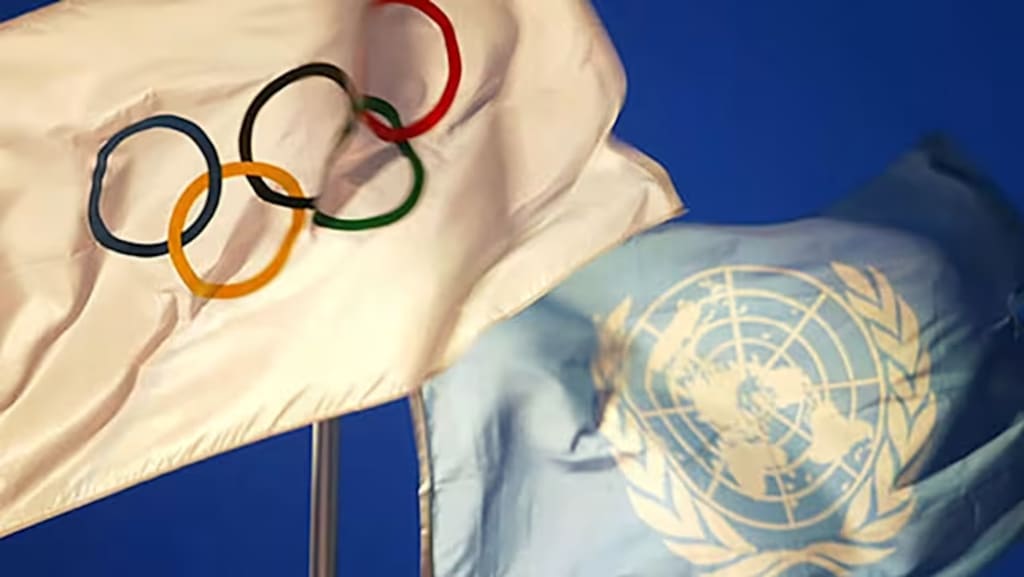
The Olympic Games, celebrated globally as a showcase of athletic prowess and unity, hold a deeper symbolic significance through the tradition of the Olympic Truce. Rooted in ancient history, the Olympic Truce represents a call for global peace, cooperation, and understanding. This tradition has evolved over centuries to serve as a beacon of hope, fostering dialogue and collaboration in a world often fragmented by conflict. In this essay, we explore the origins, development, and modern significance of the Olympic Truce, highlighting its role as a symbol of world peace.
(I)Origins of the Olympic Truce
The concept of the Olympic Truce ("Ekecheiria") dates back to the ancient Olympic Games, first held in Olympia, Greece, in 776 BCE. During these games, city-states across Greece agreed to cease hostilities and allow safe passage for athletes and spectators. This truce was not merely a practical arrangement but a reflection of the sacred status of the games. The truce was declared by the rulers of Elis, the city-state hosting the Olympics, and was respected by even the most powerful Greek city-states, emphasizing the shared cultural and Religious values of the time.
The ancient Olympic Truce was underpinned by a belief in the unifying power of sport. Despite political rivalries, the games provided a rare opportunity for Greek city-states to come together in celebration of human excellence and shared heritage. This spirit of unity and mutual respect set a precedent for the modern Olympic movement, which seeks to embody these ideals on a global scale.
(II)Revival of the Olympic Truce in the Modern Era
The modern Olympic Games, revived in 1896 by Pierre de Coubertin, were inspired by the ideals of the ancient games, including the concept of the truce. However, it was not until 1992 that the International Olympic Committee (IOC) formally revived the Olympic Truce. The initiative gained momentum during the Barcelona Games, coinciding with the end of the Cold War and a renewed emphasis on international cooperation.
In 1993, the United Nations General Assembly adopted a resolution urging member states to observe the Olympic Truce during the Games. Since then, the UN has reaffirmed its commitment to the truce every two years, highlighting its significance as a tool for promoting peace and understanding. The IOC established the International Olympic Truce Foundation in 2000 to further this cause, aiming to use sport as a means of conflict resolution and peacebuilding.
(III)Symbolism and Practical Impact of the Olympic Truce
The Olympic Truce holds profound symbolic value, representing the possibility of unity and cooperation even in times of division. By suspending conflicts during the Games, the truce reminds the world of the shared humanity that transcends political, cultural, and ideological differences. This symbolism is particularly powerful in a globalized world, where the interconnectedness of nations makes cooperation essential for addressing shared challenges such as climate change, pandemics, and social inequality.
While the Olympic Truce is largely symbolic, it has occasionally translated into tangible outcomes. For instance, during the 1992 Winter Games in Albertville, France, athletes from the former Yugoslavia competed under the Olympic flag despite ongoing conflict in their region. Similarly, the 2000 Sydney Games saw North and South Korea march together under a unified flag, demonstrating the potential of the Olympic Truce to foster dialogue and reconciliation.
(IV)Challenges to the Olympic Truce
Despite its noble intentions, the Olympic Truce faces significant challenges. In many cases, the truce is ignored by nations embroiled in conflict, highlighting the limitations of symbolic gestures in the face of entrenched geopolitical tensions. For example, the 2008 Beijing Olympics coincided with the Russo-Georgian War, underscoring the difficulty of translating the truce into practical action.
Additionally, the commercialization and politicization of the Olympic Games have sometimes overshadowed the ideals of the truce. The Games are often used as a platform for political statements, and hosting rights have been a source of controversy, raising questions about the sincerity of the commitment to peace.
(V)The Way Forward
To strengthen the Olympic Truce, it is essential to move beyond symbolism and integrate concrete measures that promote dialogue and cooperation. This could include leveraging the Games as a platform for diplomatic engagement, providing opportunities for world leaders to meet and discuss solutions to conflicts. Educational initiatives that emphasize the values of the Olympic Truce could also play a crucial role in fostering a culture of peace among future generations.
Moreover, greater collaboration between the IOC, the United Nations, and other international organizations could enhance the effectiveness of the truce. By aligning the Olympic Truce with broader peacebuilding initiatives, the Games could serve as a catalyst for lasting change in conflict-affected regions.
In The End
The Olympic Truce is a powerful reminder of the potential for sport to unite humanity and promote peace. While its impact is often symbolic, it represents a vision of a world where cooperation and understanding prevail over division and conflict. By upholding and expanding the ideals of the Olympic Truce, the international community can harness the unifying power of sport to address the challenges of our time and build a more peaceful and inclusive world. In this sense, the Olympic Truce is not merely a tradition but a call to action, urging us to strive for the betterment of humanity through unity and collaboration.
About the Creator
Badhan Sen
Myself Badhan, I am a professional writer.I like to share some stories with my friends.
Keep reading
More stories from Badhan Sen and writers in Gamers and other communities.
DIPLOMATIC BOYCOTTS AND THE IMPACT ON INTERNATIONAL RELATIONS
In the complex web of international relations, diplomatic boycotts have emerged as a potent tool for nations to express disapproval or condemnation without resorting to military or economic sanctions. Unlike full-scale embargoes or trade restrictions, diplomatic boycotts are symbolic actions that involve the withdrawal or refusal to participate in specific diplomatic events or forums. While these actions might appear merely symbolic on the surface, their implications can ripple across bilateral and multilateral relationships, impacting alliances, trade, and global governance structures.
By Badhan Senabout a year ago in Gamers
GTA 6 Budget
most talked-about video games of the decade — and its soaring budget is a major part of that conversation. As anticipation peaks with the release scheduled for late 2026, discussions about how much Rockstar Games and its parent company Take-Two Interactive have spent to develop and market this franchise-defining title have generated intense speculation, conflicting figures, and wild online rumors. �
By shaoor afridi6 days ago in Gamers



Comments (1)
What a great essay on this Olympic Truce which is a very good thing.