
The Mind Behind the Bat: Exploring Ancient Psychology in the Early History of Cricket
Uncovering How Human Behavior, Strategy, and Social Identity Shaped the Roots of the Gentleman’s Game

In the rolling green hills of 18th-century England, long before cricket became an organized international sport, it was already a psychological game.
The year was 1744. A group of men from neighboring villages gathered on a makeshift pitch in Surrey. Some wore patched waistcoats, others finer linen shirts. They weren’t professionals—just farmers, blacksmiths, and minor gentry seeking diversion. But as the wooden bat met the ball with a satisfying crack, something deeper than sport stirred in their minds: competition, strategy, pride, and community.
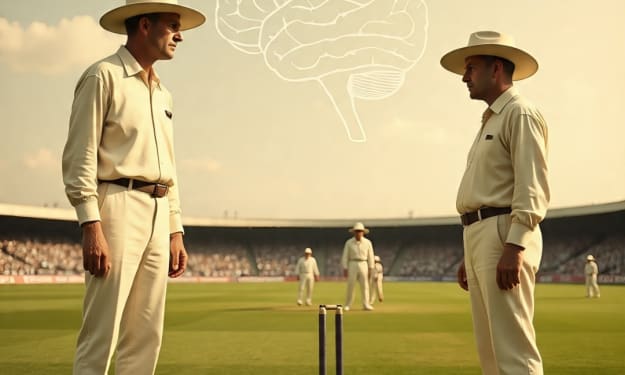
Cricket, even in its rudimentary form, was more than a physical contest. It was a game of the mind.
Historians often focus on cricket’s rules, development, and colonial expansion. Less often do they consider the psychology at play from its earliest days. Yet even in these early rural matches, the sport offered a stage where human instincts—cooperation, rivalry, performance anxiety, and even deception—played out.
Take Thomas Rayner, for instance, a middle-order batsman remembered in local journals from Kent. Rayner wasn’t the strongest hitter, but he was known for his patience. While others swung wildly, trying to impress the crowd or assert dominance, Rayner waited. He watched bowlers’ movements, learned their habits, and anticipated their deliveries. He turned cricket into a thinking man’s game.
Modern psychologists would recognize Rayner’s skill as "cognitive restraint"—the ability to suppress immediate impulses in favor of long-term goals. This trait, often linked to higher emotional intelligence, gave him a quiet edge. The villagers didn’t use such terms, of course. They simply called him "the shadow," for how he silently turned the tide of matches.
There was also an unspoken psychology among bowlers. In an era before standardized pitches, bowlers adapted quickly to inconsistent terrain. Their tactics weren’t just about where to place the ball—it was about reading the batsman’s fear or overconfidence. One village scribe wrote of a bowler who “stared until the batsman trembled, then bowled low and quick.” It was a simple act of intimidation—primitive, but psychologically effective.
Crowd dynamics played a role too. Early matches drew spectators from miles around, often fueled by local rivalries. Emotions ran high. Supporters cheered and jeered, placing bets or mocking opponents. This pressure affected players, revealing early examples of what psychologists now call "performance under social evaluation." A missed catch or a duck in front of neighbors could haunt a man for weeks.
And then there was the social structure of the game itself. Cricket became one of the first games to bridge the class divide—at least superficially. The term “gentleman versus player” would later formalize the distinction between amateurs and professionals, but even in the 1700s, subtle class psychology played out on the field.
Upper-class players often led the teams, expected to be the composed tacticians. Working-class players, though sometimes more skilled, were stereotyped as emotional or impulsive. This dynamic influenced gameplay and roles within teams. Yet paradoxically, cricket also gave the working class a rare opportunity: a chance to outwit and outperform their social superiors in public view.
Perhaps the most fascinating psychological layer was the concept of sportsmanship—or its early form. The idea of playing "fairly" wasn’t codified yet, but informal codes existed. Players who bent the rules were remembered and sometimes shunned. This early conscience, a mixture of honor and peer pressure, laid the foundation for the famed "spirit of cricket" centuries later.
Stories from the time speak of players who would confess to touching the ball with their hand, even when no one saw. Others would feign injury to manipulate outcomes. The moral tension between honesty and advantage was already embedded in the game. Psychologists would later study this tension in theories of moral development and group dynamics.
As cricket spread across the British Empire, these psychological dynamics evolved with it—but they never disappeared. From the dusty fields of colonial India to Caribbean beaches and Australian bushland, the same mental games were played: reading opponents, managing emotion, responding to crowds, and navigating status.
Back in Surrey, on that warm afternoon in 1744, the villagers didn’t know they were part of something larger. But when Thomas Rayner calmly blocked yet another fast delivery, forcing a frustrated bowler into error, the locals roared with appreciation—not just for the run, but for the mind behind the bat.
Today, centuries later, cricket remains as psychological as ever. Analytics may track performance, and sports psychologists may coach elite players, but the core remains unchanged. From dusty village greens to roaring stadiums, the battle of wits still pulses beneath every match.
The game has changed. The minds playing it have not.
About the Creator
Keep reading
More stories from Muhammad Saad and writers in Gamers and other communities.
The Timeless Mind Game: How Classic Cricket Shaped Human Psychology
The Timeless Mind Game: How Classic Cricket Shaped Human Psychology In the golden light of an early summer afternoon in 1934, a young boy named Hari sat cross-legged on a hill beside his village ground in northern India, watching an old cricket match with quiet reverence. There were no loudspeakers, no painted faces, no flashing scoreboards. Just the hush of anticipation, the rhythmic sound of leather meeting willow, and the occasional cheer breaking through the stillness. To most, the match seemed slow, even uneventful. But for Hari, every delivery was a lesson in human psychology. Cricket in its traditional form was not just a sport—it was a mental discipline. It demanded patience, strategy, emotional control, and an acute awareness of human behavior. A batter might spend hours at the crease, defending more than attacking, waiting not for the perfect shot but for the perfect moment. Bowlers, meanwhile, tested their opponents not just with variations of spin and pace, but with calculated psychological pressure—each over a quiet dialogue in the language of fatigue, temptation, and misjudgment. Hari, though just 11, was fascinated. He’d heard tales from his grandfather about test matches that lasted five full days—where a player’s endurance and mindset mattered as much as their technique. “It’s not about hitting the ball hard,” his grandfather once said. “It’s about knowing when not to hit it.” As Hari grew older, he began to realize that these games had left their imprint on the minds of generations. The old system of cricket, with its long hours, slow tempo, and subtle tactics, nurtured qualities that mirrored life itself. Restraint was as important as ambition. Focus, more powerful than force. One’s greatest opponent was not the person at the other end of the pitch—but the voice inside one’s own head. Modern psychology would later describe this mental state in terms of cognitive endurance and emotional regulation. But long before textbooks labeled it, cricket players had practiced it. They developed a form of “flow,” immersing themselves fully in the moment, maintaining concentration across long periods without external stimulation. Hari remembered a match where a batter named Prakash stood his ground for nearly six hours, scoring just 70 runs. The crowd had grown restless, even bored. But later, a local teacher praised Prakash’s innings as “a masterclass in mindfulness.” He had withstood the pressures of impatience—not only from his opponents but from his own teammates and the crowd. In this way, cricket’s old system quietly reinforced traits that modern society often struggles to teach: delayed gratification, mental resilience, and strategic thinking. A young person who played by these rules learned more than batting or bowling. They learned how to endure criticism without reacting. They learned how to wait, to observe, to adapt. And most of all, they learned how to lose without losing themselves. By the 1980s, cricket began to change. Shorter formats emerged—first One Day Internationals, then Twenty20. The pace quickened, the game became more aggressive, and the spotlight shifted to big hits and fast finishes. The crowd wanted thrill, not tension. Action, not patience. Hari, now a middle-aged schoolteacher, didn’t resent the change. But he saw something fading. He watched his students gravitate toward fast-paced games and digital rewards. Attention spans shortened. The virtue of "waiting for the right ball" disappeared—not just from cricket, but from life. The new players were skilled, energetic, and entertaining, but the old psychological dance—the subtle, almost meditative inner game—was rare. One day, during a school assembly, Hari shared a story of a cricketer who once batted through an entire day without scoring a single boundary. A student raised his hand and asked, “What was the point?” Hari smiled. “The point,” he said gently, “was that the player knew what mattered most wasn’t how much noise he made, but how long he stayed true to his plan. Sometimes, the quietest innings are the strongest.” As he looked at the young faces before him, he realized that while the format of the game had changed, its deeper lessons could still be passed down—if told the right way. Perhaps cricket, in its older form, wasn’t just about a game played on the field. It was about a game played in the mind—timeless, profound, and deeply human.
By Muhammad Saad 6 months ago in Gamers
Palworld TCG Guide: Release Date, How to Play, and Bushiroad Card List
The survival gaming world was recently rocked by an announcement that many saw coming but few expected to be this ambitious. Pocketpair has officially pulled back the curtain on the Palworld Trading Card Game, a physical tabletop experience developed in partnership with the industry giants at Bushiroad.
By Richard Bailey5 days ago in Gamers
From Stories to Systems
For a long time, this space has been a bit… quiet. If you’ve stumbled across this blog before, you might have seen short stories, poems, or bits of fiction—creative experiments written at different points in my life. That part of me hasn’t disappeared. I still love storytelling, world-building, and exploring ideas through narrative.
By D. E. King5 days ago in Gamers
The Devil's Cut
“Comrade, finally you’re awake.” The voice was smooth, sensual. A flickering incandescent bar was all that lit the white, sterile room. All Vladimir remembered was everything going black. He tried to move his arms and found them strapped to the gurney.
By Matthew J. Fromm6 days ago in Fiction


Comments
There are no comments for this story
Be the first to respond and start the conversation.