

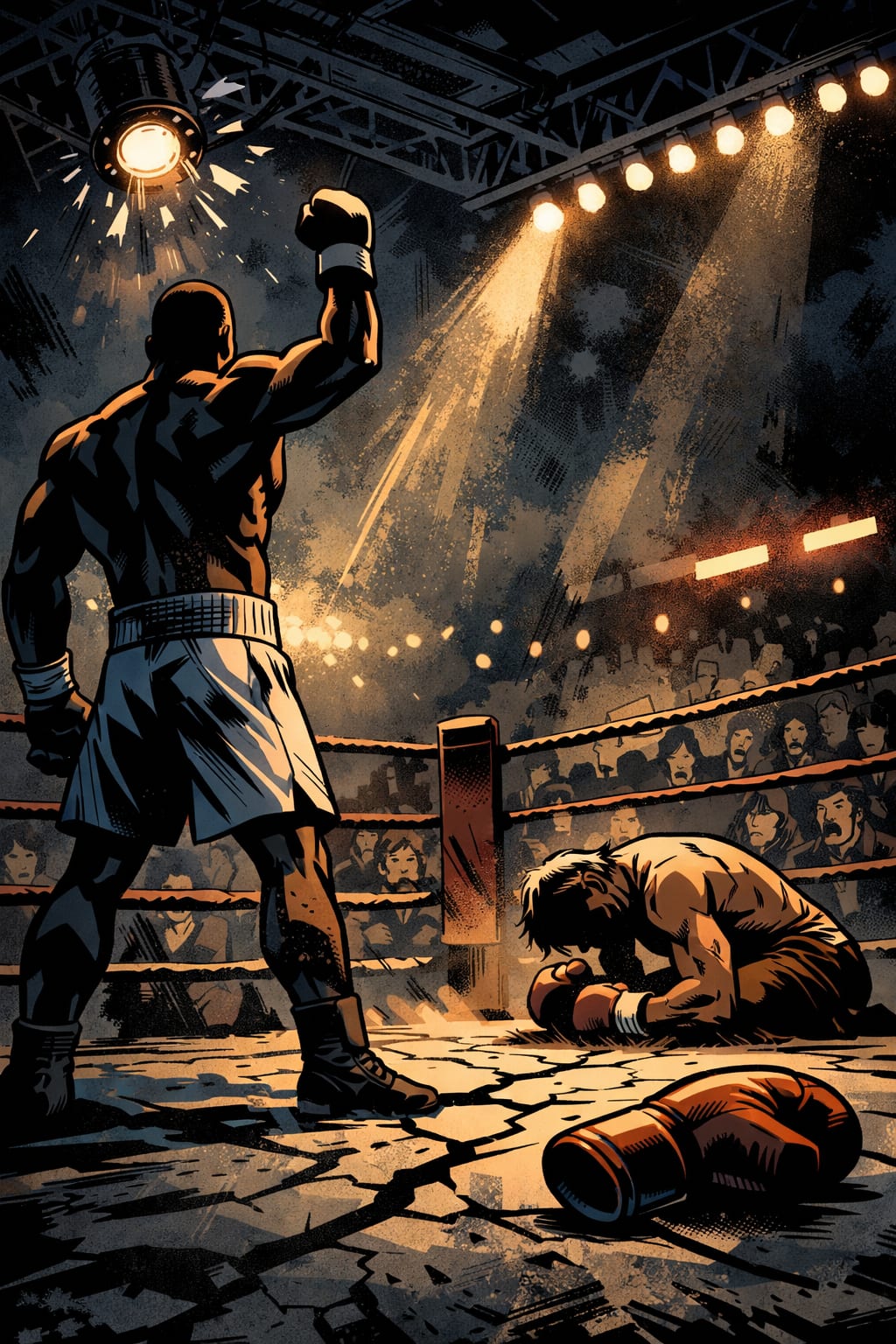
There are fights that start out as spectacles but end up becoming foundational stories. Not because they're pretty, but because they expose a truth that the era was trying to hide. The bout between Jake Paul and Anthony Joshua fits right into that mold. We're not just talking about a night of boxing here—it's a downfall. A crash between today's illusions and the raw, timeless danger of a sport that's never stopped being brutal.
That night, boxing didn't just punish a man. It set the record straight on an entire narrative.
The arena was packed—maybe too packed. Filled with shouts, raised phones, screens already hunting for the moment before it even happened. Everything was set up for a global event, engineered to spread faster than thought itself. Boxing seemed reduced to mere backdrop once again.
Jake Paul approached the ring like he was stepping onto a familiar stage. He knew the moves, the stares, the camera angles. His body showed the marks of training, but also the polish of performance. He embodied that generation convinced that boldness can stand in for experience, that confidence can bridge any gap.
Anthony Joshua, on the other hand, came in differently. His stride wasn't heavy, but resolute. His face sought nothing—no approval, no challenge. He wasn't there to spin a tale. He was there to end one.
The ring, that perfect square, is a strange place. It doesn't tolerate lies for long. You can enter with a legend, but you leave with only what you can truly defend, second by second. From the first exchanges, the contrast was clear. Joshua didn't rush. He didn't need to. He let the fight breathe, like a trap closing on its own.
Jake Paul moved a lot. Too much. His footwork wasn't that of a free man, but someone dodging the inevitable. He tried to stir up chaos, break the rhythm, inject doubt. But heavyweight boxing doesn't feed on disorder. It asserts itself.
Each jab from Joshua served as a reminder of a forgotten rule: distance is commanded, not bargained for.
As the rounds ticked by, the match lost its initial promise. It wasn't a clash anymore—it was a gradual lesson. Joshua hit without excess, without anger. He hit true. Paul absorbed, retreated, survived. But in boxing, survival is never a long-term plan.
A sharp skeptic might say plenty of fights start this way, that patience is part of the art. But here, the patience wasn't mutual. It belonged to the one who knew he had time on his side. The other was just scraping for extra minutes.
The crowd, without always realizing it, felt the imbalance. The noise grew uneven. The excitement cracked. An unease settled in, quiet, almost shameful.
The fifth round marked the break. A first collapse. Jake Paul hit the canvas like he'd reached his own inner limit. It wasn't the end yet, but it was already an admission. He got up, more from pride than clarity. His eyes had changed. That look boxers spot instantly: the one that knows there's no room left for error.
Joshua didn't speed up. Seasoned pros know haste is often the last resort of the inexperienced. He let Paul come back at him, driven by a will his body no longer backed.
The sixth round lasted only a blink, but that was enough to wrap it up. One step too far. A guard slightly lax. And the punch flew.
There's no poetry in a perfectly placed heavyweight hook. Just a sharp crack, a body giving way, and time seeming to freeze. Jake Paul went down without a fight, as if his system had quit first.
The jaw shattered. Clean. No metaphors needed.
In that instant, the arena fell silent. Cameras kept rolling, but something in the air had broken. It wasn't an event anymore. It was a consequence.
A broken jaw is a unique injury. It hits speech, breath, the fighter's very identity. It enforces silence. It reminds you this sport damages more than muscles—it strikes what lets us tell our stories.
Jake Paul, the guy who talked faster than his opponents, who built his fights on words, found himself voiceless. The symbolism was harsh, almost too on-the-nose.
Was this fight even necessary? The question lingers with observers now.
Some will say everyone owns their choices. Jake Paul signed on, he took the risk. Fair enough. But that logic, taken too far, misses the core: boxing isn't some abstract duel. It involves bodies, careers, sometimes lives.
The mismatch wasn't subtle. It was built-in. Pitting a boxer in the making against a former heavyweight world champ wasn't a bold gamble. It was an uneven risk, made palatable only by media gloss.
The broken jaw wasn't an accident. It was the logical outcome of a flawed equation.
Anthony Joshua didn't celebrate afterward. There was nothing to celebrate. He spoke with restraint, almost detachment. This wasn't a symbolic win for him. It was a job done. An unintended demonstration, maybe, but a needed one.
Joshua belongs to those boxers for whom the ring is a site of memory. Every fight carries the scars of those who fell before. He knows the cost of a mistake. He knows what it's like to take hits, lose, come back. His sobriety wasn't an act. It was a sign of keen awareness of the peril.
For Jake Paul, the aftermath is murkier. The injury will heal. Bones knit back together. But the real question isn't medical. It's deeper.
What's left when the story crumbles? When the body rejects the ambition? In those moments, two paths always emerge. The one of understanding—slow, painful, forcing a rethink of limits. And the one of denial, easier, turning the fall into just another plot point.
Boxing doesn't grant many second chances to those who won't learn.
This fight will stick as a benchmark. Not for stats or titles. But for what it says about our time. An age that loves believing everything can be sped up, squeezed, sidestepped. That night, boxing issued a flat no.
It reminded us some things take time. Experience can't be faked. Power, when controlled, always prevails.
Jake Paul's broken jaw isn't just a personal wound. It's the full stop on a modern myth: the one where visibility might someday replace substance.
JLP
About the Creator
Laurenceau Porte
Chroniqueur indépendant. J’écris sur l’actualité, la société, l’environnement et les angles oubliés. Des textes littéraires, engagés, sans dogme, pour comprendre plutôt que consommer l’information.
Keep reading
More stories from Laurenceau Porte and writers in Gamers and other communities.
Return to the Moon: Fear of Decline Disguised as Conquest
Humanity hasn't set foot on the Moon for decades. This fact, seemingly trivial, is actually dizzying. Over half a century has passed, and here we are, gazing at this celestial body we've once trod upon, without daring to return. It's as if that giant leap closed a chapter rather than opening a new one. As if the feat was so monumental it couldn't be repeated without losing its magic. Or, more bluntly, as if we'd lost faith in a future that extends beyond our little blue planet.
By Laurenceau Porte29 days ago in Earth
Rsvsr Path of Exile 2 0.1.1: Boss Respawns and New League Preview
The Path of Exile 2 community is buzzing! The 0.1.1 update is finally here, and while it’s a smaller patch, it brings some significant improvements that make the game more enjoyable, strategic, and exciting. Grinding Gear Games has focused on quality-of-life changes, balance tweaks, and preparing players for the next highly anticipated league. Here’s everything you need to know.
By Dangyc Ding4 days ago in Gamers
New Mission Mario Tennis Fever (Switch 2)
📅 Releasing on February 12, 2026 exclusively for Nintendo Switch 2 — Mario Tennis Fever serves up the next evolution of Nintendo’s beloved sports franchise, combining classic court action with whimsical new mechanics, an expanded roster, and fresh game modes that promise fun for solo players and groups alike.
By Games Mode On4 days ago in Gamers



Comments
There are no comments for this story
Be the first to respond and start the conversation.