
THE EFFECT OF THE OLYMPICS ON PROPERTY VALUES IN HOST CITIES
Analyzing the Economic Impact of Hosting the Olympics on Urban Real Estate Markets.

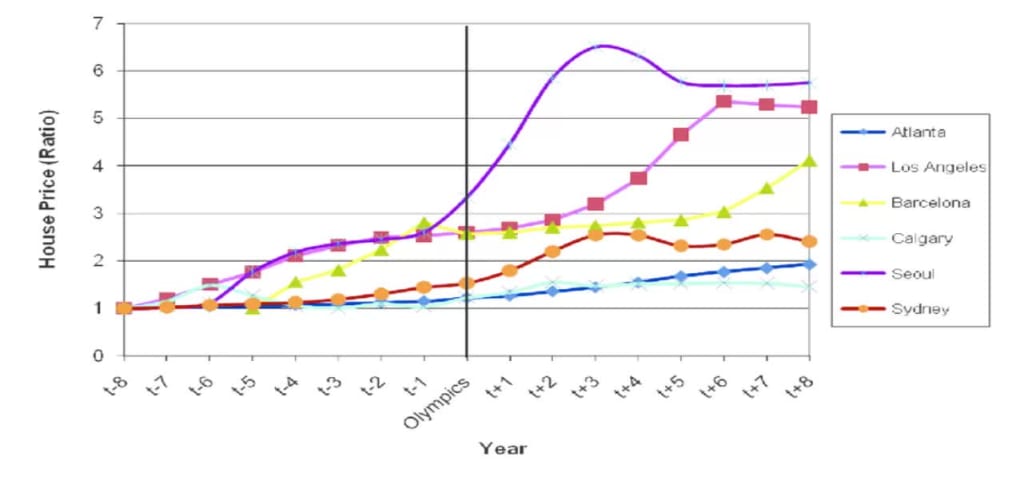
The Olympic Games are one of the largest global sporting events, with the potential to impact various sectors of a host city's economy, including property values. Hosting the Olympics brings international attention, boosts tourism, and results in significant infrastructure development, all of which can affect the local real estate market. However, the long-term effects on property values are mixed and depend on several factors such as the location, the nature of the investment, and the post-Olympic legacy.
Immediate Effects on Property Values
In the run-up to the Olympics, there is often a surge in demand for real estate. Property developers and investors anticipate increased demand for housing, both for athletes and visitors. The government and private investors typically inject significant capital into infrastructure projects, such as new hotels, sports venues, and transportation networks. This can lead to the short-term appreciation of property values, particularly in neighborhoods near Olympic venues or major transportation hubs.
For example, London 2012 saw a temporary increase in property prices in areas near the Olympic Park in Stratford. According to a report by the Royal Institution of Chartered Surveyors (RICS), property prices in East London rose by 40% in the two years leading up to the Games, particularly in areas surrounding the Olympic Village. Similarly, Beijing 2008 saw significant improvements in property values in proximity to the Olympic venues. These effects were partly driven by the influx of investment, both public and private, in the city’s infrastructure, including improvements to transportation networks.
The “Olympic Effect” on Long-Term Property Values
While property values in some areas rise in the short term due to anticipation and the influx of investment, the long-term impact is more variable. In some cases, once the Olympic Games are over, there is a decline in demand for the properties built specifically for the event. This phenomenon has been observed in previous host cities, where newly constructed sports facilities and housing developments become underutilized after the Games, leading to a decrease in property values.
For instance, in Athens 2004, many of the Olympic venues were left abandoned after the event, leading to concerns about their future use. Similarly, in Rio de Janeiro 2016, some areas near the Olympic Park, especially in the Barra da Tijuca district, saw property prices rise temporarily but then fall after the Games, as the demand for real estate decreased and many projects were left incomplete or underutilized.
However, in other cities, the post-Olympic infrastructure investment has been used to support urban regeneration, which can lead to sustained property value increases. Barcelona 1992 is often cited as a successful example of this. The city used the Olympics as a catalyst for urban renewal, transforming dilapidated areas along the waterfront into thriving neighborhoods. Property values in these areas increased significantly over the long term, and Barcelona remains a popular example of how hosting the Olympics can result in lasting economic benefits for property markets.
Influence of Infrastructure and Urban Regeneration
The infrastructure improvements made in preparation for the Olympics are often the most significant contributor to long-term property value changes. Host cities typically see major upgrades to transportation networks, including new airports, rail lines, and metro systems, which can increase the desirability of certain areas. In London, for example, the expansion of the Jubilee Line and the redevelopment of East London were seen as direct results of the Olympic legacy. These improvements continue to have a positive effect on property values, even though the Games themselves are over.
In contrast, when the investment in infrastructure is not sustained or the Olympic venues are not repurposed effectively, the property market may suffer. This can happen if the games do not lead to significant urban regeneration or if the infrastructure investments are mismanaged.
Gentrification and Displacement
One of the more controversial impacts of the Olympics on property values is the potential for gentrification. As new infrastructure projects are introduced and previously neglected areas receive upgrades, property values can increase rapidly, leading to the displacement of low-income residents. In cities like London and Rio de Janeiro, gentrification has been a major issue, as long-term residents have been pushed out by rising rents and property prices, often resulting in social unrest.
In The End
The effect of the Olympics on property values in host cities is complex and multifaceted. While short-term increases in property values are common due to the influx of investment and the creation of new infrastructure, the long-term effects are less predictable. In some cases, property values continue to rise, particularly when the games lead to lasting urban regeneration and infrastructure improvements. However, in other cities, Olympic-related developments have resulted in abandoned venues, rising inequality due to gentrification, and long-term declines in property values.
In conclusion, whether hosting the Olympics results in lasting benefits for property markets depends largely on how well the infrastructure investments are managed, how the venues are utilized after the event, and the broader economic conditions in the host city. Therefore, while there are opportunities for growth, the true impact of the Olympics on property values can vary widely between different cities and contexts.
About the Creator
Badhan Sen
Myself Badhan, I am a professional writer.I like to share some stories with my friends.
Keep reading
More stories from Badhan Sen and writers in Gamers and other communities.
HOSTING THE OLYMPICS:OPPORTUNITIES VS. COSTS
Hosting the Olympic Games is a significant achievement for any city or country, offering both extraordinary opportunities and considerable challenges. The decision to host the Olympics can have far-reaching consequences, from boosting national pride to reshaping local economies. However, the costs—both financial and social—are also substantial. In this essay, we will explore the opportunities and costs involved in hosting the Olympic Games, providing a balanced view of both sides.
By Badhan Senabout a year ago in Gamers



Comments
There are no comments for this story
Be the first to respond and start the conversation.