
THE CONTROVERSY AROUND THE 2008 BEIJING OLYMPICS
Political Protests,Human Rights,and Global Reaction

The Controversy Around the 2008 Beijing Olympics
The 2008 Beijing Olympics, held from August 8 to August 24, were a monumental event for China. They marked the first time the country hosted the Summer Olympics, showcasing its growing influence on the global stage. However, despite the grand spectacle and impressive infrastructure, the Games were not without controversy. Several issues, ranging from human rights concerns to environmental impact, sparked debates both before and during the event. This article explores the various controversies surrounding the 2008 Beijing Olympics.
Human Rights Concerns
One of the most significant and widely discussed controversies leading up to the Beijing Olympics was China's human rights record. Human rights organizations, including Amnesty International and Human Rights Watch, raised alarms about China’s treatment of its citizens, particularly in regions like Tibet and Xinjiang. In the years preceding the Games, China faced intense scrutiny for its crackdown on pro-democracy protests in Tibet in 2008. Reports of religious repression, censorship, and forced labor surfaced, drawing criticism from international human rights activists.
Many critics argued that hosting the Olympics provided China with a platform to further its international prestige while simultaneously ignoring its human rights violations. The government's heavy censorship of media, including the blocking of websites critical of its policies, also attracted attention. Furthermore, there was the issue of the rights of ethnic minorities, especially the Uighur Muslims in Xinjiang, whose plight was largely ignored by the international community during the Games.
Protests were held in cities worldwide, calling for a boycott of the Olympics or for China to improve its human rights record before the event. Despite these calls, the international community largely chose not to take action, with only a few countries, like the United States, sending lower-level representatives to protest China's policies.
Environmental Concerns
Environmental issues also played a central role in the controversy surrounding the 2008 Olympics. China, despite touting its commitment to environmental sustainability, faced criticism for its environmental record during the construction phase of the Olympic venues. Beijing's pollution levels were a primary concern, with critics pointing out that the city’s air quality was often hazardous.
In preparation for the Games, the Chinese government implemented strict measures to reduce pollution, including temporarily shutting down factories, restricting car use, and clearing smog-prone areas. However, these measures were seen by some as temporary fixes to ensure that the Games proceeded smoothly, rather than long-term solutions to Beijing's chronic air quality issues. The spectacle of a city trying to present an image of environmental responsibility while continuing to be one of the most polluted cities in the world left a lasting impact on global perceptions of the Games.
The Olympic Village and Workers’ Rights
Another point of contention was the labor used to build the Olympic venues and infrastructure. While the Chinese government promoted the idea of constructing state-of-the-art venues and a world-class Olympic village, labor conditions for many workers were reported to be poor. Human rights organizations and journalists highlighted reports of migrant workers being subjected to long hours, low wages, and unsafe working conditions while building the Olympic infrastructure.
These issues were compounded by the fact that many workers were not afforded proper labor protections, with some even reporting forced labor or unsafe living conditions. International watchdogs questioned the morality of using such labor to build the stadiums and facilities that would showcase China’s technological advancements and international status.
Political Implications
The 2008 Beijing Olympics were politically charged, as they represented China’s rise as a global superpower. For many, the Olympics became a platform for political dissent, as activists used the event to highlight human rights abuses. Notable examples included the "Free Tibet" protests that broke out in various cities, including Paris and London, during the Olympic torch relay, and the ongoing protests against China’s policies in Tibet and Xinjiang.
Some critics argued that the Games were being used by China as a political tool to gain global legitimacy, overshadowing the human rights violations taking place. The Chinese government's tight control over the media and public discourse during the Games reflected its attempt to manage its global image while stifling any negative coverage of the country’s internal issues.
The Closing Ceremony and Nationalism
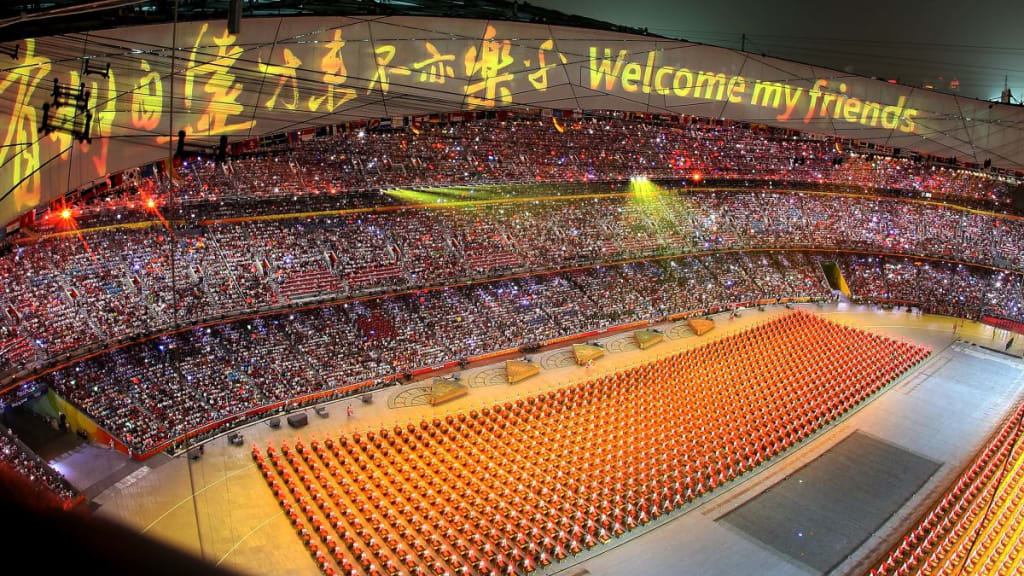
Despite the controversies surrounding the event, the 2008 Beijing Olympics were widely regarded as a spectacular success in terms of athletic performance and the opening and closing ceremonies. The grandiose opening ceremony, directed by Zhang Yimou, was hailed as a remarkable demonstration of China’s history, culture, and future potential. However, the emphasis on national pride and unity raised concerns about the underlying political motivations behind the ceremony.
While many praised the Games’ artistic achievements, others criticized the overly nationalistic tone of the event, interpreting it as an attempt by the Chinese government to project an image of dominance and power on the global stage. The closing ceremony, which featured an emotional tribute to China’s past and future, solidified the Olympics as a symbol of the country’s ambition and growing global influence.
Conclusion
The 2008 Beijing Olympics, despite their success in terms of athletic achievement and global spectacle, were marred by controversy. Issues related to human rights, environmental concerns, workers’ rights, and political implications all cast a shadow over the event. While the Games marked China’s emergence as a global power, they also underscored the challenges of balancing global aspirations with the realities of domestic policy.
The 2008 Beijing Olympics remain a testament to the complexity of hosting a global event in an increasingly interconnected world, where politics, human rights, and international relations play a crucial role in shaping the legacy of the Games.
About the Creator
Badhan Sen
Myself Badhan, I am a professional writer.I like to share some stories with my friends.
Keep reading
More stories from Badhan Sen and writers in Gamers and other communities.
THE ROLE OF POLITICS IN THE SELECTION OF OLYMPIC HOST CITIES
The Role of Politics in the Selection of Olympic Host Cities The selection of a host city for the Olympic Games is one of the most prestigious events in global sports, but it is also deeply intertwined with politics. The decision to host the Olympics involves multiple factors, ranging from infrastructure readiness to the city's ability to handle large-scale international attention. However, political considerations often play a significant role in determining which cities are selected to hold the Games. Over the years, the Olympic bidding process has demonstrated how politics, both international and local, influence the outcome of this decision.
By Badhan Senabout a year ago in Gamers
U4gm Maximizing Spores and Rewards in Pokemon Pokopia
The “More Spores for Hoppip” event in Pokemon Pokopia has quickly become one of the most exciting seasonal updates this year. Running from March 9 to March 24, 2026, the event challenges players to collect rare spores, Hoppip-themed furniture, and Pokemon Pokopia Life Coins, while exploring meadows and interacting with Hoppip, Skiploom, and Jumpluff.
By Dangyc Ding6 days ago in Gamers
Bomb Scare
It was 2027, and the world never thought it would happen. A missle hit the United States, but it wasn't where they had anticipated. A little town in the northeast was hit by a missile strike, they didn't know why, and they didn't know exactly where it hit, but they did know it was a coastal community, somewhere between Maine and Delaware.
By Gregory Payton7 days ago in Fiction


Comments (1)
Good article and it is a shame that politics and even at times economics have to enter the Games at all.