
Review: 'Kholat' — The Dyatlov Pass Incident Reborn
'Kholat' brings to life an investigation about what happened on the mountain Kholat Syakhl.

Pros:
- Extremely immersive art direction that brings players to the real-world Ural mountains
- Storytelling is directly told through the games willingness to let players adventure on their own
- Use of sound and the games imagery to tell the story is more powerful than the found diary clippings and narrative musings of Sean Bean
Cons:
- Players are expected to explore using a map and a compass to figure out where they are
- Subtitles and diary entries suffer small translation errors that can be hard to keep some immersed into the game.
It's cold when you first step off your train. Your memories go back to the winter of 1959 into the frozen expanse of the Russian Ural Mountains. You recall each bit of the occurrences that happened in the mountains as steam brushes out from your lips due to the frigid wind that blows against you. You recall the information you'd been researching about the bodies the search parties found once the snow began to thaw in 1960. You recall that something horrifying had happened. The hikers had cut their way out of their tent from the inside, they had fled into the bitter cold of night in a Russian winter.
You recall with each step you take and the sound snow beneath your feet as you move from your train, which has fallen silent, that they hadn't bothered putting on clothes or shoes. They fled in their socks and night garments. They fled because something had scared them enough to flee as they did. You recall the notes you'd stumbled upon about horrific internal injuries. A woman that had lost her tongue and eyes that fateful night. Rolling the memories slowly back, your breath deepens as the frigid air bites at your lips.
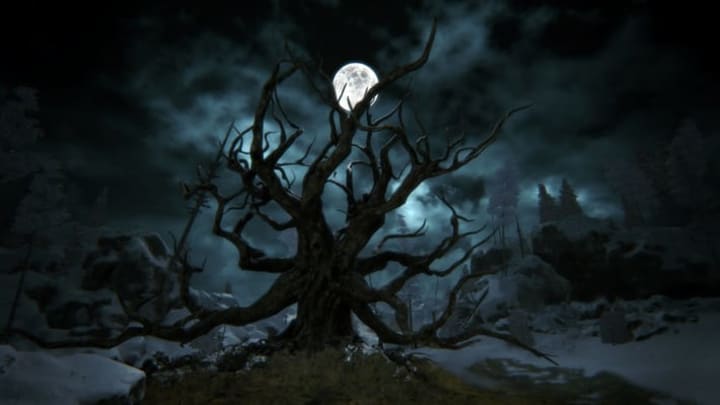
Not even the trees can survive the cold (Credits: IMGN.pro)
This is the setting you will become accustomed to in in Kholat, which brings to life an investigation about what happened on the mountain Kholat Syakhl. This very mountain is close to where the Dyatlov Incident took place as it is in the Ural Mountains. Developed by a small Polish indie studio named IMGN.pro, Kholat takes on the exploratory search to find out what exactly happened in those mountains.
From the instant players step foot off their train, they are introduced to a Russian winter. A small village in the Ural Mountains serves as the starting point. Much as expected, IMGN.pro sets the atmosphere, the tone, and element of reality from the get-go. There's no mistake that the games haunting soundtrack, ambient howling winds, and crackling tree limbs from ice serve as an unsettling element to the game. It's a superb approach to a visually stunning game that you'll be ready to explore.
To begin, players will find themselves slowly stepping into the mountain as night slowly approaches. What the game offers is something truly unique. It offers out the idea that you, you are the investigator. You - yourself - are the one whom will take the dangerous trek across Kholat in search for the truth. It was this very element that drives home the haunting information out there. You are the one who will follow the steps taken by those whom died in 1959. That the game will feast upon elements of the investigations that took place.
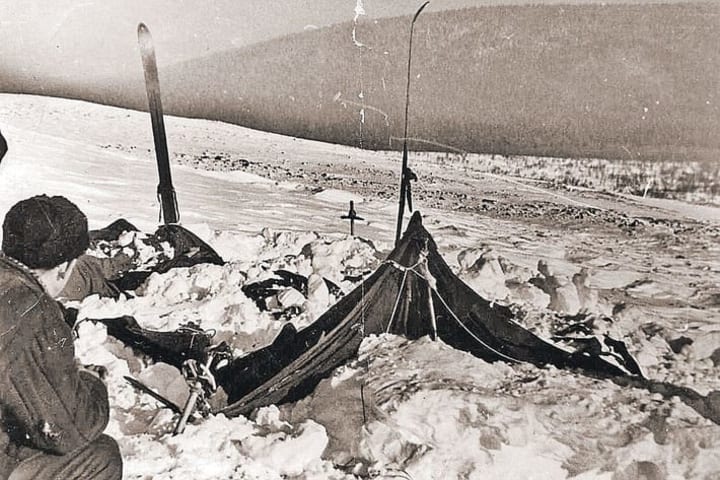
Real Photo of the tent from the Dyatlov Pass Incident
That the rumors of floating lights in the sky may become your reality. So much so that the supernatural possibilities from that fateful night, could truly be real as non-supernatural evidence couldn't be put together by Russian investigators, and that the case still remains open to this day. Since the game is a visual story, there's no doubt that it'll be driven by its visual art direction. Players will find as they explore that being half-buried in bans of snow become common place. Map locations will be etched upon the side of rocks, which gives some direction as where to go, and that this world had once been explore, but by those whom had passed.
This direction of narrative is what gives Kholat a haunting reality check, one that you may not quite be ready for as the sound of Sean Bean as his fantastic job of voice acting comes to life. While the story-script to some may seem weak, the story isn't told through his verbal narrative or haunting voice. Instead it's told through grandiose elements of art and visual coordination. The uneasiness caused by this is quickly matched by the heartfelt note of a hiker whom passed through and left sentiments of their family only to quickly be offset by magically floating boulders of fire before they slam into the ground by surprise.
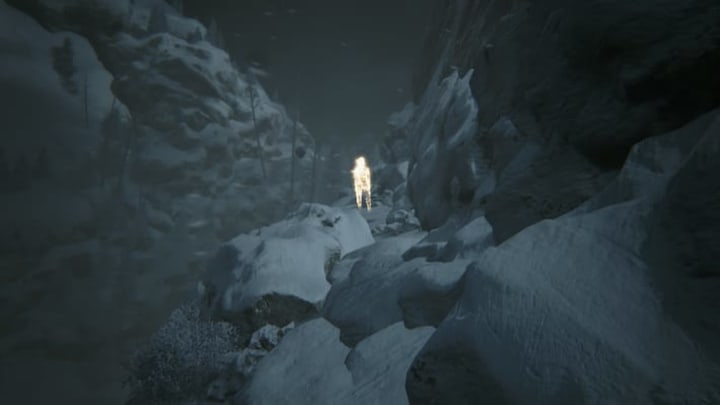
Spirit Guide in Kholat (Credits: IMGN.pro)
These little elements don't even take away from the awe and panic the game will set in by surprise. While some elements of enjoyment could be broken by incorrect grammar and dodgy sentence structures wthin the game, it doesn't take away from the overall experience, even if subtitles that are displayed upon the screen may not correctly match up to what an actor says. It's not necessarily, as stated, about the narrative driven by voice or writing.
The story is within the setting itself. It's one that works quite well to bring the horrors of what happened in the hellish snowscape of Kholat. While some may cringe at the supernatural juxtaposition; the use of supernatural orange ghosts follows through with the ideal of floating orange lights that had possibly been seen. Some of this is contrasted by a very supernatural threat that has its sight on killing the player. Just as the hikers of real and fiction, your fate is sealed by your ability to flee, giving you the feeling of helplessness that the members of the Dyatlov Pass Incident felt moments before they passed.
However, their deaths didn't result in them being pushed back to their last save point. Their reality was something much crueler than that of what the player will have as a last save point is their returning place. The game itself compounds the ideals of horror, suspense, and intrigue by the diary pages left behind, the happenings on the mountain, and the frigid landscape that players will find themselves trekking through. While the game does last a rough 6-7 hours, it's a 6-7 hours that will leave players feeling helpless, abandoned, and even lost as they find their way to each point with the help of a flashlight, a compass, journal, and a map to guide players through their adventure.
For fans of mystery and exploratory games, Kholat is one that takes both fictional and non-fictional elements to bring itself to life. IMGN.pro isn't scared to take risks and the end-result is a game that leaves a haunting question to the real life event that happened: What really happened up there and why has no one investigated further?
About the Creator
Dustin Murphy
A video games journalist and Content Creator. He has been featured on sites such as AppTrigger and MoviePilot. He's the president and editor-in-chief of the independent news publisher Blast Away the Game Review.
Keep reading
More stories from Dustin Murphy and writers in Gamers and other communities.
'Skyrim' Mod Brings 'Bloodborne' to Tamriel and it's Magnificent
Heralded as two of the best games to be developed in recent years - Skyrim and Bloodborne both remain two of the most brilliantly crafted games to date. One featuring the heavily Nordic frozenlands of Skyrim and the other a daring, but amazingly well crafted Lovecraftian inspired land of Yharnam.
By Dustin Murphy8 years ago in Gamers
How Streaming and Esports Changed Gaming Forever—For Better or Worse
Gaming has never been just about pressing buttons. It has always been about challenge, imagination, and escape. But in the last decade, gaming has gone through its biggest transformation yet. Thanks to streaming platforms and the rise of esports, games are no longer only played—they are performed, watched, monetized, and judged in real time.
By Games Mode On3 days ago in Gamers


Comments
There are no comments for this story
Be the first to respond and start the conversation.