
How to Run D&D Mystery Adventures Without Railroading Your Players
Master the art of crafting thrilling, player-driven mystery adventures in Dungeons & Dragons that keep your table engaged without forcing them down a single path

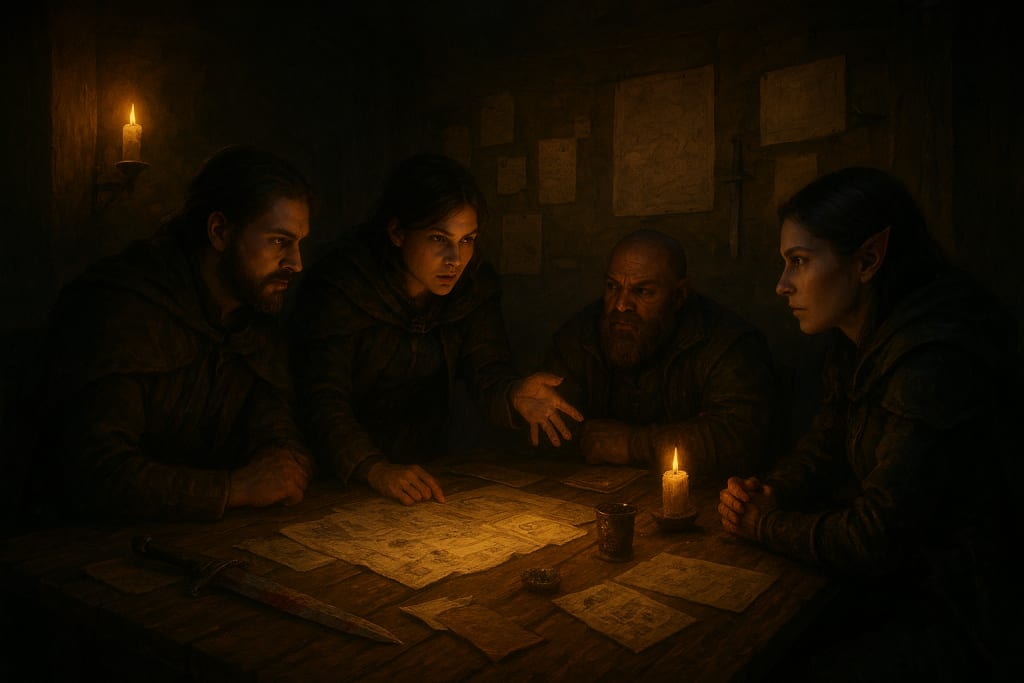
Mystery adventures can be some of the most memorable sessions you’ll ever run as a Dungeon Master. The thrill of unraveling clues, connecting the dots, and exposing the culprit gives players a level of agency that’s hard to match with a standard dungeon crawl. But mysteries in Dungeons & Dragons come with a unique challenge: it’s easy to accidentally railroad your players into a single solution. If they don’t find a clue or guess the “right” suspect, the entire story can grind to a halt.
The key is to build mysteries that are flexible, player-driven, and resilient to surprises. Here’s how to craft mystery adventures that feel organic, challenge your group, and avoid forcing them down a single narrow path.
Start with the Crime, Not the Clues
Many DMs start by designing a list of clues first. That’s a mistake. Instead, focus on the event at the heart of the mystery. Ask yourself:
- What actually happened?
- Who is responsible, and why?
- What were they trying to achieve?
Build the sequence of events like a real crime scene. Once you know the “truth,” you can then decide what evidence would logically exist. A murder might leave blood trails, witnesses, and a suspiciously missing dagger. A theft might result in broken locks, a disguised culprit, or magical residue from a spell.
When you know what happened, you can place multiple paths leading to the solution rather than one single “right” clue.
Layer Your Clues
One of the most common pitfalls in mystery adventures is making clues too scarce. If your players miss one crucial piece of evidence, they may have no way forward. Instead, use the Three Clue Rule, a simple but powerful guideline popularized by The Alexandrian:
For every conclusion you want your players to reach, include at least three clues that point to it.
For example, if you want the party to discover that the mayor is secretly a werewolf:
- They might find a journal detailing his late-night “hunting trips.”
- They could speak to a villager who saw the mayor limping the night after an attack.
- They might uncover fur samples near his office that match the beast.
This redundancy keeps the game moving forward and gives players freedom to approach the problem however they want.
Avoid Single-Point Failure
Railroading often happens because the adventure is too fragile. If there’s only one witness, one clue, or one lead and the players fail an Investigation check, the whole mystery stalls. Design with redundancy.
Here are a few ways to avoid single-point failure:
- Provide multiple suspects. Even innocent suspects can point the party toward the real culprit.
- Give clues in different forms. Some might be physical evidence, others might be conversations, rumors, or even magical visions.
- Use skill checks as enhancers, not blockers. Failure shouldn’t mean “you learn nothing.” Instead, it should give a partial clue or a complication that drives the story forward.
Keep the Mystery Player-Driven
One of the biggest fears DMs have when running a mystery is that the players won’t find the solution at all. This fear can lead to heavy-handed hint-dropping, NPCs solving the mystery for the party, or even outright forcing them into the answer.
Instead, embrace the fact that the mystery might unfold in unexpected ways.
Let players form theories. If their theory makes sense and fits the evidence, reward it. Maybe they solve the case earlier than expected — great! That just opens the door for a twist or bigger reveal.
Be ready to improvise. If they accuse the wrong NPC, think about how that NPC would react. Could that confrontation shake loose a real clue?
Accept that failure is an option. Sometimes the party doesn’t solve the mystery, and that can be dramatic too. The villain escapes. The stakes rise. The campaign continues.
Pace the Investigation
Mysteries can bog down if the players spend too much time chasing dead ends. Keep momentum high by introducing new leads, time pressure, or complications when things slow down.
- A new murder occurs, leaving fresh clues.
- A key witness goes missing — and the party must find them before the culprit silences them permanently.
- The villain accelerates their plan, forcing the players to act.
By adding tension and urgency, you prevent endless meandering and keep your table engaged.
Use NPCs as Tools, Not Solutions
Non-player characters are crucial in a mystery, but they shouldn’t just hand over the answer. Instead, they should act as conduits for information or obstacles the players must overcome.
- A terrified witness may require persuasion before speaking.
- A corrupt guard might try to throw the party off the trail.
- A scholar might reveal lore about the artifact — but only if they’re convinced of its importance.
These interactions make the investigation feel alive and reward roleplay instead of reducing everything to dice rolls.
Make the Reveal Satisfying
When the players finally piece everything together, make it matter. The villain’s motive should feel believable, their actions logical. Don’t just have the villain confess because the players asked. Give them a dramatic confrontation or a chance to reveal the truth in a climactic moment.
You might even borrow inspiration from published adventures like Curse of Strahd or Candlekeep Mysteries, both of which include strong examples of narrative-driven mysteries that build to powerful conclusions.
Running a great D&D mystery is about more than planting clues. It’s about creating a living, breathing situation where players can investigate, theorize, and ultimately shape the outcome. By starting with the crime, layering clues, avoiding single-point failure, and staying flexible, you’ll give your table a mystery that feels rewarding — without ever forcing them down a narrow track.
Your players won’t just remember solving the case. They’ll remember how they solved it.
About the Creator
Richard Bailey
I am currently working on expanding my writing topics and exploring different areas and topics of writing. I have a personal history with a very severe form of treatment-resistant major depressive disorder.
Keep reading
More stories from Richard Bailey and writers in Gamers and other communities.
How to Use Festivals and Holidays to Bring Your D&D World to Life
When players enter your world, they expect more than dungeons and dragons—they want a living, breathing setting that feels real. One of the easiest ways to make your world feel alive is by incorporating festivals and holidays into your campaign. Festivals do more than just break up the monotony of travel or combat—they create culture, set tone, and immerse players in your setting’s history.
By Richard Bailey2 months ago in Gamers
League of Legends 2026 Season Updates
With the League of Legends 2026 season, new patch notes, the return of ARURF mode, and notable ranked system updates are quietly reshaping how players approach the game. As the competitive environment evolves, tools like the LoL Purity Test offer an interesting way to reflect on how much of this shifting experience players have actually encountered not as a label, but as a record of exposure shaped by time spent in the game.
By Enzo Marcelli5 days ago in Gamers
Rsvsr GTA Online Mansion Mode: Big Rewards & Strategy
I just jumped back into GTA Online, and Rockstar is kicking off 2026 with style. From January 15th to January 21st, Mansion Mode Event Week transforms Los Santos into a playground of opulent estates and high-stakes battles. Whether you’re a veteran or a newcomer, this week offers action, strategy, and some seriously sweet rewards.
By Billo Nalia day ago in Gamers




Comments
There are no comments for this story
Be the first to respond and start the conversation.