
HOW THE 2022 BEIJING WINTER OLYMPICS HANDLED POLITICAL PROTESTS
Managing Political Protests Amidst the 2022 Beijing Winter Olympics.

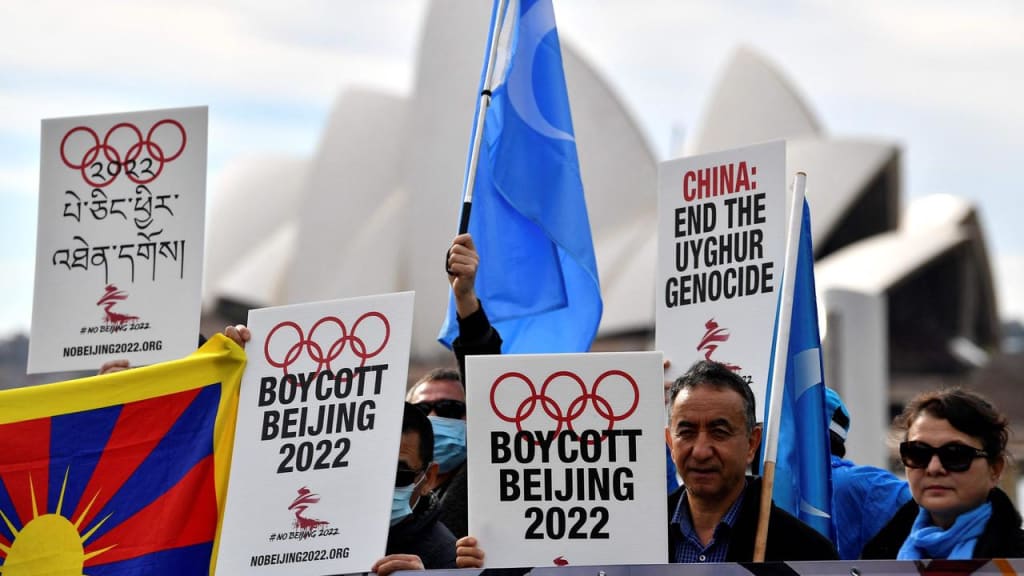
The 2022 Beijing Winter Olympics, held from February 4 to 20, 2022, were marked by heightened international scrutiny, particularly due to the political climate surrounding China’s human rights record and the geopolitical tensions that preceded the Games. Despite being a global sporting event meant to celebrate unity and international cooperation, the Olympics became a focal point for political protests and calls for accountability.
Background to the Controversy
Before the Games even began, multiple countries and organizations raised concerns about China’s human rights practices, especially regarding its treatment of Uyghur Muslims in Xinjiang, its crackdown on democracy in Hong Kong, and its repression of dissent in Tibet and other regions. The United States, Canada, the United Kingdom, and Australia, among others, led a diplomatic boycott, choosing not to send government officials to the Games in protest of China's human rights abuses. However, athletes and the general public were still allowed to attend and compete.
The political sensitivity around the Olympics became evident in the months leading up to the Games, with activists and organizations calling for action. Many advocated for a full boycott, arguing that the Games should not be used as a platform for the Chinese government to showcase its power and suppress dissent.
Protests and Restrictions During the Games
During the Winter Olympics, several incidents highlighted the tension between politics and sport. Although the Chinese government had promised to create a space for athletes and participants to express themselves freely, this did not extend to political protests. The International Olympic Committee (IOC) had a strict policy against protests during the Games, emphasizing that the Olympics should be a neutral space for sports. As such, protests, demonstrations, or any politically charged actions were banned.
China, which is known for its tightly controlled media and censorship, also implemented extensive security measures to prevent protests and dissent within the Olympic venues and surrounding areas. Authorities kept a close watch on social media platforms, and journalists were subject to restrictions, especially if they attempted to report on sensitive topics related to human rights abuses in Xinjiang or other controversial issues.
However, despite these efforts, there were still several instances where political messages or protests were displayed, albeit discreetly.
Athlete Protests
The most notable example of athlete protest occurred when American snowboarder Shaun White, despite his personal belief in free expression, was forced to backtrack after making comments that some interpreted as sympathetic to the Chinese government. White, one of the most prominent athletes at the Games, later clarified his position, emphasizing his commitment to focusing on his sport rather than politics. This incident illustrated the delicate balancing act many athletes faced—wanting to stay true to their values, but also wanting to avoid jeopardizing their careers or participation in the Games.
Some athletes were also subjected to direct consequences for their political stances. For instance, Chinese-born athlete Eileen Gu, a freestyle skier who represented China in the Games, became the center of political debates after she faced criticism from both Chinese and Western commentators. While Gu avoided making political statements, the media attention around her raised questions about whether her presence at the Games could be seen as a form of political expression, considering the broader context of international tensions.
Protests by Activist Groups
Outside the Olympic venues, protests continued to make headlines. Activist groups used the Olympics as a platform to draw attention to China’s human rights abuses. Demonstrations were staged in several countries, with people holding banners or organizing online campaigns to call for action. Some groups specifically targeted companies that were sponsors or partners of the Olympics, urging them to distance themselves from the Games or cut ties with the Chinese government. One prominent example was Tibetans, who staged protests across Europe and the United States to highlight the oppression in Tibet, calling for a boycott of the Games.
Protests also occurred in Beijing itself, with a small number of individuals managing to evade security measures. One notable protester, who was later identified as a Tibetan, unfurled a banner reading, “No Genocide Games” near the main Olympic stadium. This protest was quickly shut down by Chinese authorities, with the individual being detained for several hours before being released.
The Role of the IOC
The IOC faced significant criticism for its role in handling the political atmosphere during the Games. Despite calls for it to take a stronger stance on human rights abuses, the IOC’s official position was to remain neutral. This meant that they did not engage with the broader political protests surrounding the Games, nor did they attempt to directly challenge the Chinese government’s actions. This stance was met with widespread disapproval from activists and human rights groups, who accused the IOC of prioritizing corporate interests and the financial benefits of the Games over ethical considerations.
The IOC’s neutrality policy also led to criticism that they were complicit in allowing China to use the Olympics as a propaganda tool, distracting from the serious issues of human rights violations and political repression within the country.
In The End
In conclusion, the 2022 Beijing Winter Olympics served as a battleground for political protests, with athletes, activist groups, and media outlets drawing attention to China’s human rights record. Despite strict regulations and an atmosphere of surveillance, protests did occur, both within China and internationally. The IOC’s stance on neutrality left many feeling that the organization did not take sufficient action on human rights issues, while athletes and protestors continued to navigate the complex relationship between politics and sport. The Games ultimately underscored the challenges of holding a global sporting event in a politically sensitive environment, where the boundaries between sport and politics became increasingly blurred.
About the Creator
Badhan Sen
Myself Badhan, I am a professional writer.I like to share some stories with my friends.
Keep reading
More stories from Badhan Sen and writers in Gamers and other communities.
THE CONTROVERSIAL ROLE OF RUSSIA IN THE 2014 SOCHI WINTER OLYMPIC
The 2014 Winter Olympics, held in Sochi, Russia, stand as one of the most debated and scrutinized events in Olympic history. While the Games were intended to showcase Russia’s resurgence as a global power and its ability to organize a world-class sporting event, they were overshadowed by controversies surrounding corruption, doping scandals, human rights issues, and geopolitical tensions. These controversies have left a significant impact on the legacy of the Sochi Olympics and Russia’s role in global sports.
By Badhan Senabout a year ago in Gamers
U4gm Diamond Dynasty Red Diamond Cards: Which One Truly Dominates MLB The Show 26?
MLB The Show 26 has taken Diamond Dynasty to an entirely new level, and nothing has the community more excited than the ultra-rare Red Diamond cards. These cards aren’t just for collectors—they can completely change the outcome of Ranked Mode matches, turning a close game into a legendary comeback. But with so many options available, which Red Diamond cards truly stand out?
By Dangyc Ding2 days ago in Gamers
The Honed Ashlar, Part 2 of 5
Part 2: The Level and the Gavel The Chamber of Silence Silas awoke to silence, heavy, absolute. The air scrubbed of exhaust; smelling of cold stone, raw beeswax, and the metallic tang of a whetstone. He lay on a cot. Not a mission mat. Taut canvas stretched over a steel frame. Plumb. Level. The bolts tightened to a specific, unyielding torque. No sagging allowed.
By Nathan McAllister5 days ago in Gamers
Writing To Succeed
If you want to find something that will help readers find your writing, possibly expand your audience, and maybe even get you noticed for other things, then you’re not alone. But how can you get it done in a world full of want-to-be writers? Look less at what you’re writing now, and more at what other writers have used to boost their views and reads.
By Jason Ray Morton 6 days ago in Writers



Comments
There are no comments for this story
Be the first to respond and start the conversation.