
How DAOs and Tokenomics are Shaping Next-Gen Game Communities?
Redefining Player Ownership, Governance, and Value in Blockchain-Based Gaming Ecosystems

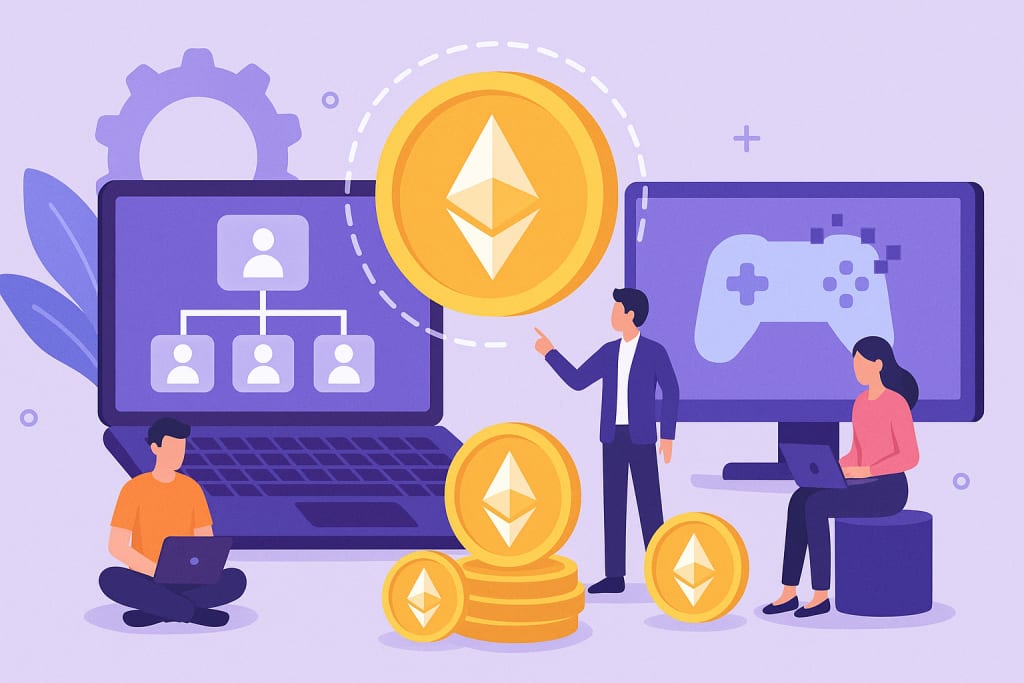
The era of passive players is fading. With the dynamic evolution of Web3, the online gaming scene is shifting to a landscape where players are decision-makers, stakeholders, and even co-creators of the game economy.
It has become the unexpected but perfect playground for decentralization. DAO games and tokenomics in gaming are no longer just buzzwords; they are defining the future of interactive entertainment, player ownership, and community empowerment.
From voting on game updates to earning real-world value through digital participation, let’s explore how these concepts are revolutionizing the blockchain game economy and giving rise to player-driven games like never before.
What is a DAO Game?
DAO stands for Decentralized Autonomous Organization. In gaming, a DAO game is one where the community, usually made up of token holders, governs some or all aspects of the game.
This form of democratic design is flipping the traditional top-down development model on its head, and studios are paying attention. This could mean:
- Voting on new features, maps, or in-game items.
- Allocating community treasury funds
- Moderate rule changes or governance proposals
- Supporting in-game creators and guilds
Think of it as a player-run board of directors, but accessible to anyone with tokens or NFTs tied to the game.
What is Tokenomics?
Tokenomics is often misunderstood as ‘crypto rewards,’ but it is much more than that. At its core, it is the economy of the game, how value is created, distributed, and maintained across players, developers, and stakeholders.
Core Components of Game Tokenomics
- Utility Tokens: Used for in-game purchases, upgrades, or staking
- Governance Tokens: Grant voting rights in the DAO
- NFT Assets: Skins, characters, weapons that are player-owned and tradeable
- Burn and Mint Mechanics: Prevent inflation, reward loyalty.
- Play-to-Earn Models
The best blockchain games do not just hand out tokens; they build sustainable loops that reward contribution, skill, and engagement.
For example, in Illuvium, players collect NFT creatures and stake ILV tokens for governance decisions. The system allows active players to vote on game design decisions and earn a share of staking revenue, forming a tightly woven economic and community loop.
Community as the Core Engine
There is a pattern emerging in next-gen games- the community is not built after the product, it is the product. By aligning incentives between developers and players through DAOs and token-based economies, games become collaborative ecosystems rather than fixed products.
Player-driven games now have features like:
- A world where top players propose balance changes
- Streamers and content creators earn royalties from their influence.
- Guilds function like in-game governments or unions
- In-game economies mirror real-world GDPs and labor
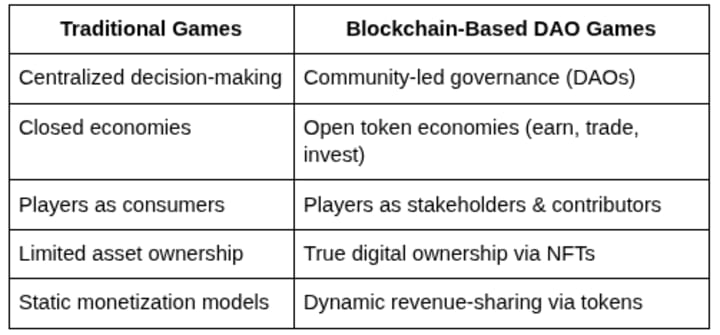
What is the Difference Between Traditional Games and Blockchain-based DAO Games?
Here is how DAO games differ from traditional games that have a centralized and closed economy.
Also Read: The Role of UAE Game Developers in Shaping the Future of Blockchain Game Development
Challenges of DAO Games and Tokenomics
While DAO games can become the next trendsetter in the gaming industry, it does come with their fair share of challenges. Some key challenges include:
- Governance Fatigue: Players may not want to vote on every minor decision
- Security Risks: DAO contracts must be audited thoroughly
- Token Inflation: Poorly designed economies collapse easily
- Entry Barriers: Wallets, tokens, and crypto UX still scare away casual gamers
Successful DAO games like Treasure DAO or Guild of Guardians focus on progressive decentralization, starting with developer oversight and gradually giving power to the community.
How to Build a DAO-driven Game Economy?
If you want to build a DAO-driven economy, you can follow a simplified path to ensure maximum efficiency:
- Define Your Governance Model: Will players vote on everything? Or just on major updates?
- Design Token Utility: Give your tokens real use, in-game and on-chain.
- Start with Community-first Thinking: Your early adopters will be the backbone of your future board.
- Use NFT Assets Smartly: Make ownership meaningful. Do not just provide cosmetic fluff.
- Use Layer 2 or Sidechains: Minimize gas fees to improve scalability
- Plan a Treasury Strategy: Let players propose and vote on where funds are used (content, grants, or rewards).
- Iterate Based on Feedback: Evaluate user feedback and adjust accordingly.
Future of DAO Blockchain-based Games
The future of gaming is not just Web3, it is player-run ecosystems, where fun, finance, and freedom converge. In the next few years, we can hope to see trends like:
- Guild-based governance, where factions run regions or economies
- Dynamic economies that shift based on supply/demand, not pre-written rules.
- Composable games, where NFTs and tokens interact across multiple games or universes
- DAO-led publishing models where players vote to greenlight new games.
Final Words
DAO games and token-powered ecosystems aren’t replacing traditional games - they’re reimagining what’s possible when players become more than just users. These aren’t merely tech upgrades; they represent ideological shifts. DAO games challenge who holds control, how value is distributed, and even redefine the meaning of a game itself.
In a world where attention is limited and loyalty is fragile, player ownership becomes the key to retention. If you’re building for the future, this is the direction your compass should point. For developers, blockchain-based gaming ecosystems mark a major transformation in gaming economies; for players, it’s a new era of empowerment.
About the Creator
Avloire Games
Avloire Webs Gaming is a UAE-based game development company at the forefront of integrating artificial intelligence with immersive entertainment. We harness cutting-edge technologies - like AI, machine learning, blockchain, NFTs, and AR/VR.
Keep reading
More stories from Avloire Games and writers in Gamers and other communities.
FIFA 23 Will Completely Change How You Experience Football on Xbox Forever
Few sports games have reached the global recognition and influence of FIFA 23. Developed by EA Sports and available on Xbox, the game represents one of the most refined football simulations ever created. It combines realism, fast-paced gameplay, and immersive presentation to deliver an experience that captures the essence of the sport.
By Lukáš Hrdlička5 days ago in Gamers
"Scream 7" (2026): Running out of Fresh Screams
This is the seventh time we’ve had a Ghostface crisis. Scream 7 is the latest edition of the Scream franchise. Sydney Prescott and her family are under attack by another anonymous killer dressed in a Ghostface costume. While having issues with her daughter, Tatum, they run from the bloody murders, trying to determine who is behind it all.
By Marielle Sabbag6 days ago in Horror



Comments
There are no comments for this story
Be the first to respond and start the conversation.