
D&D: How to Balance Homebrew Monsters Like a Pro
A Step-by-Step Guide for Dungeon Masters to Create Fair, Challenging, and Memorable Custom Creatures in Dungeons & Dragons

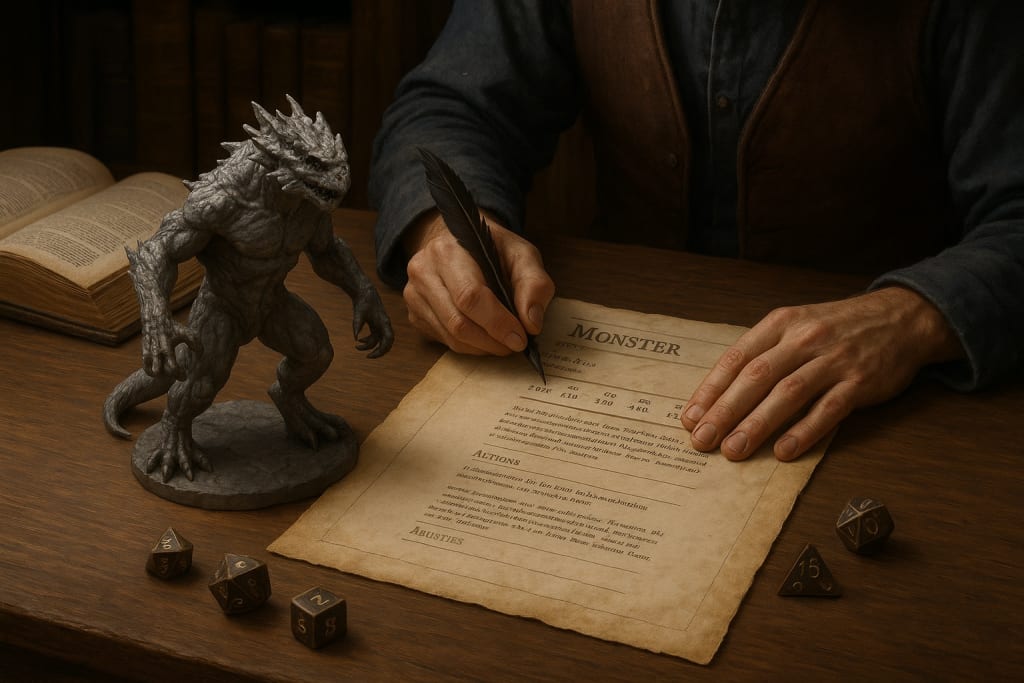
Homebrewing monsters is one of the most satisfying parts of being a Dungeon Master. It’s your chance to unleash something entirely new into your campaign—an abomination no player has ever faced, a cunning foe that feels alive, or a massive creature so dangerous that just hearing its name sends shivers down the table.
But creating a homebrew monster that is fun, memorable, and balanced? That’s the real challenge.
Balancing monsters isn’t just about crunching numbers or copying stats from an official book. It’s about designing something that can challenge your players without becoming a grind or an unfair death sentence. Too weak, and the encounter feels flat. Too strong, and you risk wiping the party before the story even gets going.
Let’s break down how to balance your custom monsters like a pro—step-by-step.
Step 1: Start With a Clear Monster Role
Every good monster needs a purpose in combat. Ask yourself: What is this creature here to do?
Is it a bruiser designed to stand in melee and trade blows? A glass cannon that hits hard but can’t take much punishment? A controller that manipulates the battlefield with abilities and terrain? Or perhaps a support unit that buffs allies and debuffs enemies.
When you define a monster’s role, every stat you create has a direction. For example:
- A tanky beast should have high hit points, moderate AC, and one or two abilities that punish melee attackers.
- A spellcasting monster should have fewer hit points but tools to control the fight—crowd control spells, area effects, or illusions.
- A skirmisher thrives on movement and hit-and-run tactics, meaning higher speed and abilities that keep it out of reach.
By locking in the role early, you keep your design focused and avoid “jack of all trades” creatures that do everything but nothing well.
Step 2: Establish the Right Challenge Rating (CR)
The Challenge Rating is your first balancing anchor. It determines roughly how deadly the monster is compared to a party of four adventurers.
The Dungeon Master’s Guide provides a step-by-step system for calculating CR, but here’s the key: don’t just pick a number because it feels right. Instead, consider:
- Your party’s average level.
- The encounter’s difficulty goal (easy, medium, hard, or deadly).
- Action economy—how many actions the monster gets vs. how many the party gets.
A CR 6 monster against a level 5 party might seem fair, but if it has legendary actions or lair effects, its effective difficulty can be much higher. Likewise, a CR 10 monster with low mobility might underperform if your party can kite it without consequence.
Step 3: Build Stats With Purpose
Once you’ve set the CR, build the monster’s core stats: Hit Points, Armor Class, Damage Output, and Saving Throws.
Hit Points: Use the DMG’s hit point ranges for your CR as a guideline, then adjust for flavor. A massive rock elemental should have a lot more HP than a frail necromancer.
Armor Class: AC should match the CR’s expected range. High AC on a low-HP creature makes for frustrating fights, so balance defenses.
Damage Output: Players need to feel the danger. Calculate average damage per round, and make sure it falls within the DMG’s guidelines. Spread damage across multiple attacks if you want consistency; concentrate it in one hit for burst threats.
Saving Throws: Decide which saves are strengths and which are weaknesses. Every monster should have exploitable flaws to keep fights dynamic.
The trick is not to aim for perfect symmetry. Asymmetry makes monsters interesting—but don’t overcompensate in one area without pulling back somewhere else.
Step 4: Add Unique Abilities That Fit the Theme
Numbers alone don’t make a monster memorable. Special abilities—done right—can turn a stat block into an unforgettable encounter.
Ask yourself:
- Does this monster have a signature move?
- Does its ability create tension or change how the players approach the fight?
- Can the ability interact with the environment or encourage creative tactics?
For example, a Sand Wraith could vanish into the dunes and reappear behind the party. A Clockwork Golem might wind itself up, storing kinetic energy for a devastating attack if not interrupted. A Fungal Horror could release spores that slowly sap strength unless burned away.
The key is restraint. Too many flashy abilities can overwhelm players and dilute the creature’s identity. Pick one or two defining features and make them shine.
Step 5: Master the Action Economy
This is where most homebrew monsters fall apart. The action economy—how many meaningful actions a creature can take per round—often matters more than raw stats.
A single monster fighting a party of five will almost always be at a disadvantage unless it has multiattack, legendary actions, or lair actions. If you want a solo monster to feel dangerous, give it ways to act outside its normal turn:
- Legendary Actions: Small, repeatable actions at the end of other creatures’ turns.
- Reactions: Abilities that trigger when players do certain things (attack, move, cast spells).
- Lair Actions: Environmental hazards or terrain shifts that occur on initiative count 20.
By balancing action economy, you prevent encounters from becoming one-sided slugfests where the party overwhelms the monster simply by taking more turns.
Step 6: Test, Adjust, Repeat
Even the most carefully built monster might surprise you in play. That’s why testing is essential.
Run quick mock combats using your monster against simulated party members. See how long the fight lasts, whether it feels too easy or too deadly, and if the monster’s abilities actually come into play. If the fight ends in two rounds, your monster may need more staying power. If players have no chance to counter its abilities, tone it down.
Don’t be afraid to adjust between sessions. The beauty of homebrew is flexibility—you can fine-tune the creature’s stats, tweak abilities, or add new tactics after seeing how it performs.
Step 7: Balance for Fun, Not Just Fairness
Finally, remember that “balanced” doesn’t mean “perfectly even.” In fact, some of the best encounters involve monsters that seem overwhelming but have built-in weaknesses clever players can exploit.
A monster’s job isn’t just to deal damage—it’s to tell a story, to create tension, and to give your players moments of triumph. If the fight is exciting, unpredictable, and ends with the party talking about it weeks later, you’ve succeeded.
Balancing homebrew monsters is part science, part art. The science lies in the math: CR calculations, damage averages, and defensive thresholds. The art lies in how you twist those numbers into something alive, something your players will remember.
If you take the time to define your monster’s role, calculate its CR accurately, give it meaningful abilities, respect the action economy, and test it thoroughly, you’ll find yourself creating balanced foes that are both dangerous and fun to fight.
And once you’ve done it a few times, you won’t just be homebrewing monsters—you’ll be building legends.
About the Creator
Richard Bailey
I am currently working on expanding my writing topics and exploring different areas and topics of writing. I have a personal history with a very severe form of treatment-resistant major depressive disorder.
Keep reading
More stories from Richard Bailey and writers in Gamers and other communities.
Diablo Immortal Tempest & Blood Knight Classes Breakdown
Diablo Immortal has never been shy about adding new ways to fight the Burning Hells. The introduction of the Tempest and Blood Knight classes brought a fresh wave of excitement. These classes don’t just expand the roster. They reshape the meta, influence group compositions, and challenge players to rethink how they approach both PvE and PvP combat.
By Richard Bailey7 months ago in Gamers
My Top 25 NES Games
The Nintendo Entertainment System, or the Famicom in Japan, is the earliest console I have any direct experience of. We didn’t have a NES in our house when we were kids. I was a bit sniffy of it actually, viewing it as old-fashioned and before my time (I was born in 1984, between the Japanese and Western releases of the system). It was years later that I started to appreciate earlier games and hardware. I played the NES round friends’ houses and, eventually, well into adulthood, someone decided to get rid of theirs and now we had our own Family Computer.
By Daniel Tessier8 days ago in Gamers
Essential Golf Tips Every Beginner Needs to Improve Their Game
Golf is a rewarding sport that combines skill, patience, and strategy. For beginners, the game can feel challenging because it requires mastering several techniques at once. Many new golfers focus too much on hitting the ball far instead of learning the fundamentals that lead to consistent performance. Improvement comes from developing good habits early, practicing with purpose, and understanding how each part of the game works together. With the right approach and consistent effort, beginners can build confidence and steadily improve their performance on the course.
By Daniel Ladnerabout 20 hours ago in Gamers
Hottest in the Office
Dear Rafi, You’re very distracting to work around. For the first second I saw you the other day, I thought you were some type of executive. It took a moment to realize no, you were just the new guy, dressed up for the job he wants. Be still, my heart.
By Gabriel Shames3 days ago in Pride



Comments
There are no comments for this story
Be the first to respond and start the conversation.