
40 Years of Super Mario - Part 2: The 1990s
Continuing my classic Super Mario replay

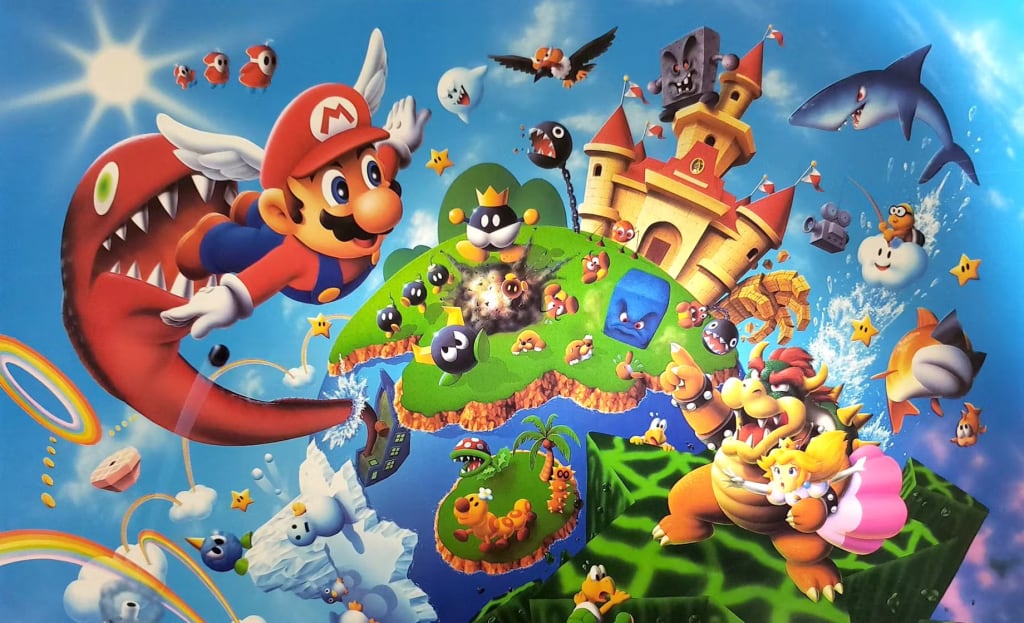
The 1990s started with the debut of the Super Nintendo Entertainment System and ended with the Nintendo 64 firmly established. Mario was, of course, at the centre of this evolution in gaming.
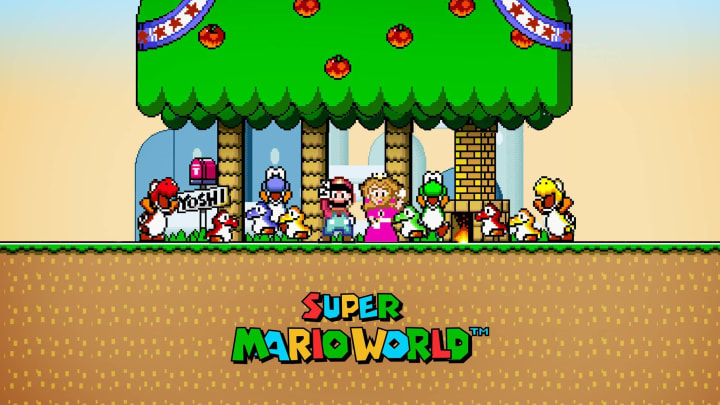
Super Mario World
First released: 1990
Platform: SNES/Super Famicom
This is the one. The launch title for the Super Famicom in Japan and for the SNES in North America a year later, Super Mario World is an absolute beauty of a game. Miyamoto’s team began work on it virtually as soon as they’d released Super Mario Bros. 3, eager to move onto the newer, more powerful 16-bit system and do everything they couldn’t on SMB3. Super Mario World is subtitled Super Mario Bros. 4 in Japan and it’s very clearly a follow-up to SMB3; it doesn’t reinvent the wheel but does add and improve all manner of game elements.
The name Super Mario World suggests something huge and expansive, and the game delivers. This game introduces secret exits to several levels, giving a total of 96 exits across over seventy levels. The world map returns from Super Mario 3 but is hugely improved; there’s now a single overworld map with branching paths that lead either to specific levels or to smaller sub-worlds, making the new location, Dinosaur Land, feel more like a real setting. The gameplay is more varied than in SMB3 but is, on the whole, easier, yet it’s so entertaining that it maintains huge replay value.
Dinosaur Land, though. If there was one thing that could make the Super Mario universe better, it was the addition of dinosaurs. Miyamoto had wanted to give Mario a dinosaur steed since the beginning, and had tried to include it in SMB3 but was unable to thanks to the NES’ limitations. Yoshi is a fantastic addition to the game, a hungry dino-dragon with a chameleon-like tongue who can swallow enemies from afar. The ubiquitous Koopa Troopers, always both an enemy and a weapon thanks to their kickable, throwable shells, now become raw material for Yoshi’s defences. There are even variants, with green Yoshi and green shells being the standard; red Yoshi breathes fire when swallowing a shell, and red shells bestow this ability on any Yoshi. Blue Yoshi and blue shells grant birdlike wings with which to fly, while the yellow versions generate damaging sand when Yoshi jumps and lands.
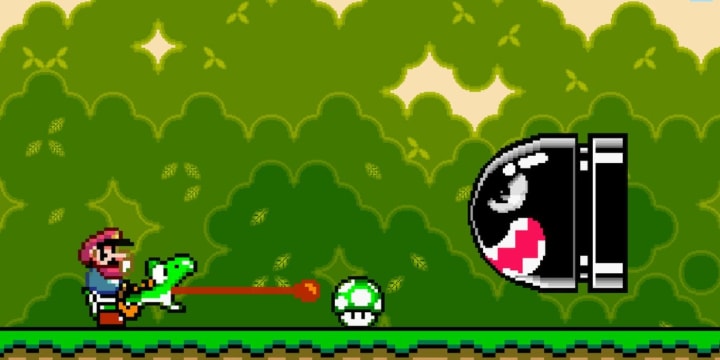
Miyamoto had originally intended to carry over the Super Leaf from SMB3, but this was changed to the Magic Feather, granting Mario a Superman-like cape that grants him far superior flying abilities and several tricky-to-master moves that are nonetheless super satisfying when you pull them off. There’s also a rarely encountered balloon power-up that inflates Mario and allows him to bob to hard-to-reach places, plus the ubiquitous Super Mushroom, Fire Flower and Super Star. A major help in this game is that an additional power-up can be stored in a little box at the top of the screen, dropping down when you need it. Even without all the power-ups, Mario is tougher than before, with a new spin jump that can drill through blocks and defeat enemies.
The plot has Mario, Luigi and Peach visit Dinosaur Land for a holiday after liberating the Mushroom World from the Koopa Clan (ah, so SMB3 did happen!), only for Bowser to swoop down and abduct the princess yet again. Bowser and the Koopas have wasted no time and have already conquered Dinosaur Land, building castles across the realm and turning all the Yoshis back into eggs. The big green guy really doesn’t take a day off. The Koopalings are back, each one ruling a world from a castle (which Mario amusingly blows up once the villain is defeated). While this is a little repetitive coming from SMB3, there’s enough variety in the different boss fights to keep it fun and challenging. There are four fortresses dotted about the place, where you fight Reznor, a fire-breathing Triceratops that attacks in fours.
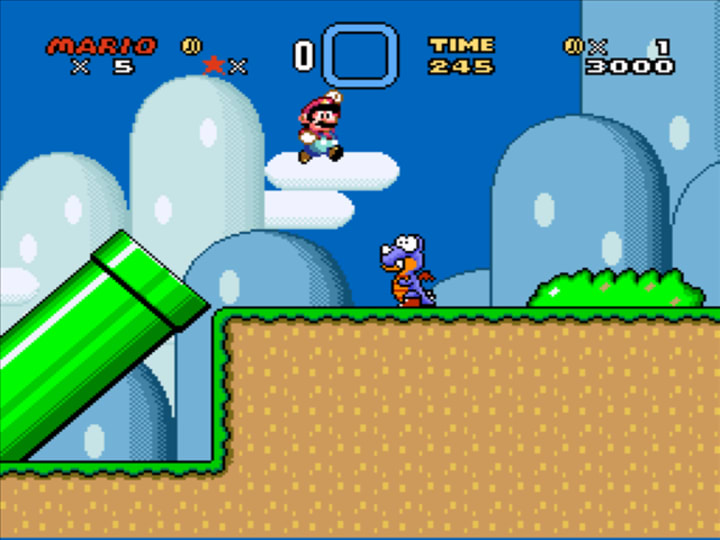
There’s plenty of variety in the levels, keeping things fun and inventive throughout. For some baffling reason, most worlds contain a Ghost House, a tricksy level full of false and looping routes. Why there are haunted houses dotted about Dinosaur Land I can’t tell you, but they’re among the most fun levels in the game. The airship from SMB3 returns as the Sunken Ghost Ship, forming the entrance to the Valley of Bowser, where eventually you’ll fight the King Koopa himself in one of the best boss battles in the series. Beating the final boss is only part of the mission though, as there are all those secret exits to find, which we lead you to the Star Zone and from there to the otherworldly Special Zone. The levels here have wonderfully 90s names like “Mondo” and “Tubular;” beat these exceedingly tough levels and the game shifts into Fall Mode, with the leaves turning brown, the piranha plants turning into pumpkin plants and the Koopa Troopers wearing little Mario masks, as if to mock our hero.
The graphics are simple but beautiful, perfectly demonstrating the improvements of the SNES over the NES. It’s a smooth, charmingly animated world, giving the player the feel of running their own cartoon, combined with some great music from the always-excellent Koji Kondo. It’s glitchy as hell; in spite of the three-year development time, the game was still something of a rush job, with the sheer amount of content necessitating botches and fixes that don’t always hold. Yet it doesn’t seem to matter; Super Mario World is just a gorgeous experience.
Being one of the biggest hits of the 16-bit era and a jewel in Nintendo’s crown, it’s unsurprising that Super Mario World has had several rereleases and ports, from being bundled with the rerelease of Super Mario All-Stars to being included on the SNES Mini Classic emulator. It was remade as Super Mario Advance 2 in the noughties with a few tweaks, notably the ability to play as Luigi in single-player mode. It’s been made available on the Wii Virtual Console and Switch Online, and is an absolute must-have for any platform fan.
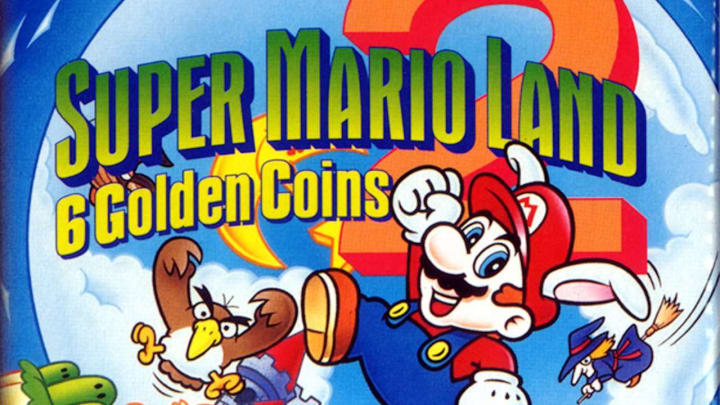
Super Mario Land 2: 6 Golden Coins
First released: 1992
Platform: Game Boy
Seeing this one advertised in a catalogue as a kid confused me. We’d just got a Game Boy and a handful of second-hand games, including the amazing Wario Land (below), and there was a listing for “Super Mario Land 2 – 6.” Fortunately, I sussed it out before ordering it in the excitement of getting five games for the price of one. We did buy it, though, second-hand again because we were not well off, from our local, much-missed Game Trader.
What a game it is. Quite underrated today, with so many options for playing Super Mario on the go, Super Mario Land 2 improves on its predecessor in almost every aspect. Once again made by Gunpei Yokoi and his team, this time with Metroid designer Hiroji Kiyotake and assistant Takehiko Hosokawa on direction and design duties, it’s another step into the odd parallel world of Super Mario on the Game Boy. Following straight on from Super Mario Land, this game takes the name literally and reveals that he has his own personal island named Mario Land. During his mission to Sarasaland to rescue Princess Daisy, Mario Land was conquered by Mario’s archrival, the villainous Wario.
Being a pun on both the name Wario and the Japanese word for bad, warui, Wario is basically a parody of Mario, an oversized exaggeration of our hero’s form. Of course, he makes a better antihero than an outright villain, but here he presents a strong final foe for Mario, even using the same power-ups as the hero in the final battle. Mario Land is a strange place, almost a theme park, split into six themed zones which, in a bigger step to non-linear play than ever before, can be approached in any order. The Tree Zone is the easiest and seems positioned to play first, featuring inventive environments such as the sap-filled hollows of a giant tree and an enormous beehive. There’s the Macro Zone, perhaps inspired by the Giant Land of Super Mario Bros. 3; the Hallowe’en-themed Pumpkin Zone; and the Turtle Zone, an undersea world accessed by being swallowed by a giant turtle, and inside that Mario is then swallowed by a whale and fights his way through his innards.
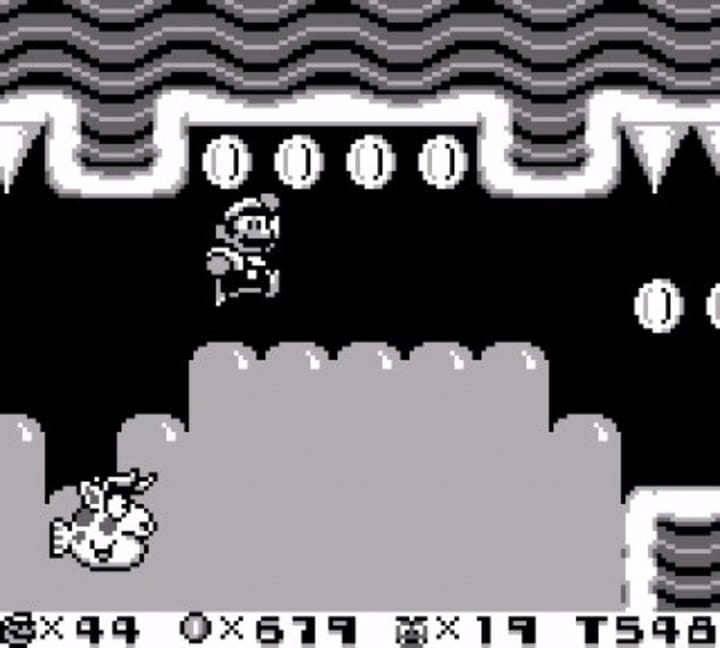
The Mario Zone is the strangest; as if having his own island wasn’t vanity enough, Mario owns a gigantic, motorised statue of himself, with the levels played amongst its cogs and gears. (Although it's not as grotesquely self-aggrandising as the Starship Mario in Super Mario Galaxy 2.) The shortest but hardest zone is the low-gravity Space Zone, accessed by floating in a bubble snorted out by a hippo, because why not? The bosses of this game are entirely new, including a wicked witch, a giant octopus and the Three Little Pigheads, with the exception of Tatanga, who returns from the previous game to defend the Space Zone. Is he in cahoots with Wario? Did Wario mastermind the previous game as well, just as a way of getting his hands on Mario Land?
Super Mario Land 2 is clearly heavily influenced by Super Mario World, with a similar style of gameplay, long elaborate levels with multiple exits, and a return of the spin jump move. The Super Mushroom, Super Star and Fire Flower are present and correct, although being unable to change colour on the Game Boy, Fire Mario instead sports a nifty feather in his cap. Instead of the Super Leaf or Magic Feather, SML2 has the Magic Carrot, a one-off power-up and a personal favourite. This transforms Mario into Bunny Mario, giving him an adorable pair of rabbit ears on his cap, which he can use as wings to slowly flutter down the screen, as well as giving him improved jumping abilities. Definitely the No. 1 power-up that should be brought back.
In other respects, though, this is very different to previous Super Mario games. Coins no longer add up to lives, but are instead collected to pay to gamble for lives in a bonus game. There’s no building score, but a running kill-meter that rewards you with a Super Star when you take out 100 enemies. The creative team wanted to make Super Mario Land 2 stand out amongst the other games of the series, and they succeeded, with unique music, sound effects and level design. Aside from a few stalwarts who appear in almost every game, the monsters are unique, ranging from giant ants to jack-in-the-boxes to a host of Japanese yokai.
If there’s an issue with this game, it’s that it’s too easy. The levels are not without their challenges but are mostly fairly easy, as are the bosses, with the exceptions being the Space Zone and Wario’s castle. The latter is unlocked after each zone is freed and its special golden coin locked into place at the castle entrance, and represents a sudden sharp rise in difficulty. With 32 levels its equal to Super Mario Bros. and more than twice the length of Super Mario Land, but it still feels short thanks to the lower difficulty level. However, this game wasn’t designed for long play session but for dropping in and out of on the go. With that in mind, the difficulty level is judged well. An overlooked gem.
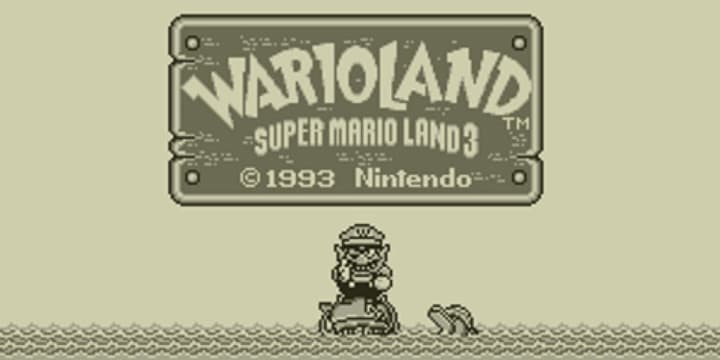
Wario Land: Super Mario Land 3
First released: 1994
Platform: Game Boy
Strictly speaking, Super Mario Land 2 was the last 2D Mario platformer until New Super Mario Bros. on the Nintendo DS nearly fourteen years later. The next two games on the list starred other characters and are really the first games of spin-off series. However, they are both officially Super Mario games according to their titles and they’re both brilliant, so there was no way I was going to leave them out.
So I’m going to say that Super Mario Land 3 is the best of the trilogy, even though it’s not exactly a Mario game. Instead, this is the first Wario Land game, showcasing the big brute himself. Mario may collect gold coins as a perk of the job, but Wario is wholly selfish: his entire mission is about getting as rich as possible. Still smarting after losing the castle and island back to Mario, he travels to Kitchen Island (tee hee) to steal a golden statue of Princess Peach from the Brown Sugar Pirates, who of course stole it in the first place. On the way, his aim is to collect as much treasure as he can find.
The same design-directing team of Kiyotake and Hosokawa returned from Super Mario Land 2, appropriately as they were responsible for creating Wario. While it continues directly from the previous game, Wario Land makes some major changes to the core Super Mario platforming style. While the running/jumping/climbing essentials are there and Wario smashes blocks to remove them and to release items, the game is otherwise almost entirely new. There’s an emphasis on Wario’s strength, with his primary attacks being to shoulder barge and ground pound his way through enemies and obstacles. A regular jump and stomp on an enemy won’t kill it, but allows Wario to pick the critter up and lob it at another, Super Mario Bros. 2 style.
Coins don’t reward lives, but are instead collected for rewards and can be gambled, as in Super Mario Land 2. So mercenary is the game that you need at least ten coins to get through the locked door at the end of each level. (You can also lob a ten-coin piece at enemies to kill them, before quickly running to get your money back.) After clearing a level, after the optional game of chance, the coins are banked. The more that’s in the bank at the end of the game, the better Wario’s final prize. (Spoiler: he never gets his hands on the statue. He’s awarded a new home and, depending on how rich he is, he gets anything from a birdhouse to castle or, if you finish the game with the maximum score, an entire planet.)
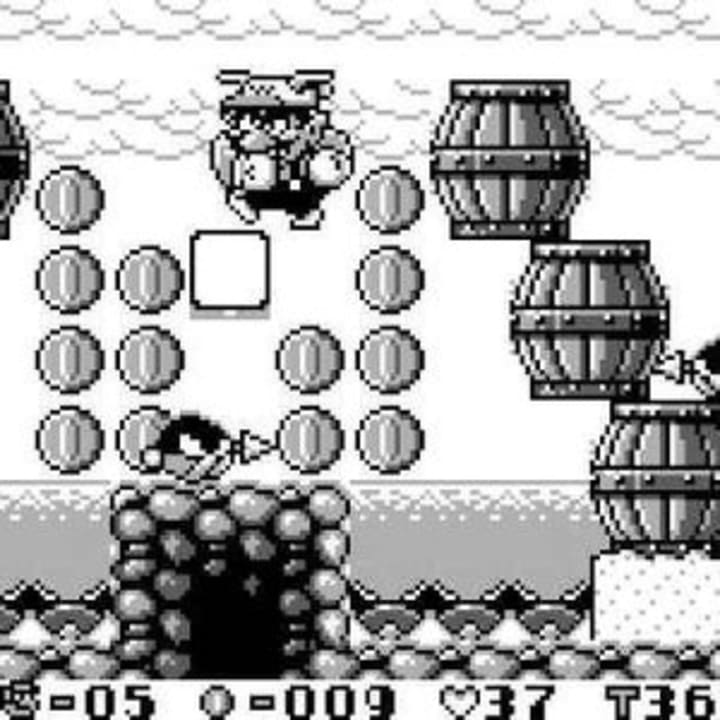
Lives are instead gained by accumulating heart points, with one given for every enemy defeated and ten for collecting a heart icon. The pipes are gone, replaced with ladders, and the only returning power-up is the Super Star (now with new, wonderfully ridiculous music to accompany the burst of invincibility). The Super Mushroom is replaced by a pot of garlic. A hit shrinks Wario to a weak, goblin-like mini-form; eating garlic turns him back to his regular, hench form. The other power-ups are special helmets (or pots) that transform Wario and give him new powers. The Bull Helmet increases his already impressive strength, and lets him cling to ceilings with his horns (useful about twice in the game). The Jet Helmet translates his shoulder barge to a jet-powered burst of flight, as well as increasing his speed overall and letting him barge underwater. The Dragon Helmet is Wario Land’s equivalent of the Fire Flower, giving Wario the ability to shoot flames both on land and underwater.
The game has a good difficulty curve, with the earlier levels being pretty straightforward and the later ones often very challenging. As always, the overworld is split into several sub-worlds, each with a unique boss. Virtually no enemies return from earlier games, with Wario instead facing a host of new monsters. Gooms, the clear equivalent of the Goombas, come in harmless and spear-wielding varieties, with the pirate gang also incorporating rat-dogs, “pencoons” and the wonderful D.D. aka the Dangerous Duck. There are piranha plants and a single Koopa (as the boss to World 1), but Kitchen Island is clearly far from the Mushroom Kingdom.
As with World and Land 2, there are several secret exits which open up alternative paths, and although progress is still mostly linear there’s an entire secret world, the icy Sherbert Land. There’s a lot of replay value thanks to not only the sheer fun of smashing your way through the levels, but also looking for the pirates’ lost treasure, hidden inside locked often a long way from where the key is hidden. (In the meantime, you can brain enemies with the key as well.) Only by finding every treasure can you hope to get the grand prize of Planet Wario.
This game began the Wario Land series, being followed by Virtual Boy Wario Land and then the erroneously named Wario Land II, Wario Land 3 and Wario Land 4 (aka Wario Land Advance). There was even Wario World on the GameCube, Wario: Master of Disguise on the NDS and Wario Land: Shake It! (aka The Shake Dimension) on the Wii. The sultry Captain Syrup and her Brown Sugar Pirates (later renamed the Black Sugar Gang) would become recurring adversaries for Wario, who is now almost as big a star as Mario. Wario Land is an outright Game Boy classic but, while it got a Virtual Console release on the 3DS, it still isn’t available on the Switch. A crime on a par with stealing a giant golden statue of Princess Peach.
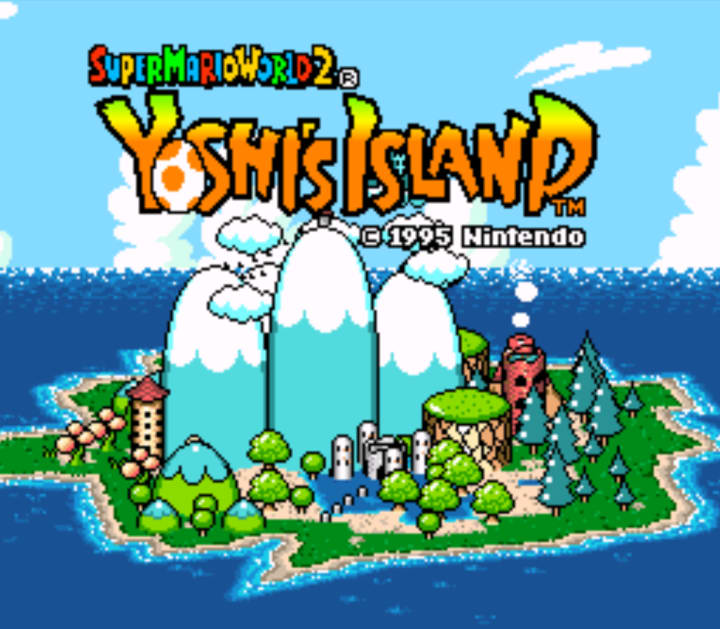
Super Mario World 2: Yoshi’s Island
First released: 1995
Platform: SNES/Super Famicom
I've waffled on about Yoshi's Island at length recently as it just enjoyed its own thirtieth anniversary, so I won't go into too much detail here. Suffice to say, it's my absolute favourite game and, I'd argue, the pinnacle of 2D platforming. In spite of being titled Super Mario World 2, this is the first game of the Yoshi platforming series, with Yoshi – or rather, Yoshis – as the main playable character. A prequel to the Super Mario series, Yoshi's Island takes us back to when the Mario Bros. were just babies, abducted by Baby Bowser's guardian and lacky, Kamek. Baby Mario falls from Kamek's grasp as he flies back to the Koopa Kingdom, luckily landing with on Yoshi's Island, where the dinosaurs vow to reunite him with his brother.
Yoshi's Island may be set decades before the previous games, but it still takes its cue from Super Mario World, albeit trying entirely new things with everything its predecessor introduced. While named for the first world of the previous game, Yoshi's Island takes place in an expansive location with six worlds to play through. Mario still rides on Yoshi's back, but it's Yoshi who you play as, with protecting Mario central to the game. Yoshi is as tough as old boots, but a single hit throws Mario off and leaves him at the mercy of Kamek's Toadies, with a short countdown to get him back before the level ends. The classic platforming gameplay is enhanced, with Yoshi's egg-laying abilities now a major part of play; he throws eggs to take out enemies, break barriers and release items. There are new transformations for Yoshi and one for Mario: like a combination of the Super Star and Feather, it turns Baby Mario into an unstoppable caped crusader for a few seconds.
Kamek is straight from Super Mario World, not only following the design of that games Magikoopa but also sharing his name with them in Japanese. When it comes to it, how do we know there was ever more than one Magikoopa? Maybe they were all Kamek, using his magic to appear in two places at once. Weirdly, though, Yoshi's Island draws equally heavily on Super Mario Bros. 2, bringing back the Shy Guys as its most common, base-level enemies, plus the POW blocks and even the toss-and-throw method of dispatching enemies has more in common with SMB2 than World.
Far more of the game is brand new, with a host of new enemies; some of the greatest and most varied boss battles in the franchise's history; long, inventive, maze-like levels; and hidden items that add replay value by rewarding the player for achieving 100% on each level. Yoshi's Island is a true joy, kicking off Yoshi's platforming adventures in unequalled style. Sequels have tried to match it but none have succeeded, with the most celebrated later release being the remake Super Mario Advance 3, which changed nothing of the game itself but added unlockable new levels. However, with Yoshi and the Mysterious Book just announced as the latest Yoshi game for the Switch 2, perhaps we have another classic to come.
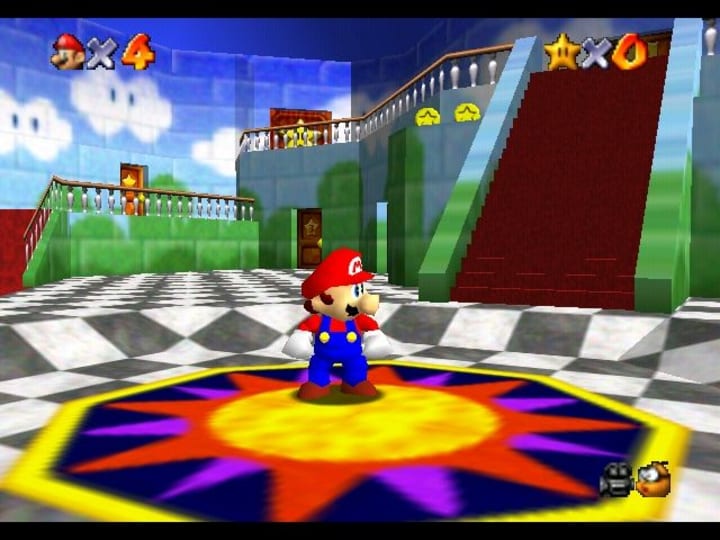
Super Mario 64
First released: 1996
Platform: Nintendo 64
It’s staggering to think that not only is this game almost thirty years old, but also that it came out only eleven years after Super Mario Bros. I can still remember the palpable excitement of the upcoming release of the N64, the drips of information about its capabilities, and finally the first reviews of its launch games: Super Mario 64, Pilotwings 64 and Shogi. Well, OK, maybe not Shogi.
It didn’t arrive in the UK and the rest of the PAL world until almost a year later, but it was well worth the wait. Super Mario 64 alone was worth the outlay. Super Mario Bros. wasn’t the first platformer, but it set the template for the genre. Likewise, Super Mario 64 wasn’t the first 3D platformer. The first platform game in real 3D was probably Alpha Waves, a 1990 title by French company Infogrames for Atari. The Sega Saturn title Bug! made strides forward in 1995, as did Jumping Flash! on the Playstation. Super Mario 64 leapt forward, though, truly realising what 3D gaming could be, and forever setting the standard for 3D platform and action-adventure games (defining a platformer becomes increasingly tricky once expansive 3D is involved).
SM64 was actually only a 32-MB game, but utilised the 64-bit hardware to create an entirely new experience. Miyamoto had begun working on it after releasing the 1993 SNES/Super Famicom title Starfox (aka Starwing) which used the Super FX chip to create limited 3D gameplay. In another world, we got a 3D Mario game on the SNES, but it’s unlikely it would have had the impact that SM64 did, even if the time needed to develop delayed the N64’s release by almost a year.
Unlike the more limited 3D games that preceded it, SM64 pioneered the sandbox style of gaming, creating large, expansive environments in which the protagonist can explore freely. In honesty, not all of SM64 is as free as this; a number of courses and sections are constrained in their movement. In its standout levels, though, the game is an astonishingly free world; simply running around the castle grounds is exhilarating. Simple running, jumping and climbing wouldn’t do for a world like this, and Mario was given an updated set of moves, both building on and revolutionising the way players controlled him.
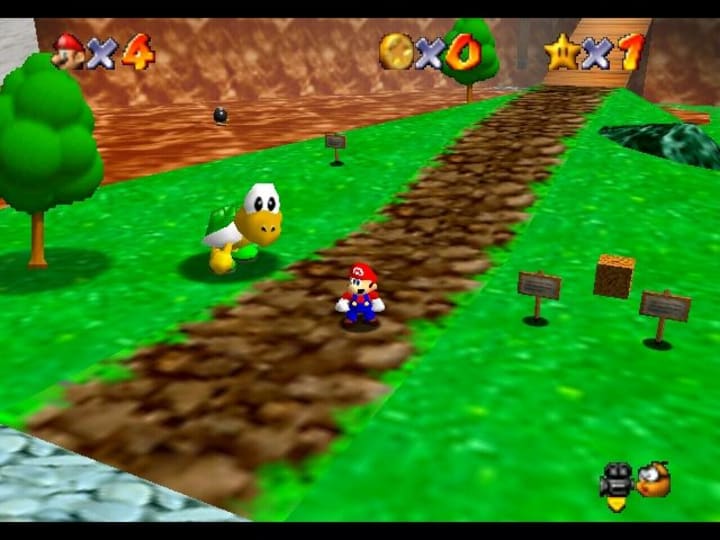
Some of these moves originated in earlier games: the ground pound was in both Wario Land and Yoshi’s Island, while the backflip first appeared in the 1994 Game Boy Donkey Kong, of all places. Others required more complex series of moves, such as the sideways somersault. Some, notably the triple jump, became mainstays of the series, even in later 2D games. In spite of the increasingly complex jumping mechanics, simply stomping on an enemy was no longer the focus: Mario could now punch and kick too, as well as once again being able to pick up and throw various objects and creatures. He could even lunge after fast-moving critters that would steal his hat. SM64 saw the series evolve into a truly athletic gaming experience.
These more complex moves required a more complex controller. The N64’s three-pronged handset remains divisive. Specifically designed for SM64’s gameplay, it features an extensive and oddly laid-out set of buttons. It was a tricky new skill set but, in time, using these controls became second nature. Perhaps most significant was having a separate set of direction controls for the in-game camera (carried by a friendly Lakitu). While still the most frustrating element of the game, managing the camera angle is vastly easier and more intuitive than in any other 3D game of the era. A qualified success, then, but a success nonetheless.
With the move into wider, open-space play, Miyamoto and team ditched the tried-and-tested gameplay of reaching the end of a level, and instead made the game mission-based. From the hub world of Princess Peach’s castle, players could leap into paintings and be magically transported to other worlds, each of which contained six Power Stars that could be won by completing specific tasks. These range from beating a Koopa Trooper in a running race, to reuniting a baby penguin with his mother, to defeating the boss monster of the level. The red coins from Yoshi’s Island returned as another mission for each course, with the golden coins now awarding a seventh, secret star if 100 were collected in a single playthrough in each course. (50 would now award a life, but only upon completion of a course). Through the castle are secret rooms, bonus courses and more Power Stars, with Mario able to climb further up the castle’s levels as he gains more stars and unlocks more areas.
For all the advancements, the story is back to basics: Bowser has invaded the Mushroom Kingdom and kidnapped Peach. Mario battles Bowser three times, each much the same but genuinely challenging as he has to swing the Koopa king, at his most dinosaur-like, by his tail and out of the arena. There are surprisingly few enemies in the courses, but the old favourites are back, along with a handful of new creatures. The different environments call back to the classic styles of earlier games, from the meadow and hills of the first course, Bob-Omb Battlefield, to the fiery danger of Lethal Lava Land, the slippery tundra of Snowman’s Land and the grim, confusing Hazy Maze Caves (complete with the classic underground music). There’s a great deal of swimming, only now, Mario has a limited amount of time he can spend underwater before he runs out of breath.
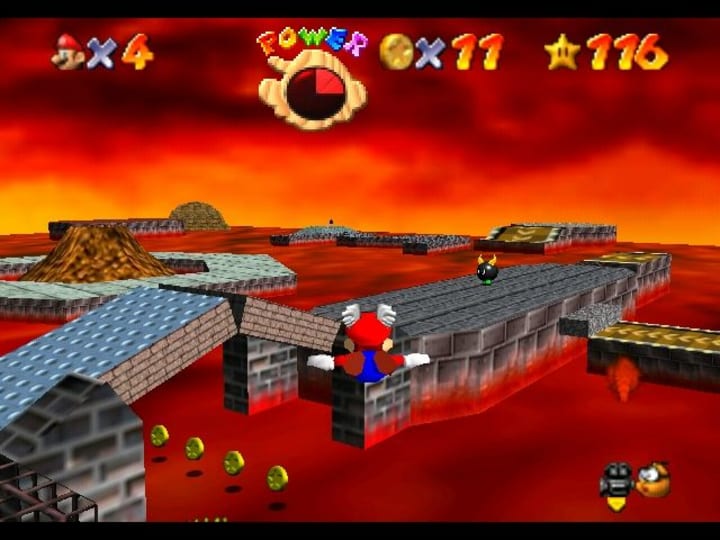
None of the classic power-ups are there. Mario no longer boosts himself with a mushroom, but instead has a health meter that’s replenished by collecting coins. There’s no Fire Flower, Super Leaf or Starman, but instead there are three caps that grant special abilities. The Metal Cap turns Mario into invulnerable steel, while the Vanish Cap phases him out of this plane so that he can pass through grates and fences. The Wing Cap is, on the face of it, the simplest, but is the hardest to master. The sheer joy of soaring through the sky, though (often having been blasted from a cannon by a helpful Bob-Omb Buddy), means that you’ll not get tired of learning the tricks. SM64 also introduced Dorrie, a rideable Nessie-like plesiosaur who would return sporadically in future games. More significantly, this was the first game in which Mario spoke, voiced by Charles Martinet, who would own the role right up until Mario Kart 8 in 2023.
Even with the extra processing power and extended development time, SM64 was released unfinished. A multiplayer mode would have allowed players to control Luigi, whose files are still hidden in the game’s code. While early plans for a sequel or extension using the N64 Disk Drive were scrapped when that hardware failed to sell, the game did receive a huge reworking in 2004 as Super Mario 64 DS, a true reworking which adds Luigi, Wario and Yoshi as playable characters with different move sets (indeed, you start the game as Yoshi). The first true 3D game for a Nintendo handheld, SM64 DS was another remarkable achievement, although the controls translated poorly to the handheld. An upscaled version of the original SM64 was released for the 35th anniversary as part of Super Mario 3D All-Stars for the Switch, along with its follow-ups, Super Mario Sunshine and Super Mario Galaxy. SM64 was also available on the Virtual Console and was the launch title for the Switch Online N64 application.
Super Mario 64 has enjoyed a powerful legacy in its many follow-ups, with the 2017 Switch title Super Mario Odyssey as perhaps its true sequel. It’s also influenced the 2D Super Mario titles, which repopularised 2D platforming with 2006’s New Super Mario Bros. Its greater legacy, though, was in how it revolutionised 3D gaming, along with its stablemate, The Legend of Zelda: Ocarina of Time. On the N64 alone, GoldenEye 007, Banjo-Kazooie and Donkey Kong 64 are among the most heavily influenced in their mission-based, exploratory style, with everything from A Hat in Time to Jersey Devil to the Assassin’s Creed series clearly influenced. Super Mario 64 was genre-defining in the same way that Super Mario Bros. was eleven years earlier, preparing Super Mario and gaming as a whole for the 21st century.
About the Creator
Daniel Tessier
I'm a terrible geek living in sunny Brighton on the Sussex coast in England. I enjoy writing about TV, comics, movies, LGBTQ issues and science.
Keep reading
More stories from Daniel Tessier and writers in Gamers and other communities.
40 Years of Super Mario - Part 1: The 1980s
It’s September 2025 and Super Mario is forty years old. The first game in the series, the legendary Super Mario Bros. was released for the Famicom on 13th September 1985, one of the first games for Nintendo’s earliest true home console. It wouldn’t arrive on the Nintendo Entertainment System – the western version of the Famicom – until the following year in North America, as a launch title for the system, and not in PAL regions such as the UK and Europe until 1987. Regardless, the game was instrumental in revitalising the American video games market, which had suffered an almost lethal crash in 1983 due to a glut of low quality systems and games.
By Daniel Tessier6 months ago in Gamers


Comments
There are no comments for this story
Be the first to respond and start the conversation.