
Why Temporary Employment Is Becoming a Smart Choice for Modern Businesses
Hiring today is no longer just about filling open positions it’s about managing uncertainty.
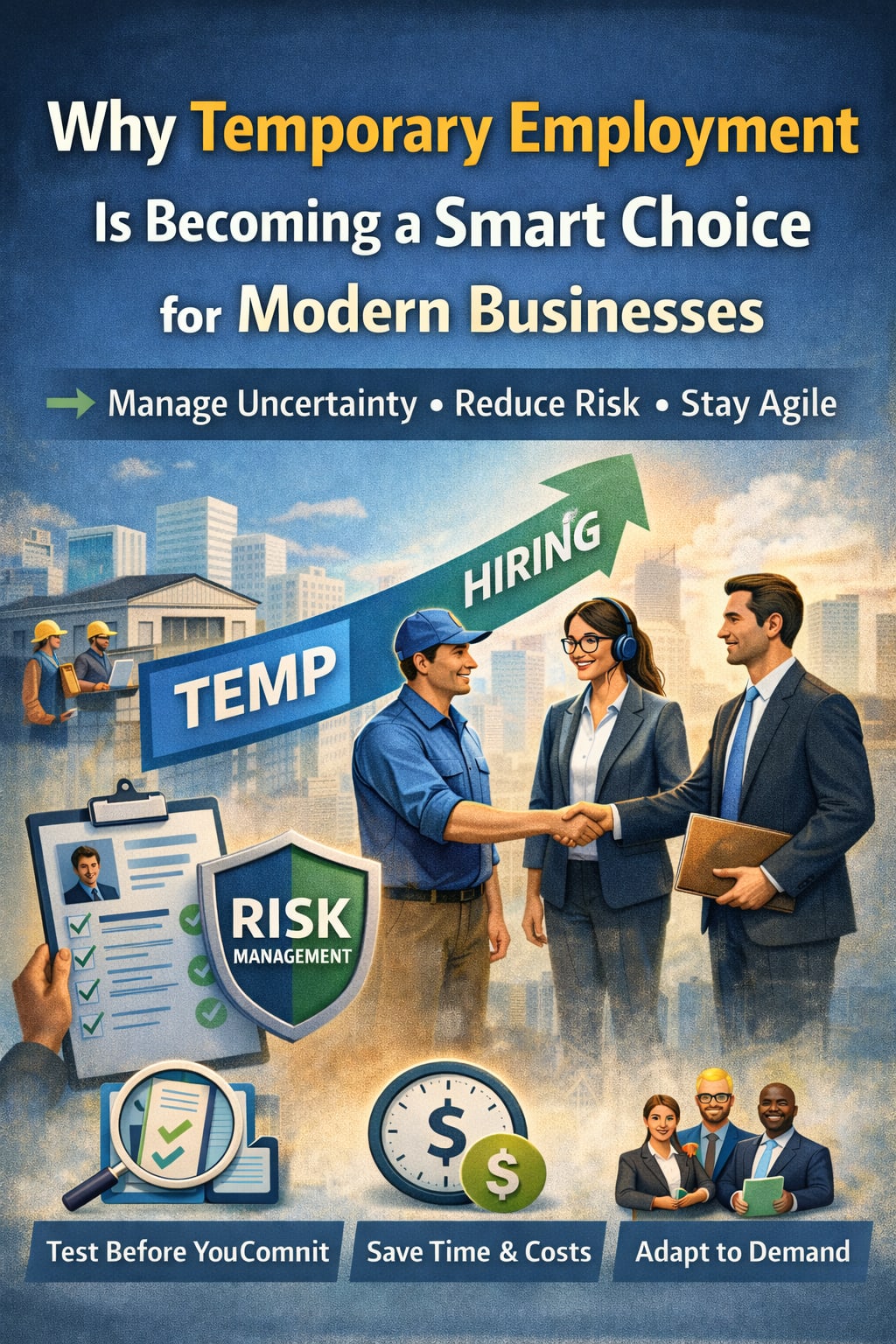
Businesses face fluctuating demand, competitive labor markets, and rising costs associated with bad hires. In response, many employers are rethinking traditional hiring models and turning toward more flexible workforce solutions.
One approach gaining renewed attention is temporary employment.
The Changing Nature of Work
Workplace dynamics have shifted dramatically over the last decade.
Companies now operate in environments shaped by:
- Seasonal or project-based workloads
- Rapid growth or downsizing cycles
- Economic uncertainty
- Increased demand for specialized skills
According to Entrepreneur, organizations that adopt flexible staffing models are often better equipped to adapt to change and remain competitive in uncertain markets. This flexibility allows companies to respond quickly without committing to long-term hiring decisions too early.
What Is Temporary Employment?
Temporary employment refers to work arrangements where individuals are hired for a limited period rather than as permanent employees. These roles may last from a few days to several months, depending on business needs.
As explained by Wikipedia, temporary employment plays a critical role in modern labor markets by helping organizations address short-term staffing gaps while giving workers access to job opportunities and experience across industries.
Today, many companies rely on temporary employment not as a last resort, but as a strategic staffing solution.
Why Businesses Are Turning to Temporary Employment
Temporary employment offers several advantages that traditional hiring models often lack.
1. Reduced Hiring Risk
Employers can evaluate performance, reliability, and skills in real working conditions before making longer-term commitments.
2. Workforce Flexibility
Temporary roles allow companies to scale staffing levels up or down based on demand without overextending budgets.
3. Faster Hiring Process
Staffing partners often manage recruiting, screening, and onboarding, allowing businesses to fill roles quickly.
4. Cost Control
According to research highlighted by SHRM, hiring mistakes can cost employers a significant percentage of an employee’s annual salary. Temporary employment helps reduce this risk by limiting upfront commitment.
When Temporary Employment Makes Sense
Temporary employment is particularly effective for:
- Seasonal industries such as logistics, retail, and manufacturing
- Businesses managing short-term projects
- Companies testing new roles or departments
- Organizations recovering from high turnover
For example, a business experiencing a sudden increase in demand can bring in temporary workers immediately, maintain productivity, and later decide which roles should become permanent.
Temporary Employment as a Long-Term Strategy
While temporary employment is often viewed as a short-term fix, many organizations now integrate it into long-term workforce planning.
By combining flexibility with performance-based evaluation, employers gain better visibility into talent quality while maintaining operational stability.
This approach aligns with broader hiring trends focused on adaptability, data-driven decisions, and sustainable growth.
How Temporary Employment Supports Business Continuity
Unexpected disruptions are becoming more common from supply chain delays to sudden changes in customer demand. Temporary employment helps businesses maintain continuity during these periods without overcommitting resources.
By having access to temporary workers, companies can quickly fill operational gaps caused by absenteeism, turnover, or short-term spikes in workload. This ensures deadlines are met and service levels remain consistent, even during uncertain periods.
Rather than scrambling to recruit under pressure, businesses can rely on flexible staffing to stay operational and responsive.
Temporary Employment and Skills-Based Hiring
Another reason temporary employment is gaining traction is the shift toward skills-based hiring.
Instead of focusing solely on credentials or years of experience, employers increasingly prioritize practical skills and performance. Temporary roles provide a real-world environment to assess these capabilities before making long-term decisions.
This approach benefits both employers and workers. Businesses gain clarity on performance, while workers have the opportunity to demonstrate their value beyond what a resume can show.
Over time, this leads to stronger hiring outcomes and better alignment between roles and talent.
Cost Efficiency Without Compromising Quality
Cost control is a major concern for businesses of all sizes, especially in competitive or volatile markets.
Temporary employment allows organizations to manage labor costs more efficiently by:
- Reducing overtime expenses
- Limiting long-term payroll commitments
- Avoiding repeated recruitment and onboarding cycles
Importantly, cost efficiency does not mean sacrificing quality. With proper screening and workforce planning, temporary employment can deliver highly capable workers who meet immediate needs while preserving budget flexibility.
This balance makes temporary staffing particularly attractive for growing and mid-sized businesses.
Improving Workforce Agility Through Temporary Roles
Agility has become a defining trait of successful organizations.
Temporary employment enables businesses to respond quickly to changing conditions whether launching a new initiative, entering a new market, or adjusting to seasonal demand. Instead of being constrained by fixed staffing models, employers can adapt workforce size and skill sets as needed.
This agility supports innovation and growth, allowing teams to experiment, scale, and refine operations without being locked into permanent structures too early.
Building Stronger Long-Term Teams
Contrary to common misconceptions, temporary employment often contributes to stronger long-term teams.
Many companies use temporary roles as a pipeline for permanent hires, selecting individuals who have already proven their skills, reliability, and cultural fit. This reduces onboarding friction and improves retention rates once employees transition into long-term positions.
By making hiring decisions based on real performance rather than assumptions, businesses can build teams that are both capable and resilient.
Final Thoughts
The future of hiring is not about choosing between temporary and permanent work it’s about using the right model at the right time.
Temporary employment offers businesses a practical way to manage risk, control costs, and stay agile in a changing labor market. For companies navigating uncertainty, flexibility is no longer optional it’s essential.
About the Creator
Keep reading
More stories from writers in FYI and other communities.


Comments
There are no comments for this story
Be the first to respond and start the conversation.