
Why Do Airplanes Fly at 35,000 Feet?
The Science, Strategy, and Safety Behind Cruising at High Altitudes
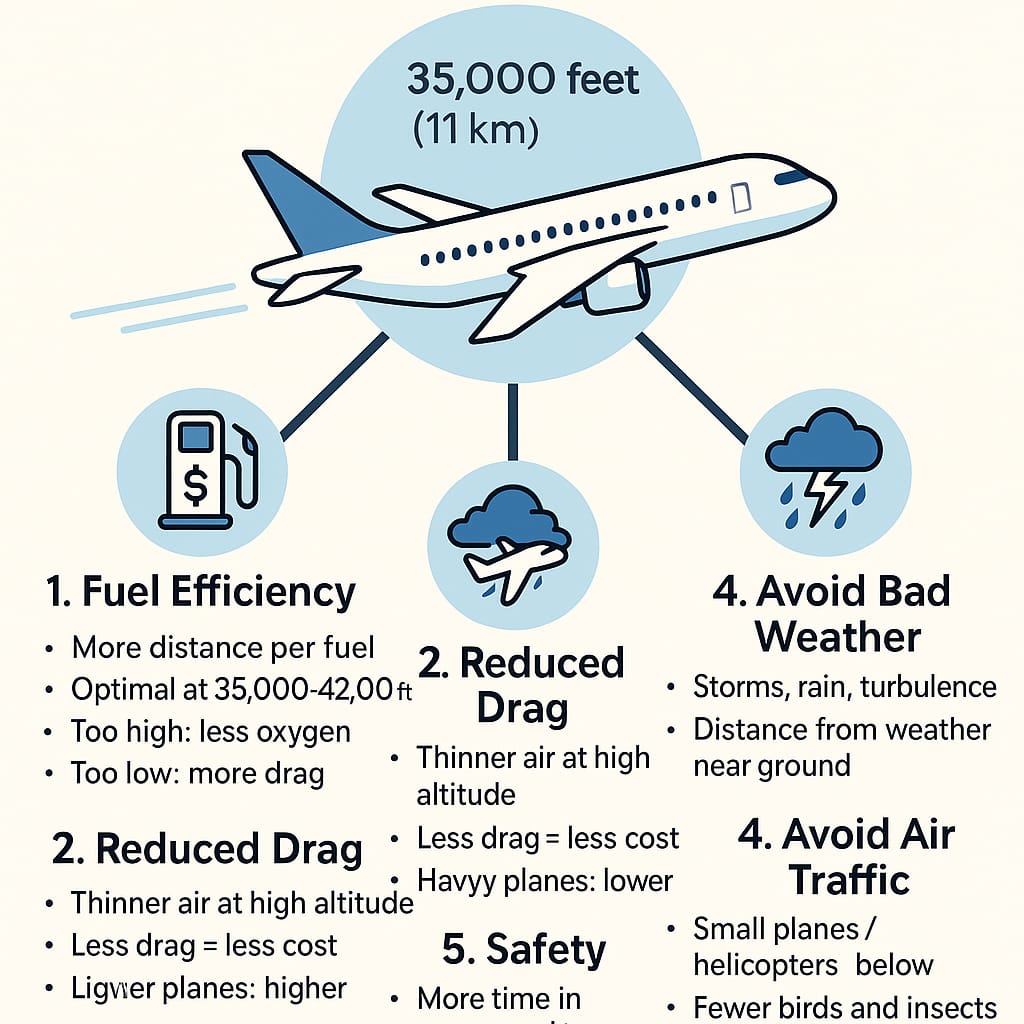
Why Do Passenger Planes Fly at Such High Altitudes?
A Deep Dive into the Science and Safety Behind Cruising at 35,000 Feet
When we board a passenger airplane, buckle our seat belts, and watch the world shrink beneath us, few of us stop to think: Why do planes fly so high? At cruising altitude, most commercial aircraft soar at around 35,000 feet, which is roughly 11 kilometers above sea level. This altitude might seem extreme to many, but there are several well-founded scientific, technical, and economic reasons behind this practice.
Let’s explore why this specific altitude range is ideal for air travel, and what makes it beneficial from both a performance and safety perspective.
---
1. Fuel Efficiency and Operational Cost
One of the primary reasons commercial aircraft fly at high altitudes is to maximize fuel efficiency. At around 35,000 feet, the atmosphere is much thinner than at sea level. Thinner air means less aerodynamic drag acting against the aircraft. With reduced resistance, the engines don’t have to work as hard to maintain speed, and as a result, they consume less fuel.
This is crucial because fuel is one of the biggest operating costs for airlines. By flying at this optimal altitude, airlines save millions of dollars annually. The optimal cruising altitude for most commercial jets typically ranges between 35,000 and 42,000 feet (10 to 14 kilometers), depending on the type of aircraft, its weight, and flight conditions.
However, there’s a limit to how high an aircraft can go. If it climbs too high, the air becomes too thin to support engine combustion efficiently. Jet engines require oxygen to function, and there’s simply not enough of it beyond certain altitudes. So, 35,000 feet becomes the “sweet spot” where the balance between efficiency and functionality is best maintained.
---
2. Reduced Air Resistance
As mentioned above, the higher a plane flies, the thinner the air. At lower altitudes, air density is greater, which creates more friction or drag against the aircraft. This increased resistance would force the engines to work harder and burn more fuel to maintain speed and altitude.
By cruising at higher altitudes, the airplane encounters less friction, enabling it to glide more smoothly and economically through the air. The reduced resistance at such altitudes not only improves speed and fuel consumption but also allows for longer travel ranges.
Heavier aircraft, such as large international jets at the start of a journey with full fuel tanks, may begin at slightly lower altitudes and climb higher as fuel burns off and the plane becomes lighter. In contrast, lighter aircraft or those with shorter routes can afford to cruise at higher altitudes from the beginning.
---
3. Avoiding Bad Weather
Weather systems—like storms, turbulence, and heavy clouds—typically occur in the troposphere, which is the lowest layer of Earth's atmosphere. This layer extends from ground level to about 7 to 12 kilometers (23,000 to 39,000 feet) depending on location and season. By flying at or above 35,000 feet, commercial planes can often avoid the worst weather conditions, including thunderstorms, rain, and turbulence caused by air currents.
Although turbulence can still occur at higher altitudes due to jet streams or temperature differences between air layers, it is generally less intense and more predictable, allowing pilots to navigate it more safely. In essence, cruising above the weather makes for a smoother and more comfortable ride for passengers.
---
4. Reduced Air Traffic and Bird Hazards
At lower altitudes, airspace is much busier with light aircraft, helicopters, and private planes that typically operate below 10,000 feet. Commercial planes avoid this crowded zone by flying much higher, thus reducing the risk of mid-air collisions and air traffic congestion.
Moreover, birds and insects are usually found in the lower atmosphere, particularly below 10,000 feet. Flying at higher altitudes drastically reduces the chances of bird strikes, which can damage engines and compromise safety during critical flight phases like takeoff or landing.
By staying at higher altitudes, commercial aircraft remain above most of these potential hazards, contributing to the overall safety of the flight.
---
5. Emergency Time and Safety Buffer
In the unlikely event of an in-flight emergency—such as engine failure or cabin depressurization—altitude gives pilots valuable time to react, troubleshoot, and safely descend. A plane cruising at 35,000 feet has more room to glide if engines fail, giving the crew the opportunity to navigate toward the nearest airport or safe landing area.
It’s also important to note that modern commercial aircraft are designed to fly and even land safely with just one engine, or glide for considerable distances in the rare case of total engine failure. So the altitude acts as a built-in buffer that enhances safety and provides margin for error in emergencies.
---
6. A Record of Extremes: The Highest Altitude Ever Flown
While 35,000 feet is standard for passenger flights, aircraft can fly much higher under special conditions. The record for the highest altitude ever achieved by a jet aircraft was set in 1977 by Soviet pilot Alexander Fedotov, who flew the MiG-25M, a high-performance military reconnaissance aircraft, to an astonishing altitude of 123,520 feet—around 41 kilometers.
This record, though, was achieved under very controlled circumstances and isn’t feasible for commercial travel. The MiG-25 was a specially designed military aircraft with features and protection systems that allow it to survive extreme altitudes where oxygen is scarce, and pressure is dangerously low.
---
Conclusion: The Sky Has Its Limits—and Its Logic
The decision to fly commercial aircraft at around 35,000 feet isn’t random—it’s a carefully calculated choice that balances economy, performance, safety, and comfort. From reducing fuel consumption to minimizing exposure to weather and air traffic, this altitude provides the best conditions for efficient air travel.
Next time you look out the window and marvel at the clouds far below, remember: there's a fascinating mix of physics, engineering, and strategy that allows us to travel so high, so fast, and so safely—on nothing more than a few tons of metal and wings.
About the Creator
Keep reading
More stories from Ikram Ullah and writers in FYI and other communities.
The Headless Survivor: Nature’s Most Resilient Insect
Did You Know? > There is a creature that can survive for a whole week even after its head is cut off! As unbelievable as it sounds, it’s absolutely true. There exists a creature in this world that can live for days—even up to a week—without its head.
By Ikram Ullah8 months ago in FYI
A Failed Artist, A Disillusioned Poet, An Underpaid Game Show Host
I took my son and niece to Gori, a small town in Georgia where Joseph Stalin was born. They talked me into visiting the Stalin's Museum, the largest in the post-Soviet space. I had resisted going there because I just can't stand the monster and know enough about him, or so I thought.
By Lana V Lynx9 days ago in FYI
A Dart at Dusk
Seconds ago, the sullen sun set on the two of us… my exuberant furry companion and me. A fresh breeze embraces us, delivering welcome relief from the day’s oppressive heat. His typical stumbling and staggering along — apace with a sloth — has turned into trip-trapping, high-stepping, almost skipping along.
By Angie the Archivist 📚🪶about 22 hours ago in Petlife


Comments (1)
Flying at high altitudes makes a lot of sense. Less air resistance means engines don't have to work as hard, saving fuel. I remember a long flight where the pilot mentioned they were at the optimal altitude for efficiency. But what about in really bad weather? Does that affect the ideal cruising altitude? And how do they figure out the best height for different planes?