
Who was first?
Did the Greeks Really Copy the Round Earth Idea from the Egyptians?

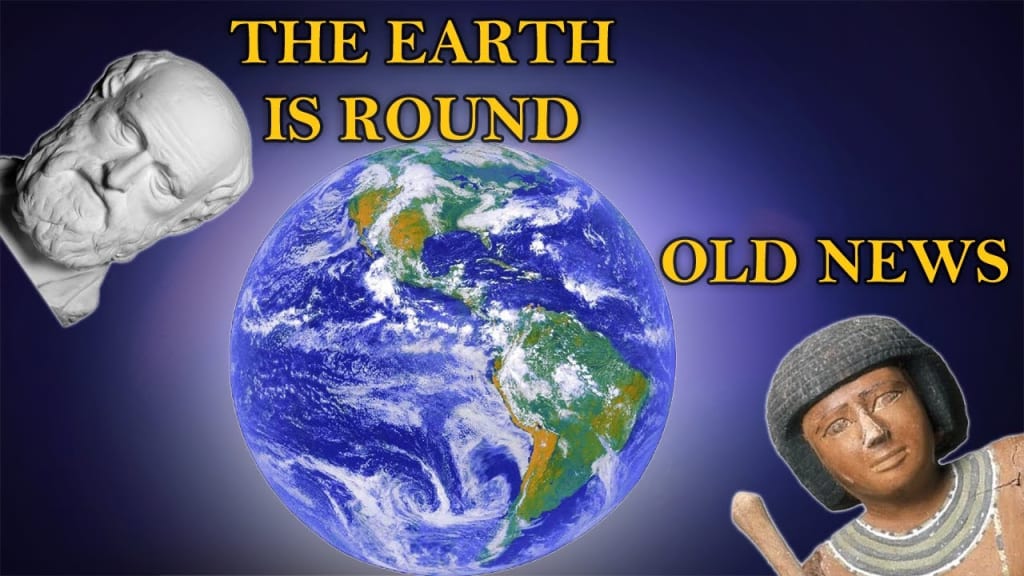
For centuries, Eratosthenes of Cyrene has been credited as the first person to accurately measure the circumference of the Earth. His groundbreaking work laid the foundation for centuries of astronomical and geographical discovery, earning him a revered place in history. However, there's a growing argument that perhaps the ancient Greeks did not discover the roundness of the Earth on their own. Instead, they may have borrowed this knowledge from an even older civilization—the Egyptians. Is there any truth to the theory that the Greeks copied the idea of a round Earth from the Egyptians? Let's dive into the evidence and explore the intriguing possibilities.
Eratosthenes - The Greek Pioneer
Eratosthenes, born in Cyrene (modern-day Libya), was a scholar who studied in Alexandria, Egypt, which was a bustling center of learning during his time. In 240 BCE, Eratosthenes famously used simple geometry to calculate the Earth’s circumference. His method involved measuring the angle of a shadow cast by a vertical rod in Alexandria during the summer solstice and comparing it to the lack of shadow at noon in the city of Syene (modern-day Aswan). By knowing the distance between the two cities and the angle of the shadow, he was able to estimate the Earth’s size with remarkable accuracy, only being off by about 15%.
This was a monumental achievement for the ancient world, and Eratosthenes has long been hailed as the first to calculate the Earth’s curvature. But did Eratosthenes rely on his own observations, or did he draw from a well of ancient knowledge already present in Egypt?
The Egyptian Connection - Did They Know the Earth Was Round?
Eratosthenes wasn’t working in a vacuum. He studied in the Great Library of Alexandria, a repository of knowledge that included works from Mesopotamia, Egypt, and the wider Near East. Some scholars argue that much of what the Greeks accomplished was built upon earlier discoveries made by older civilizations, including the Egyptians.
In Egypt, astronomy and geometry were integral to the functioning of their society. Their construction of massive structures like the pyramids depended on precise geometric knowledge, and their calendar was based on astronomical observations. There’s even evidence that the Egyptians had some understanding of the Earth's curvature. For instance, they could have observed that as they traveled north or south, certain stars would disappear or reappear over the horizon. This, combined with their reverence for the sun and meticulous tracking of its movement, suggests they might have had an inkling that the Earth wasn’t flat.
One of the most compelling pieces of evidence comes from the discrepancy in Eratosthenes' calculations. It turns out that the Tropic of Cancer, where the sun would be directly overhead during the solstice, was not actually aligned with Syene during Eratosthenes' time. In fact, the Tropic of Cancer had shifted about 40 kilometers south by the time he made his measurements. This suggests that Eratosthenes may have relied on older data, possibly collected by the Egyptians, who could have made these observations centuries earlier when the Tropic of Cancer was directly overhead at Syene.
Egyptian Contributions to Astronomy
Egyptians were known to track the movement of the sun, moon, and stars, and their society was heavily influenced by celestial events. Their knowledge was vital to predicting the annual flooding of the Nile, which was key to their agricultural success. They also built some of the earliest sundials and other time-measuring devices, which required an understanding of the movement of celestial bodies.
The argument that the Egyptians could have known about the Earth’s roundness is supported by the fact that many ancient civilizations, from the Babylonians to the Mayans, tracked the skies with surprising accuracy. Even without modern tools, the curved horizon, the behavior of stars and planets, and the way ships disappear over the horizon when viewed from shore would have provided enough clues to suggest that the Earth was not flat.
A Borrowed Theory?
The Greeks were known for assimilating knowledge from other cultures. Their travels and conquests exposed them to various civilizations and their discoveries. Thales, Pythagoras, and Ptolemy—other well-known Greek scholars—all had connections to Egypt. Thales is said to have studied there, while Pythagoras is believed to have learned about mathematics and philosophy during his time in Egypt. Given the long history of intellectual exchange between Greece and Egypt, it’s not far-fetched to think that Eratosthenes might have drawn on ancient Egyptian data, particularly if such knowledge had been passed down over generations.
This doesn’t diminish Eratosthenes’ achievement. Even if he built upon pre-existing data, his method of calculating the Earth's circumference using geometry was entirely his own. The Greeks took ancient knowledge and expanded upon it, refining and developing it into the scientific methods we recognize today. But it does raise the question: how much of their early success was rooted in the work of earlier civilizations like Egypt?
Closing
It’s unlikely that the Greeks were the first to consider the idea that the Earth was round. The Egyptians, with their keen astronomical observations and sophisticated geometry, may very well have had a conceptual understanding of the Earth’s curvature long before Eratosthenes put his geometric theories into practice. The shifting of the Tropic of Cancer over time suggests that the data Eratosthenes used was based on observations that could have been made centuries earlier, possibly by Egyptian astronomers.
In the end, rather than viewing this as a case of intellectual theft, we might see it as a testament to the enduring power of knowledge. Civilizations build upon one another’s discoveries, and the Greeks' ability to take earlier insights and transform them into formal scientific theories is what truly set them apart. Whether or not they copied the idea of a round Earth from the Egyptians, the Greeks’ contributions to science and philosophy remain significant, and Eratosthenes’ work will always stand as one of the ancient world’s greatest achievements.
About the Creator
Horace Wasland
Research analyst, writer & mystical healer. Exploring the edge where science meets mystery. From mystery/the mystical, to facts, news & psychology. Follow for weekly insights on all four and please leave a tip if you like what you read :)
Keep reading
More stories from Horace Wasland and writers in FYI and other communities.
Your Eye Color
Eye color is one of the most distinct features that define how we look, but did you know it's not as permanent as most people think? From genetic quirks to medical conditions, your eye color can change more often than you'd expect. If you’re curious about what can alter the shade of your eyes, here are 10 surprising ways your eye color can really change.
By Horace Waslandabout a year ago in FYI
A Failed Artist, A Disillusioned Poet, An Underpaid Game Show Host
I took my son and niece to Gori, a small town in Georgia where Joseph Stalin was born. They talked me into visiting the Stalin's Museum, the largest in the post-Soviet space. I had resisted going there because I just can't stand the monster and know enough about him, or so I thought.
By Lana V Lynx9 days ago in FYI


Comments (2)
Thank you Brett 🙂
Very informative and thought-provoking!