
Who Developed the World’s First Vaccine?
And Then What Happened?

Some of us may not want to pay attention to current events these days—except as it relates to the COVID-19 vaccination, that is. Instead, we are turning to past events, aka history.
Well, this book intro, which I wrote back in 2011 (dang; now that seems like ancient history!), is exceedingly relevant today. The following excerpt from my intro for Pioneers in Medicine (published by Encyclopædia Britannica)—cut down a bit for this Vocal Challenge—focuses on, ahem, a challenging balance. Namely, pushing the envelope of scientific discovery to help people, all while dealing with inevitable pushback from… you guessed it, people.
First up, vaccines.
Whoa, mister. What do you think you’re doing with that sharp pointy thing? Wait! Stop! Seriously?
___________________________________________________
One sure way to both help humanity and gain a place in history is to tackle a seemingly unstoppable disease. For Walter Reed it was yellow fever. For Jonas Salk, polio. But in order to create a cure, one must break with the past. And doing things that have not been done before—especially when lives are on the line—can lead to opposition.
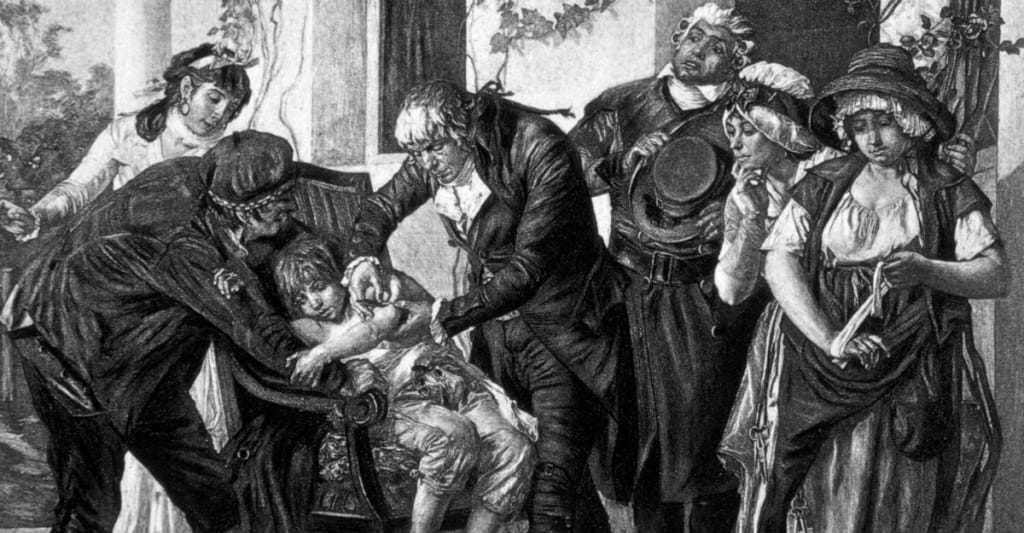
Take the case of Edward Jenner. As a young apprentice to a doctor in 18th-century England, Jenner had heard a farm girl tell the doctor that she could not contract smallpox because she had already had cowpox. Years later, after much experimenting with that notion of resistance based on prior exposure, Jenner, then a doctor himself, went so far as to inject a healthy eight-year-old boy with cowpox. Two months later he exposed him to smallpox. Jenner’s experiment was met with scorn and incredulity. But it worked. And so in time, enough other doctors started using the same preventative method, one which Jenner had given a now-familiar name: vaccination.
Sometimes a medical advance was as basic as insisting upon cleanliness—namely, noticing that the simple act of washing hands could stop the spread of infection. Such was the now elementary but then revolutionary contribution of 19th-century Hungarian physician Ignaz Semmelweis.
That notion of maintaining sanitary conditions was one that 19th-century English nurse Florence Nightingale championed as well. In her case, doing so in the military hospitals of Scutari, Turkey—used as a troop base during war between England and Russia—was extremely challenging. There, soldiers were dying more as a result of infection than of battlefield wounds. By her own rigorous insistence upon sanitary regulations, as well as the introduction of special diets, Nightingale brought down the death rate from 45 to 2 percent. And for the renowned 19th-century German physician Rudolf Virchow, public cleanliness and proper hygiene became something of a crusade, Virchow going so far as to design the sewage system of Germany’s capital, Berlin.
If at first you don’t succeed, inoculate, inoculate again. Such might be the motto for 19th-century French chemist Louis Pasteur. Best known for his discovery of the pasteurization process, in 1882 Pasteur turned his attention to rabies, beginning careful and repeated trials in which he attempted to halt the development of rabies in infected animals. He eventually succeeded in curing an infected dog after inoculating the animal 14 times.
And it just so happened that three years later, the number 14 would again resurface in regard to rabies for Pasteur, as it happened to be the number of times that a nine-year-old boy had been bitten by a rabid dog. Though reluctant to try his remedy on a human, at the fervent request of the boy’s mother, Pasteur did so. The wounds healed and no rabies appeared, making the boy the first human saved by Pasteur’s cure.
___________________________________________________
So, curing disease while battling three mighty foes—disease, long-entrenched habits, and fear—ain’t new. I am certainly no anti-vaxxer—Jonas Salk is in our family tree, and for me, science rules!—but until recently I nonetheless had extreme trepidation about a COVID-19 vaccine. There weren’t any longitudinal studies!
Now, however, knowing that the current vaccines rest on the scientific shoulders of yore, I am hoping to get the most reliable shot posthaste—before some new variant attacks me. (I found out I had COVID this past December, right as we were opening the first round of Christmas presents at my in-laws. So not fun. [The news came via phone from an anonymous caller. Turned out to be my doctor’s office. ] Happily, not only did I not transmit the virus to anyone, I have clearly lived to tell the tale.)
There are, as we all know, a ton of problems in our world today. Let’s learn from history, and try being part of the solution.
About the Creator
Hope Lourie Killcoyne
I'm visual, verbal, and very outgoing.
(And right here, uncharacteristically brief. ; - )
• amazon.com/author/hopelouriekillcoyne
Keep reading
More stories from writers in FYI and other communities.
A Failed Artist, A Disillusioned Poet, An Underpaid Game Show Host
I took my son and niece to Gori, a small town in Georgia where Joseph Stalin was born. They talked me into visiting the Stalin's Museum, the largest in the post-Soviet space. I had resisted going there because I just can't stand the monster and know enough about him, or so I thought.
By Lana V Lynx7 days ago in FYI
Is Human Levitation Real? The Viral Russian Forest Mystery
With superhero movies dominating our screens, it’s only natural that we spend a little too much time thinking about superpowers. But I’m not talking about those bizarre, "niche" talents you see on talent shows, like the guy who can pull a literal airplane with his eyelids.
By Areeba Umaira day ago in FYI
FPS: The Last Flame Challenge Winners
Welcome to our first Winners Announcement of the year and to the final challenge in the Fall Poetry Series. The Last Flame invited writers to sit with endings, using fire as a central image to consider what remains when something burns out: ash, warmth, memory, silence, or the faint promise of what comes next. The strongest pieces treated endings as gradual rather than sudden, allowing them to flicker, dim, and linger.
By Vocal Curation Team6 days ago in Resources
Getting Serious About Comedy (Part I)
If I were asked to remark on my life and the childhood that paved some road leading me to this point, I would have to say something about all the funny people who surrounded me for the last 26,872 days (and counting). Somewhere along that road, I became a big fan of laughter and the comedy that spawns it – and, I mean not only my own laughter, but the laughter of others, some of which I have actually been responsible for inducing.
By John Oliver Smith4 days ago in Humor




Comments
There are no comments for this story
Be the first to respond and start the conversation.