
What is the Harvard Business Review's Focus in Relation to Readers and Its Sentiment in Relation to Writers?
Computational Analysis of HBR's Website

This article is a summary of my results from a word frequency analysis of the Harvard Business Review's topic list, which is available on its website. I also conducted a sentiment analysis of its instructions to potential contributors. I also used Google Ngram to analyze the most frequent words' usage over 100 years in a corpus of 8 million books.
Word Frequency Analysis Results
Based on my observation, it is clear that the Harvard Business Review is mostly about strategic business management. Survey the results before I go into more details below.
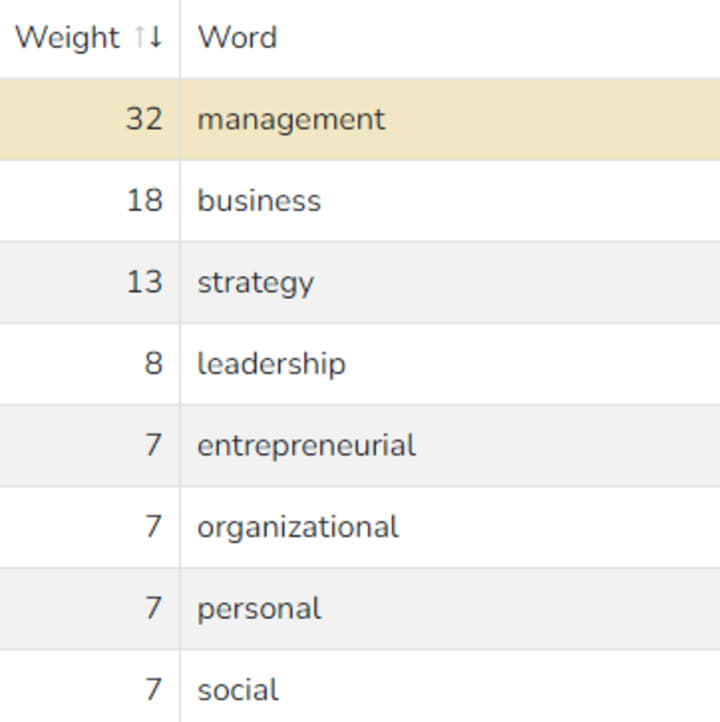
Let’s take a moment to think about the relationship between business, management, and strategy. At its core, business is about creating value—providing goods and services that people need and want. It’s about the hustle and the innovation that drive our economy.
Now, management is where the rubber meets the road. It’s about organizing people and resources, making sure that everything runs smoothly, and empowering teams to do their best work. Effective management is essential; it’s the backbone of any successful operation.
Then there’s strategy. This is the long-term vision that guides a business toward its goals. A strong strategy helps us understand the landscape, anticipate challenges, and seize opportunities. It’s about asking the big questions: What do we want to achieve? How can we stand out in a crowded marketplace?
These three elements—business, management, and strategy—are deeply interconnected. Management brings strategy to life, ensuring that we execute our plans with precision and purpose. Meanwhile, a well-crafted strategy informs the decisions we make every day, helping us align our actions with our aspirations.
So, when we think about success in any organization, we must recognize how these pieces work together. It’s about vision, it’s about leadership, and ultimately, it’s about the people who make it all happen. Together, they create a powerful framework for achieving our goals and building a brighter future.
Sentiment Analysis Results
The sentiment of the text is largely positive and encouraging. On a scale ranging from -100 to +100, this text's sentiment is +80. It emphasizes a commitment to high-quality, original content that can benefit readers in management and leadership roles. The guidelines express a clear belief in the value of effective management and the importance of diverse perspectives. There’s a supportive tone toward potential contributors, highlighting the editorial process as thorough and attentive, while also setting clear expectations regarding expertise, originality, and evidence. Overall, the message conveys an openness to new ideas and a desire to engage with contributors who can provide valuable insights.
Google Ngram Viewer
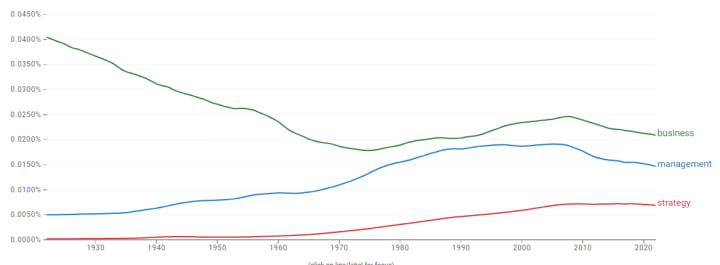
These results are common sense results. Business is broad, management is less broad, and strategy is more specific. Combining all of these results. The Harvard Business Review seems mostly about generating positive content about strategic management for scholars and industry leaders.
Text mining is set to become an essential tool for future companies, and here’s why. In today’s world, we’re generating more data than ever before—emails, social media posts, customer reviews, and reports. Much of this data is unstructured, and that’s where text mining comes in. It allows businesses to sift through all that information and extract valuable insights that can drive smarter decision-making.
One of the most compelling reasons companies will embrace text mining is its ability to enhance customer understanding. By analyzing feedback and sentiment from consumers, businesses can better grasp what people truly want and need. This isn’t just about selling more; it’s about building stronger relationships with customers, making sure they feel heard and valued. When companies listen, they foster loyalty and trust, which is crucial in today’s competitive landscape.
Text mining also plays a vital role in risk management. In industries like finance and healthcare, companies must navigate a complex web of regulations. By employing text mining, organizations can automate the process of monitoring communications, flagging potential issues before they escalate. This not only helps them stay compliant but also protects them from costly pitfalls.
Moreover, companies can use text mining for competitive intelligence. By analyzing news articles and reports, they can stay ahead of market trends and understand what competitors are doing. This agility allows businesses to adapt quickly and strategically.
As we move forward, integrating text mining with artificial intelligence will unlock even greater potential. Real-time analysis will empower organizations to make proactive decisions, fostering innovation and efficiency.
In short, the future of business hinges on the ability to turn unstructured data into actionable insights. Companies that harness the power of text mining will not only thrive but will also create a more responsive and customer-centric economy.
About the Creator
Keep reading
More stories from writers in FYI and other communities.
A Failed Artist, A Disillusioned Poet, An Underpaid Game Show Host
I took my son and niece to Gori, a small town in Georgia where Joseph Stalin was born. They talked me into visiting the Stalin's Museum, the largest in the post-Soviet space. I had resisted going there because I just can't stand the monster and know enough about him, or so I thought.
By Lana V Lynx30 days ago in FYI
Why Aircraft Components Are Overbuilt on Purpose
When we look at an aircraft, it’s easy to be impressed by its size or complexity but what many people don’t realize is that every part of an aircraft is engineered to be stronger and more reliable than it ever strictly needs to be. In aviation, nothing is left to chance. What may seem like “overbuilding” to the untrained eye is actually a deliberate, essential aspect of engineering that keeps passengers safe thousands of times a day.
By Beckett Dowhan7 days ago in FYI
~ Fired ~
— Ai Intrusion ~ Are you Next ~ Is Ai Evolution after your job? — Few workplaces haven't been affected. Ai is in supermarkets, at doctors' offices, and even monitoring farms. I just can't think of anything this machine is not getting into, can you? For instance: Education ~ Law and Tech jobs will one day have a major influence or be taken over by these inanimate machines, with accuracy and vigor. From mechanics' diagnoses to a wide variety of everyday jobs, including fast food workers, with this input having the ability to cut their unnecessary work hours. I'm certain all of us have been touched by this with our short stories and colorful headings, have you? Even comments are very questionable 'Non-Robot' insertions.
By Jay Kantor4 days ago in Journal
Time to change your life.
Is it even possible for you to change your life? A lot of people, more than there should be, are unhappy with their lives. But what are they doing about it? Usually nothing. People talk about how shitty their lives are and want change, but are they not taking the actions to change?
By Jen Phillips4 days ago in Humans


Comments
There are no comments for this story
Be the first to respond and start the conversation.